Written by
on
Email remains an important part of any enrollment marketing strategy. I’m certainly not suggesting that institutions stop emailing prospective students. But email is only one part of a successful nurture strategy.
Too often, institutions rely on email as the primary, or sometimes only, way to nurture prospective students. Even the best email strategy can take you only so far if students aren’t opening those messages in the first place.
The good news is that there are plenty of other opportunities to make meaningful connections.
In our recent webinar, How to Reach Students Who Aren’t Reading Your Emails, I shared strategies we use with our higher education partners to build stronger student nurture plans. These strategies bring together multichannel communication, personalized content, social media, and high-touch admissions outreach.
The goal is to create more relevant opportunities for students to connect with your institution. Below are six ways to get started.
1. Build a True Multichannel Nurture Strategy
A solid email plan matters. But your nurture strategy should also include text messaging, direct mail, phone calls, organic social media, paid digital campaigns, CRM list retargeting, and in-person interactions.
The key is making those channels work together.
Start by mapping your strategy across the enrollment funnel. A student who just entered your search pool needs something very different from a student who has been accepted but hasn’t deposited.
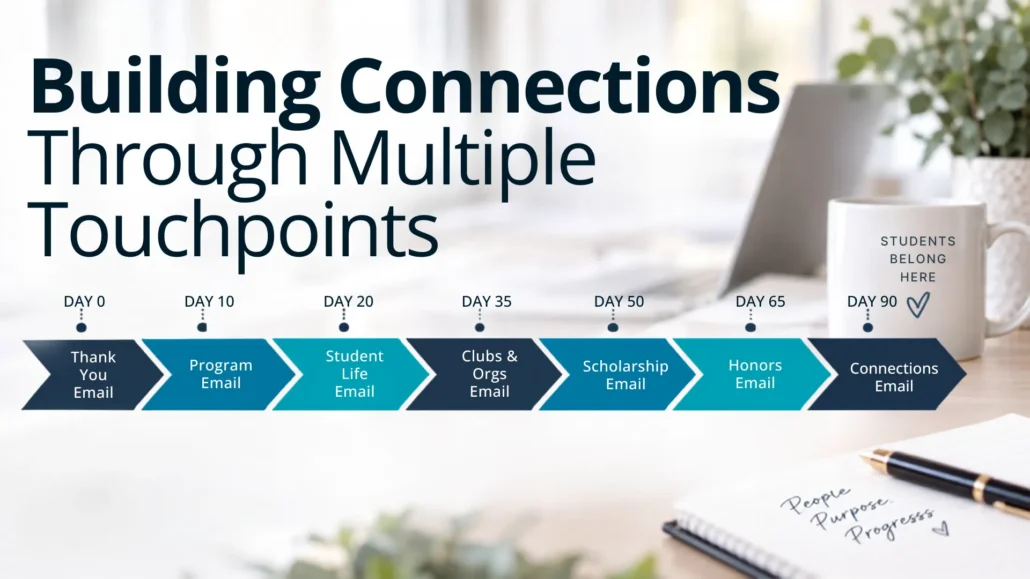
Next, map the touchpoints students should receive at each stage. For example, a 90-day inquiry nurture track might begin with a Day 0 thank-you email followed by messages about academic programs, student life, clubs and organizations, scholarships, honors opportunities, and ways to connect. Those emails don’t have to work alone. Calls, texts and direct mail can be placed strategically throughout the same journey, with additional communications supporting open houses and other important events.
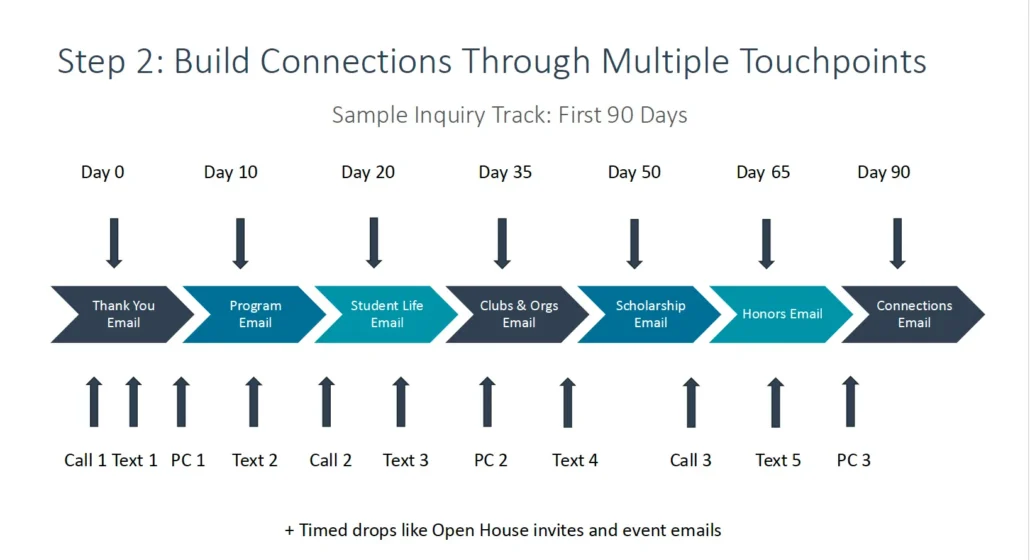
Much of this can be automated, and that matters.
Your admissions counselors shouldn’t have to spend their busiest months determining who needs a text or which prospect should receive a follow-up email. A strong CRM strategy can automate routine touchpoints while creating tasks for the moments when a personal phone call or individual connection matters most.
Multichannel Doesn’t Have to Mean a Massive Budget
Fox Valley Technical College is a great example.
The college came to us with a targeted list of purchased names and stop-outs and a limited budget. There wasn’t enough funding to run digital advertising throughout the entire 10-month campaign, so we focused its resources on a coordinated nurture strategy using email, direct mail and text messaging.
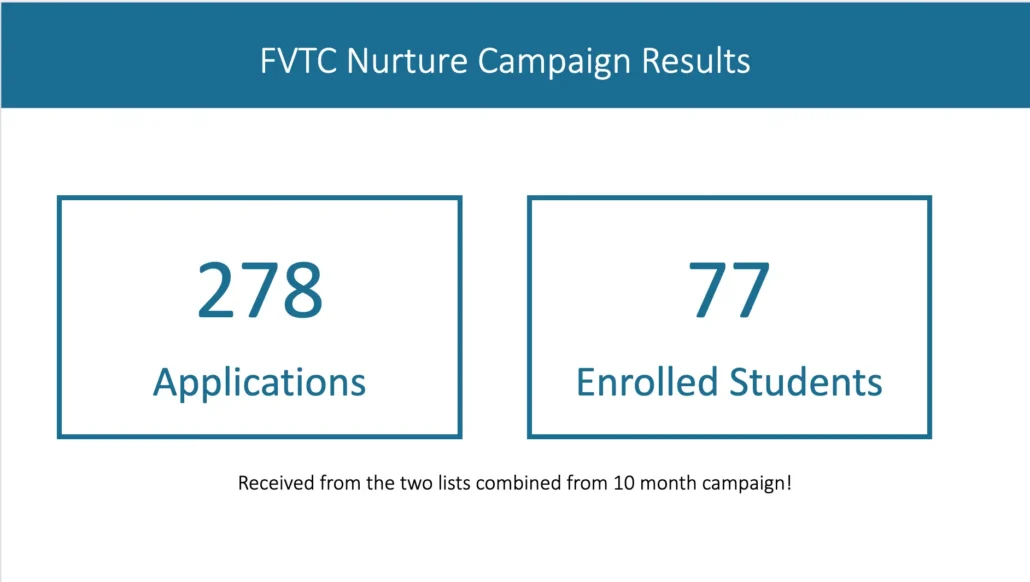
Emails combined brand messaging with application pushes, direct mail reinforced brand awareness, and text messages became increasingly important as application deadlines approached. The campaign generated 278 applications and 77 enrolled students from the two lists over 10 months.
2. Personalization Means More Than “Hi, [First Name]”
Real personalization means relevance. Your inquiries aren’t one audience. Neither are your applicants or accepted students.
You may be communicating with first-year students, transfer students, and adult learners. Even within your high school audience, sophomores, juniors and seniors are at very different points in their college search. They shouldn’t all receive the same message or the same call-to-action.
A high school sophomore doesn’t need an aggressive application push. That student may be better served by an invitation to visit campus, explore academic programs or meet your admissions team at a nearby event.
If students have already told you what interests them, use that information.
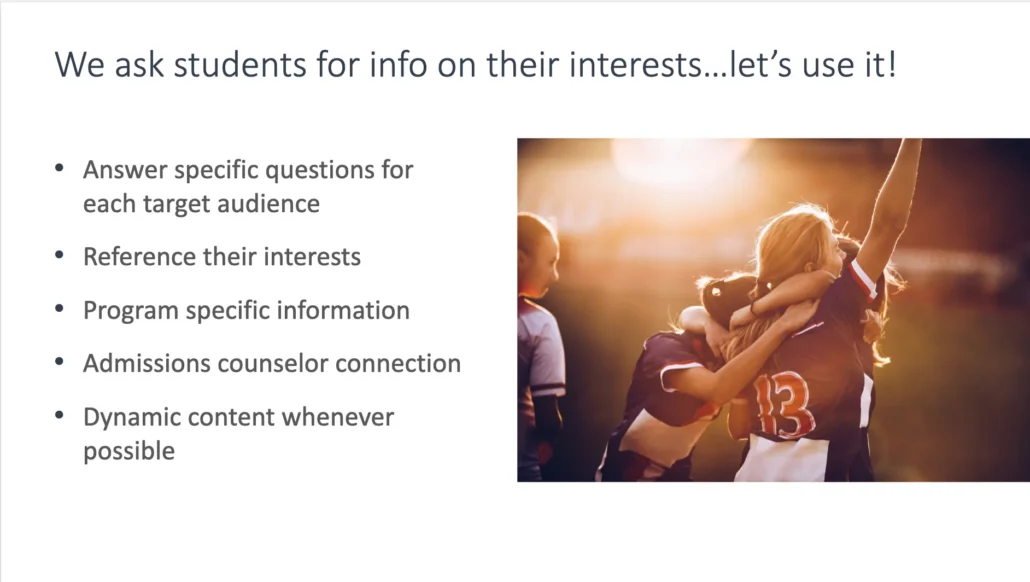
If a student is interested in nursing, show outcomes and student experiences related to that program. If they’ve expressed an interest in theater, tell them about an upcoming campus production. If you know where they live, you can personalize information about tuition, scholarships, or visiting campus.
Dynamic subject lines, images, content, outcomes, and facts can make an email feel as though it was created for a particular student rather than sent to thousands of people in your CRM. Personalization is about showing that you understand what matters to them.
3. Use Personalization Beyond the Inbox
Once you’ve built more relevant email communications, apply the same thinking across your marketing strategy. Consider our work with the University of Southern Maine. The university needed to strengthen yield in a year when applications were down. We developed a campaign specifically for accepted students who had not yet enrolled.
The digital campaign retargeted accepted students and directed them to the Confirm Your Enrollment page. The audience list was refreshed weekly so newly accepted students could enter the campaign while students who had already taken the next step were removed.
The yield email campaign reinforced the same strategy. Instead of simply telling accepted students that they would “find their fit,” we used current student voices, testimonials, imagery and facts to show them what belonging at the University of Southern Maine could look like.
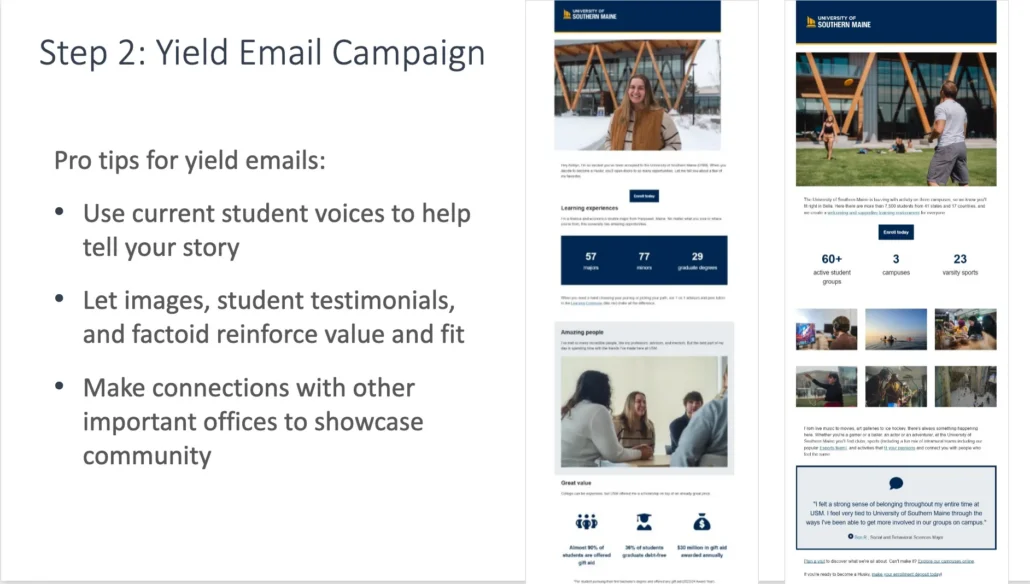
At the same time, the admissions team increased its high-touch outreach. Together, those efforts contributed to an 8% year-over-year increase in enrolled students for fall 2025.
We took a similar audience-first approach with an adult learner campaign for Owens Community College. Adult learners often bring different questions and concerns to the enrollment process than traditional first-year students:
- Can I afford it?
- How long will this take?
- Can I fit classes around work and family?
- Will this help me move forward in my career?
The campaign addressed those questions directly through messaging about goals, timelines, flexibility, and career outcomes. The landing page reinforced that message by focusing on affordability, flexible learning options, salary information, and student stories.
For the spring 2025 start, Owens Community College saw a 74% year-over-year increase in enrolled adult learners. The lesson here is that the more your marketing reflects the person you’re trying to reach, the more relevant the experience becomes.
4. Your Thank You Page Should Say More Than That
Think about what happens immediately after a prospective student completes your request-for-information form. At that moment, they’re engaged. They’ve told you they want to know more about your institution. Then, many institutions send them to a page that says little more than: “Thanks! We’ll be in touch.”
That’s a missed opportunity. Use your thank you page to help students take another meaningful step while you still have their attention.
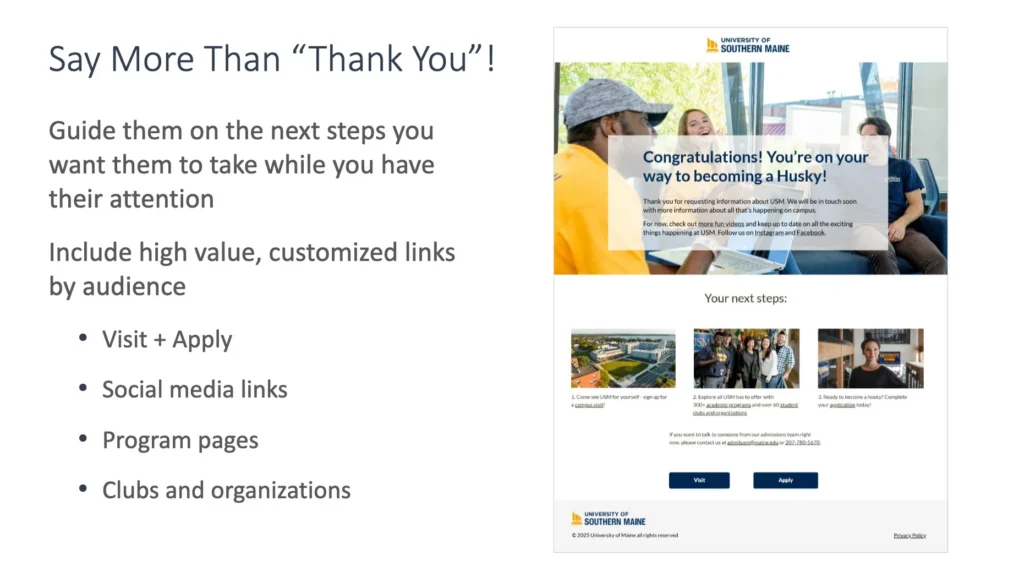
Depending on the student and where they are in their journey, you might encourage them to:
- Schedule a campus visit or take a virtual tour
- Start an application
- Explore their program of interest
- Discover clubs and organizations
- Follow the social channels most relevant to them
- Connect with their admissions counselor
But don’t focus only on the page itself. Pay close attention to what happens next. Your Day Zero response matters. 75% of students expect a response within 24 hours. Students shouldn’t have to wait days to hear from you after they have explicitly asked for information. Use automation to deliver an immediate, relevant response, then create a clear path to personal outreach when it will be most valuable.
5. Make Social Media Part of Your Nurture Strategy
Social media shouldn’t operate in a separate marketing bubble. Prospective students use social channels as part of their college exploration. Your organic social strategy should connect with the rest of your enrollment and marketing plan.
Start with a content calendar based on the questions students are likely to ask throughout the year. Then consider who you’re trying to reach and what they need from you at that point in their journey.
Your channel strategy should change based on your audience. High school students may be more likely to engage with Instagram, YouTube, and TikTok. Adult learners may be better reached through Facebook, LinkedIn, and YouTube. Parents may turn to Facebook and YouTube, particularly for helpful how-to content.
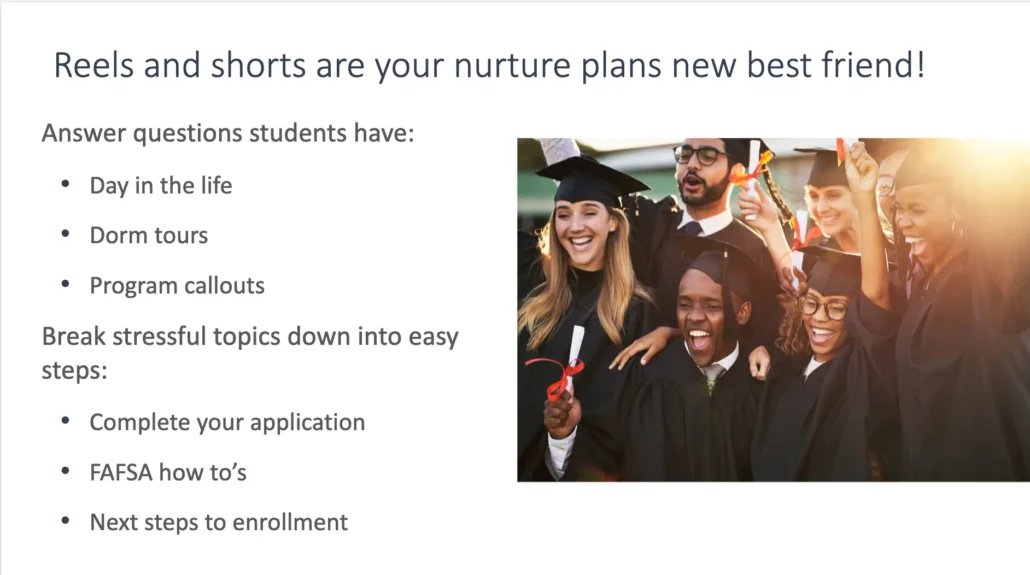
Don’t overlook short-form video. Not every video needs to be a polished brand production. Short-form content can answer the practical questions students most often have:
- What does a day in the life of student in my major look like?
- What are the residence halls really like?
- Why should I choose this program?
- How do I complete my application?
- How do I fill out the FAFSA?
- What do I need to do after I’m accepted?
Short, useful content can make complicated or stressful parts of the enrollment process feel more manageable. The most effective social content doesn’t simply promote your institution. It helps students make their next decision.
6. Don’t Forget the Human Connection
With all this talk about automation, digital campaigns and social media, don’t lose sight of one essential truth: Students still need people. The goal of automation is to free counselors to spend more time on interactions where human connection matters. Your digital strategy can help create those moments.
If your admissions counselors are traveling to a high school or attending a college fair, tell interested students in that market that your team will be there. Coordinate with guidance counselors. Promote the visit through social media. Consider supporting posts around larger events or priority locations with boosted posts.
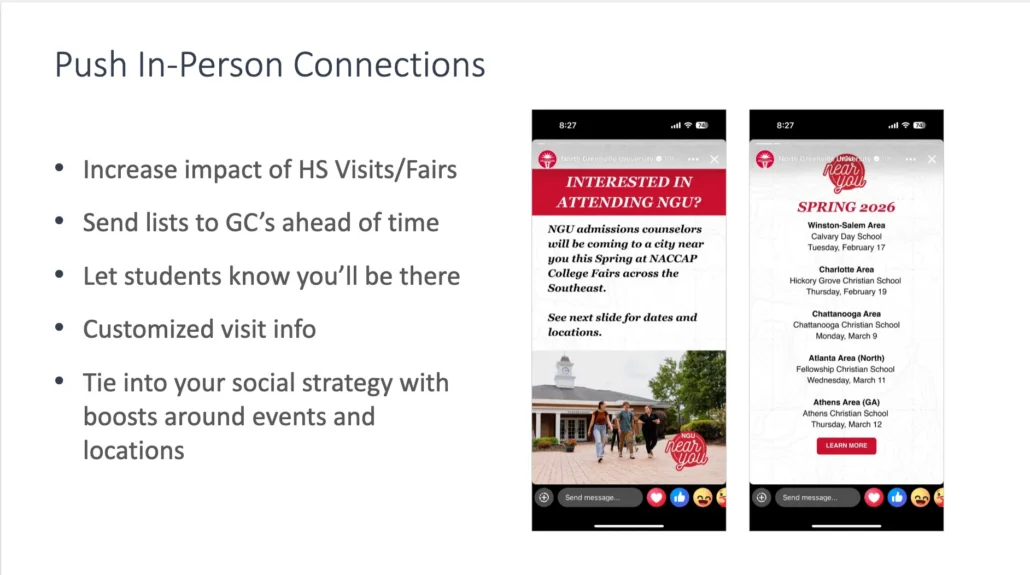
You’re already investing time and resources in those visits. Your other communication channels can help make the resulting in-person opportunities more valuable. Automation should handle repetition. People should handle relationships.
One Final Recommendation: Become Your Own Prospective Student
If you do only one thing after reading this, make it this: Take your own prospective student journey. Fill out the request-for-information form on your website. Do it on your phone, too, and see what happens.
Start an application. Read the emails. Check the texts. Follow the links. Pay attention to how long it takes before someone responds. You may be surprised by what you find.
When we’ve conducted mystery-shopping and student-journey exercises with institutions, we’ve uncovered:
- Request-for-information forms that didn’t work correctly on mobile devices
- Day Zero texts that weren’t sending
- Missing thank you pages and emails
- Gaps in nurture plans
- Missing program-specific outreach
- Student populations or majors that were absent from communication plans.
You can spend a lot of time building the perfect strategy on paper and in your CRM. But you also need to understand what the experience feels like on the other side.
Build the Journey Around the Student
Students aren’t going to change their communication habits to make our marketing plans more convenient. Our job is to build the experience around them and meet them where they are.
That means using email without relying on it alone, making communications genuinely relevant instead of simply inserting a first name, connecting your CRM, digital campaigns, social content, admissions outreach and in-person interactions layered together in one coherent student journey.
It also means paying close attention to what happens after a student asks to hear from you.
A great nurture strategy isn’t defined by how many emails you send. It’s defined by how many meaningful opportunities you create for prospective students to connect with your institution.
Want More Examples?
Watch the on-demand webinar, How to Reach Students Who Aren’t Reading Your Emails, for additional case studies, sample nurture strategies and practical ideas you can put to work at your institution.