Written by
on
September 11, 2026
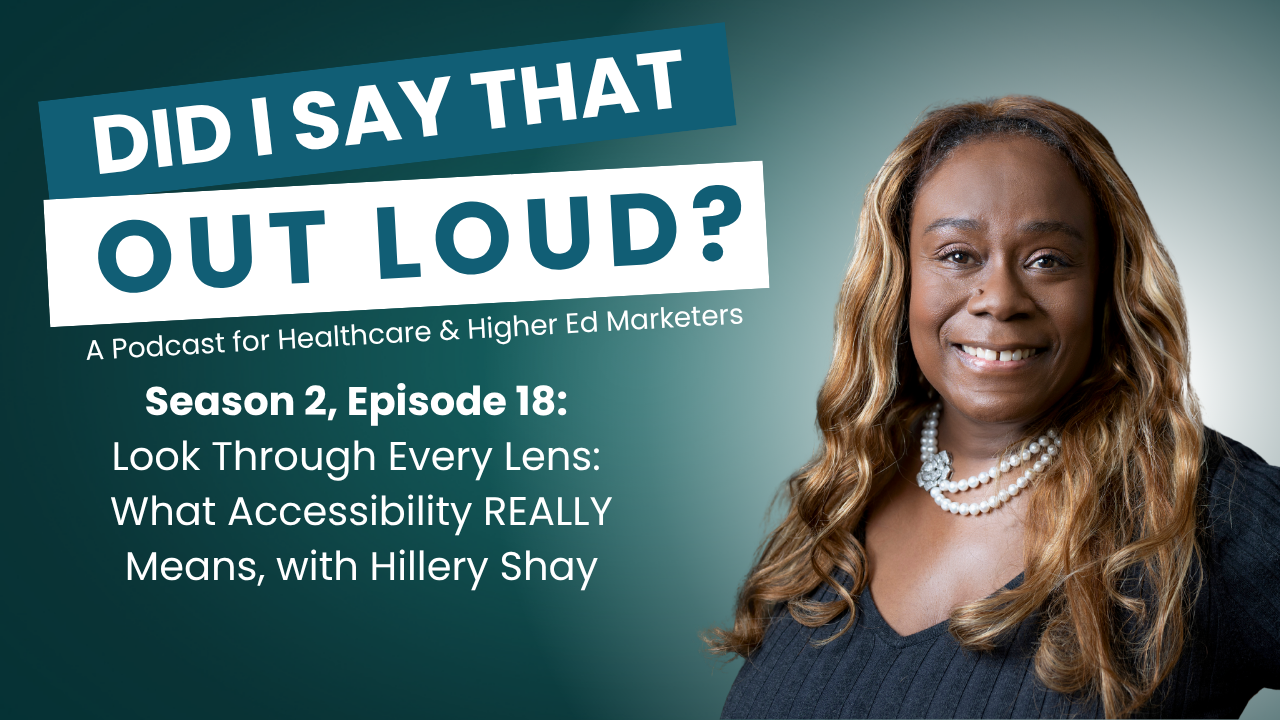
Season 2, Episode 18
Optimizing for accessibility in healthcare goes far beyond updating the website—it should include every touch point of care, both digital and in person. Hillery Shay discusses her team’s unique perspective on accessibility and their innovative plans to enhance the care experience at Children’s Minnesota.
Hillery Shay joined Children’s Minnesota in 2021, as VP of marketing and
communications and is now chief marketing and experience officer, senior
vice president of communications. She provides strategic direction for
organizational marketing and communications. She is also responsible for
defining and building an organization-wide experience strategy. She brings nearly 25 years of leadership experience in health care and
mass communication.
Listen to Episode
Show Notes
Transcript
Mariah Tang: Did I say that out loud? Welcome to “Did I Say that Out Loud?”, a podcast where Stu Eddins and Mariah Tang reflect on agency life and answer questions from our higher ed and healthcare clients about the latest in digital marketing, content and SEO.
Mariah: Hi everybody. Thanks for joining us on Did I Say That Out Loud? We have a fabulous guest today. With me is Hillery Shay. She is the Chief Marketing and Experience Officer and the Senior Vice President of Communications at Children’s Minnesota. Hillery joined the institution in 2021, and she provides strategic direction for organizational marketing and communications.
She is responsible for defining and building an organization-wide experience strategy, which we’ll talk about today. And Hillery brings 25 years of leadership experience in healthcare and mass communication with a proven track record of success leading national and global public health campaigns and marketing initiatives. I feel unworthy to talk with you today, Hillery. You are fantastic.
Hillery Shay: You go on. It’s okay. No, I absolutely like to sound both balanced, seasoned, and but I’m just trying to keep it young.
Mariah: Well, Hillery has a great background and so I’m sure that all of you are going to learn a lot today from her experiences and the cool things that she’s doing at Children’s Minnesota. So let’s just jump right into our first question.
In my world, in the agency world, we talk a lot about digital accessibility. We talk about health literacy and when we do so, people tend to, and myself included, jump right to thinking about content like on the website, on social, in patient literature that we hand out. But when we were talking before the recording, you have a really unique perspective, Hillery, on health literacy, much more granularly and starting with really basic interactions with the brand and with Children’s. Could you tell us a little bit, Hillery, about what the term health literacy means to you and to your team?
Hillery: Absolutely. I actually really loved this question because when I sat back and thought about it, one of the things that we’re really trying to tackle is we love, you know, solutions to things. It’s like, okay, we’ve got a metric and we can check off our boxes. And did we do this and did we do this? And did we translate it into several languages? And all of that stuff needs to happen. But at the higher level, you really have to put people in a position of understanding multiple perspectives and
Creating a place where all sorts of different levels of knowledge can feel, you know, welcome to ask questions. Most people think, you know, specifically the materials that we hand out when they talk about health literacy, but it’s really about the understanding or the comprehension you need to have in the journey. And so it’s our job to make sure that things are as digestible, as understandable and comprehensible as possible for everybody, for everything. So part of the journey is, okay, my doctor wants me to see the specialist. They’ve mentioned this about my child. And so I go to the internet and I’m where am I going? You know, what specialist am I seeing? How long have they been practicing?
Not that, you know, I mean that’s just generally stuff that we do to make us feel good because of course it, you know, how long a practitioner practices versus how long they studied does not, you know, differentiate their ability to do great work, but rather their commitment to their specialty and how many times they’ve seen a situation and all of those things. So really not thinking about it as just understanding the clinical, but really helping patients understand everything that’s supposed to happen in the journey. That’s literacy too, like where am I supposed to park? Do I need to take my ticket with me? Do I need to pay to go out?
Can I actually navigate with wayfinding that actually says things that make sense to me versus, you know, I always laugh because one of the things I often say to people is like, yeah, we’re really working on transforming our EDs. That’s such inside baseball. Because most people come in and they’re like, We need the emergency room. Or if they’ve watched TV, they hear about ER. And so they’re just like, What’s an ED?
And I was like, actually, it’s our emergency department. And internally, when you’re talking about it, you don’t actually talk about just the room. You talk about all the physicians, the whole department. And so we’ve always referred to it as the E D versus the ER, but that’s just again a we have to think about listing how to get to the emergency room so that it makes sense for the people coming in, not for our inside baseball. so I really like the idea of, when I think about it, it’s not that we are creating a framework to touch different things different ways, lots of frameworks in the world.
But at Children’s Minnesota, we think about experience through five connected domains, the clinical experience, the human experience, the digital experience, and the environmental experience. And then of course the brand. What is the promise that we made that you’ll find when you get here? And I always tell people I was like our brand promise is right beneath our name so you know that we are the kid experts because we do we do all kids all the time and that’s where our expertise lies and so making sure that we’re delivering on being the kid experts and understanding that technically if we’re really going to be patient-friendly, the kids should be able to navigate if they can you know if they can walk on their own they should be able it should be understandable even to them where they’re going or what they’re doing.
Mariah: My gosh, yes, absolutely.
Hillery: But it’s so important. that that we actually you know, health literacy lives in every one of these domains because every one of these moments either helps families make sense of the journey or creates more confusion. And so, you know, when they put us in charge of, you know, experience, it was it it’s literally like you’re in charge of people’s understanding of where we’re going and what we’re doing and how to use us.
And when you think about that, it’s so much more than just the patient experience for us, because you know our patients come with families and grandmas and stuffies who need band-aids and who need care and they may need to hear have their heart listened to as well. And they may need music therapy because music helps them calm and regulate themselves. And they need a clear explanation that makes sense and that is age-appropriate, of what you’re about to do and how this is going to help them help you make help make them better.
And so doing all of those things, you have to put yourself in an experienced mind shift that is from the position of not knowing instead of knowing. And so, I actually think that’s why I was so excited about getting asked to do this because I meant that I get to engage with our organization in a way where my curiosity is that of someone who’s experiencing this for the first time or somebody who’s walking through these things. And I really think through like what does this feel like to interact with Children’s Minnesota? And that’s really what total experience is. And so that’s why we wanted to approach it from a whole strategy.
Mariah: Yeah, yeah. When you were describing the navigation on your campus, it made me think of the last time I had to take in one of my kiddos. And we’ve been very blessed and very fortunate to not have to deal with some of the more complicated health things with my kids. But just going to the ER when you’re exhausted because you’ve been up all night and after you’ve been at work all day and then your child is sick, like you don’t want a more confusing experience. And I appreciate so much that perspective. And Hillery, I mean, it’s a really unique way to think about health literacy and trying to get a full team of people on board, let alone, you know, going up the ladder, so to speak, to executives and so forth. How did you and your team really formulate this perspective? How did you decide to take that path together? And maybe tell us a bit about some of the obstacles that you and your team have overcome in that work.
Hillery: So I will say that we you know, everybody always likes to say, we thought of this brilliant framework. Now, yeah, I did come up with a framework at the end because I needed to explain it to others, but the first thing I did was I listened. And I just realized that, and that’s one of the things that I really like from my journalism, is that I’ve often really just been good at being a fly on the wall. as a news photographer, it was like you didn’t want the natural action to not happen. So you didn’t want to disturb it. So you’re really kind of well-trained to listen and observe and then see what you see.
And then, you know, the best advice I ever got in my career. And I laugh because this is still one of my favorite mentors. He was a photographer. I was doing a two-year internship at the Baltimore Sun. And Jed Kirschbaum said to me, Where’s the rest of your assignment? He was the photographer who was going to look at my work and help me edit my pictures in this whole process of learning how to be a news photographer.
And I said, well, you know, I thought I got a good enough picture with just this, you know, and I think I had shot like maybe two rolls of film and he was like, So you thought you got enough. He’s like, you know what? I’m going to tell you something. You’re not done till you’ve looked through every lens in your bag.
And that was like life-changing advice for me. I didn’t know it then, but to this day, I’m just sort of like, wow, the knowledge Jed dropped on me is how I approach everything now. I really stop, I listen, I learn, I figure out which senses are activated. Is there a smell in here? Like I literally use all of my senses, every lens I have, and then I borrow from other people’s lenses. They’re bringing a perspective that I hadn’t even considered and so I really would say, you know, I didn’t have prop people telling me they couldn’t have, you know, traditional health literacy issues, like, I don’t understand discharge ex instructions, but I don’t understand why this parking is this way. Is more or less like, I get here, I’m coming to a children’s hospital, you’d think there’d be room for me, the car, a stroller without dinging somebody else’s car.
And you know, that so one of the things that I you know, I’ve talked with our, I said, I know we can’t fix everything at once. I said, but we really need to position ourselves to really be thinking about our audiences more. And so we’ve got to take a holistic approach to this. I said, because we’re finding that we’re getting data in places that it we don’t normally get it.
And that means two things. It means one, people were so affected by their experience parking that they were waiting till even after their doctor’s visit to let us know that our parking was not helpful. And people are just like, well, apparently they didn’t understand the question because we asked the question about how is your care? And that’s the problem. We weren’t listening well enough. And that person placing that feedback there, they’re saying that the one thing that they maintained focus on all the way to the end and that motivated them to take our survey is that their parking experience was awful.
Because we hadn’t thought about what it means to be a mother of multiple children trying to navigate and make it to appointments on time without even thinking about stroller space in the parking lot. Or making sure navigation from parking is easy to understand. And so when people put things in the wrong bucket, you’re just like, well, they clearly didn’t understand the question. And I’m like, that’s a question of literacy.
You’re thinking that they didn’t, they couldn’t figure out where to park, but they have pretty good executive function. They made a tier, they made it managed to figure out how to answer our survey. What they’re telling you is that this was so bad that it’s the thing that I need you to fix. Everything else I don’t need to comment on. And this is the only place you have for me to leave feedback on this. And so I said we’ve got to take a much more comprehensive approach to experience.
We’ve got to give people the ability to tell me your parking experience was terrible, but then also give us feedback on whether or not you understood the doctor’s instruction or whatever was happening at a time when you’re sleep deprived, you’re tired, the child fell off of something, you’re not necessarily in your best frame of mind. We’ve got to make it so easy to digest that you don’t have to have extra thinking there. But when people, when that makes it all the way to that one question survey, the NPS question, you know, people always say, what’s your net promoter score? It’s like when you’re only waiting to get the net promoter score and you get things that are just not related to care, but there it means you don’t have a place for people to put their complaints or their thoughts and experiences about the other realms of experience they have with Children’s Minnesota. And you think that that that the care we provide started with the healthcare instead of started with the care and making sure they can safely get to us and navigate. And our care begins the moment they are heading towards us.
Mariah: Yeah. And I would even say with that, with that wonderful brand tagline that you shared with us, the Kid Experts, it would make you question, you know, like, how expert is this? If this little thing. And I just love that. I love that one you surfaced those things with your team and said, Yeah, this is a learning opportunity for us, not just I can’t believe we made this mistake or kicking ourselves or, boy, they were focused on the wrong thing, like you mentioned before, which I think a lot of marketers really take our jobs so personally. And it’s like, every time something happens, but those are those growth moments like you talked about. You know, what are some of the other priorities that you’re working on now in the health system or in your community, whether it’s some of that brand-involved outreach or additional you know, infrastructure-type things like wayfinding and just making those little touch points.
Hillery: Thinking about the intensity of the burden that people are carrying is also extremely important. So we recognize that sometimes the people who are coming to us, even our, you know, our patients, their families, etc., they forget that they’re also looking at a human whose day job is to be there to care for them and to give them care. But they might also just be a caregiver in general. And so there’s a sort of intensity score. They may have their own children, they may have aging parents of their own, and this is now their occupation. So they’re basically pressured to be in caregiving mode a lot of the time of the day. And so it’s really about how you understand how interactions can get confused, that you can make them more intrinsic, more easy to understand without actually using words. We want to start thinking about the things that are putting cognitive pressure on our people who are walking through our doors, the confusion, the parking, the you know, whether or not the space that they’re even entering in is healing or gives a sense of well-being or calming, especially for any of our patients who are coming into our inpatient mental health areas.
We want to be thinking about all of the things that need to happen without words, even and we have to be careful about things that, you know, clinical language increases anxiety. Because now they’re just like, I’ve got to look this up on my cell phone. And then we don’t think about the true situations, the true health disparities that can actually happen just from not understanding someone’s social drivers of health and how they are entering our space. So you know, one person actually said, hey, you know how we solved this problem at a hospital I frequent frequently worked at. We put up QR codes and we ask people to scan the QR code. And that would help them get to where they’re going. And I’m like, well, it does for a certain population of people.
I said, what about the people who are on pay-as-you-go cell phone plans? And now you’ve actually said, I need you to use a resource that you have to keep scarcely in order to navigate our space. That’s not respecting of the fact that, you know what, whether you are on the $25 or $15 a month plan and you have a certain amount of minutes that I now need to take some one of your resources from you in order for you to navigate our space.
That to me is something that we need to be more thoughtful about. And it doesn’t mean that that wasn’t a good solution for that hospital because maybe they were only serving populations where they weren’t going to have that many people. But if we understand our community and we do our how community health needs work and we understand that we have a large immigrant population, a lot of people who need to use their phones for things like translation or helping themselves better understand. And now we’ve asked to use that precious resource on a pay-as-you-go phone just to get there. That’s not really solving a problem for everyone. It’s solving a problem for everyone with a cell phone plan that has unlimited data.
Mariah: It’s creating another barrier, like you had mentioned before. And you know, we encounter this a lot in the agency side where I work with a lot of groups on content marketing. So videos and blog articles and web page content. And one of the things that we see consistently is talk to your doctor or improve your access to care. And these are such triggering type phrases because it sounds really innocuous to somebody who has had access to care or has had insurance or has a primary care provider or, you know, in the in the children’s case, a pediatrician. Not everybody, and I would even go so far as to say a lot of people, don’t have a primary care provider. They may not have a specific pediatrician for their child. They may live in an area where the closest hospital or doctor is several hours away. And so when we’re saying things like that, it really comes off as tone deaf and it and disconnected from the community.
So thinking about those levels of accessibility as well, so important. And I think that’s one of the coolest things about your role and your team, Hillery, is you’re not just the communications people. You’re not just the CMO. You’re the experience officer and tying all of that information and all of those brand experiences together. And I I love that your team is vulnerable enough and strategic enough that you want to share those data points. Like your previous example when those feedback forms come in and it’s not necessarily great, but it’s not like nasty, and they still recognize this is important and we should let somebody know about this so we can fix it. That’s remarkable.
Could you tell us, Hillery, just you know, maybe three to five little tidbits here that your fellow healthcare marketing professionals can follow this pathway that you and your team have laid out, that delighting patients, that welcoming experience that you’re providing at Children’s Minnesota?
Hillery: Absolutely. I think listening and observing and looking through every lens in your bag is always going to be because of my unique pathway into here. you know, that’s a a really important sharing is because people are like, how is it that you have you know, it seems like you have a lot of patience. And I was like, takes time to look through every lens. It takes time to experience a space. I can’t just imagine it. I have to go walk it. And I have to say, now if I had never been here before, what would where how would I know how to navigate? You know, not if I were just now how would I navigate with children? So it’s like I really even look think back to my life with my toddlers and they are 22 and 19 now, so no longer toddlers. But just thinking about how I needed to navigate and all of the things that I was thinking about.
But I take that and I stand there in the space and then I walk it. Because one of the things we have to recognize is that our accessibility is tied to our usability. And it’s tied to our ability to the only way you can actually be an expert in something is thinking about that experience over and over and over again and sort of that PDCA: plan, do, check, act.
you know, and that’s our continuous improvement mindset for the organization. But basically, my philosophy that I would share with everybody is that families shouldn’t have to become usability experts before we improve the experience. They don’t need to tell us how to fix it. They just need to they’re just looking for a place to actually tell us what’s right. Like, you know, here’s a here’s a one question survey and then here’s a space for you to say anything else you want to say. And so pointing it out that way, it’s like, okay, they can give us our feedback on our care, but then they can actually tell us, I really didn’t have a wonderful parking experience, or I really didn’t have a such and such. And then like looking at groups of advisors that actually are there to help you with all that family advisory groups, walk the garage with them, walk the entrance to emergency.
I got to help figure out a problem that we were having in our Minneapolis campus that we didn’t even know was a problem because of it had to do with parking. And so we have this area for parking outside of our emergency room in Minneapolis. And it’s actually parking for the patients who are going to emergency. It just says parking for emergency department only. And it’s red.
None of our patients were parking there. They were all paying the fee, going into a ramp that’s going to charge you hourly. And you know how wait times really tick people off. Think about all those wait times and when you get a bill for $25 to get out of a ramp. That’s not nice. But we actually have free parking for those who are going to our emergency department, but we didn’t actually label it in a way that let them know it was for them. So I just pulled together the powers that be and just said, hey, we got to get these signs turned around. We’ve got to get some paint here that actually lets people know that this is the green zone.
This is where you come for emergency parking only. And then you’ve got to ask them to check in so that we make sure that other people are not, you know, just parking in those spots that they need. And so when they check in at security, they should actually get a little post-it note that they can go put on their windshield to just let people know they really are in the emergency department. And isn’t that, you know, easy? Literally print some post-it notes and change the signs from red to green and actually say patient family parking for the emergency department only. And so even just the nomenclature on the sign, the color of the sign, all of the things that naturally tell you don’t park there, we were displaying all of them and wondering why people weren’t parking there.
But if we didn’t actually say, you know, get the complaint for somebody saying, you know, I waited this long to see a doctor and they helped me and that was great, but then it cost me $25 to get out of your parking garage. Why didn’t they use free emergency parking? Oops, we didn’t make that really easy for them to understand. So we can do better. It sounds so simple than all my experiences around parking, but that just happens to be the one that pops up in a lot of NPS. Did you know that? I was like, you guys, at some point, when we get a great endowment, we’re going to build a nice new parking ramp and we’re going to make the spaces wide enough for strollers. And we’re going to let people know what parking is for whom and they’re going to make it, say, green. So there’s like, yes, it’s a good thing. Come on in here. this is where this is where you’re supposed to be.
Mariah: And all those feedback forms are going to say, Did you see this great parking?
Hillery: You guys really thought through what it’s like to actually have an encounter with you when I have a child who may have broken their leg and they’re crying and they’re sick or they’re vomiting because they’re not well. Think about the state of a parent coming into an emergency room. And the last headache they need is, after all that my car got towed because I was in the wrong place. So they’re certainly not going to assume that. So you have to like let people know this is a service. We are the kid experts. We know you’ve got to scoop somebody up and run in here. That’s why your parking is free and that’s why it’s the closest to the door. So that’s the fun in what I get to do. And so be curious, walk through it, look through every lens, and ask questions that you might think are too simple, but ask them of yourself even. What would I be going through if I had done this differently? Or why would we have a group of people trying to access us in such an inaccessible way?
And what can I do to reduce that burden? Because you’re not going to be able to just throw a ton of money at it. I it’s not like I all of a sudden got a bigger budget. I had to beg them to not make me build experience out of marketing. But it is about the trade-off and saying, I want to make sure we’re delivering on everything we say we can. And so those domains and letting people actually see that we’re thinking about it clinically, we’re thinking about it digitally, we’re thinking about it from a human perspective, thinking about it from our brand perspective, but most importantly, we’re thinking about it comprehensively. And the office of experience that I’m creating for Children’s Minnesota really wants to get that right and really wants to make sure that we can differentiate on that.
And so when differentiation is part of the equation and part of our 10-year future state, you’ve really got to think about it. You’ve got to let people understand why it can’t just be three people in a department trying to coach somebody to, you know, call someone by their chosen name versus their given name. Those are important things too, and that’s why our patient experience coaches are priceless. But we needed a total experience approach because we were getting plenty of signs that other things were making us hard to work with.
Mariah: You just mentioned your patient experience coaches. I would love to hear more about that, what they’re doing, or what you’re planning for them to do.
Hillery: So the beauty is that operations lives in operations. We are still running efficient hospitals. So we’re not changing that. But they are my wonderful dyad partners and that they are the people who are going to make sure that they implement their part of the strategy. So just like we actually have patient experience coaches, the office of experience is going to actually have experts who think about, you know, human-centered design of any of our future spaces or any of our pathways and workflows for patients and families.
So it really is this idea that we want the work to stay in operations where they do it well, but we want that strategy to be holistically led so that we’re all in the right mindset of making the patient and family experience, total experience with us easier, but also making the employees’ experience also easier. There’s a great correlation between your employee engagement in the satisfaction of their work coming to the satisfaction of the care that they’re giving or the help that they’re providing. And that runs from everybody from the people in EVS who want to make sure that rooms turn as quickly as possible so that they can reduce those wait times. They take it personally. They know that they are the kid experts for reducing wait times in the ED.
Our environmental services staff, they love the fact that we call ourselves the kid experts because you don’t need to be you don’t need an MD title to be a kid expert, but you can be the person who’s really helping to manage something that matters to people. Wait times are an experience breaker. And so EVS is just sort of they actually gamify how quickly they can turn the rooms because it drives them to actually be better. But until we, you know, added a little incentive and put some structure around, like, hey, you know, we need the kid experts at reducing wait times, and that’s you guys. And they took ownership of that.
So our patient experience coaches are fabulous, but they live in the value in clinical excellence department so that they are there to actually work with patient caregivers and people who are patient facing all day to make sure that they’re being thoughtful about how this feels, whether they need help with a second language, whether they need an in-person interpreter, or they could actually use AI. I had somebody say, my God, we’ve gone to an AI tool with interpretation. And I said, Yes, we did, and it’s awesome. Because you know what an AI interpretation tool allows? It allows other people who are not that experienced translator to now interact with that family.
So I can actually go in and say, Can I help you see where you need to go to find a snack? Do you need a restroom? I have that ability now because we have this AI tool that’s literally going to ask them, How can I help you while you’re waiting here? So it actually allows us to be more inclusive because we don’t have this barrier of language between us and not just the translator. And while translators and live translators are comforting, especially in triage scenarios and things that we have.
Absolutely need good experienced medical translators to share. We’re not taking the place of that. We’re not getting rid of that. We’re adding to it. We’re basically saying, but here’s a tool that can actually help empower you to be inclusive to that person of asking them if they want a snack in their native language, asking them if they need if they need to find the way to the cafeteria, letting them know that, I can I can just ask you a question in my native language. You have a tool now that will help you understand me.
And it gives us the ability to be able to do things like translate a joke. Like what if you had just told a joke to somebody or you know, you were laughing about something? It’s there’s nothing less inclusive than not somebody not getting the joke in the room.
Mariah: Especially in the Midwest, we’re always joking and we’re always saying silly things and like self-deprecating statements like it’s nice to let everybody in on that.
Hillery: Exactly. Let everybody in on the joke. And so, think about technology enable inclusivity, enabling you to be create an environment where people felt welcome so that while they waited, it didn’t seem like each minute took an hour. It seemed easy because they were in on the project, they were able to get a snack, there were helpers there to watch the kids while they went to the restroom. So it’s like, you don’t understand mothers, look at us and we’ve got this wonderful ambassador program we’re running for our EDs with local college students. And it’s great because they literally like it’s like you get you put a mother’s helper in the emergency room. It’s like, yeah, we did. And they’re earning class hours and we’re gaining the fact that you need somebody you can trust to sit there while the baby is sleeping because we all know sleeping baby is a much easier baby to have waiting than you trying to go to the restroom with baby sleeping.
But I think that sometimes we think about solving things, that’s going to cost too much or that’s going to take away from our care. It’s like, no, it’s actually going to help the care. You’re going to actually help the caregiver be able to take care of themselves too.
Releasing that burden on the caregiver is really important because they’re not just coming with the sick husband and the baby. They’re coming with everything that they value in the world to you and saying, please help me. I don’t have the capacity to fix this. And we can fix more than just the broken bone or the actual ailment. We can fix what it feels like to need this kind of help because it drives up your anxiety. We can help bring that down with by creating spaces that are inviting and calming. We can have sensory rooms available for when your child who has autism needs a space where they can wait that is actually more calming for them and will mute the sounds and mute the lighting and creating spaces that are healing for whatever it is that our populations need.
And those are things we can find unique ways to do them. And I love our ambassador program. We piloted it. It went wonderfully. We have lots of students who want to be a child life specialist and they need, you know, clinical hours. And so they can actually come be an emergency room ambassador. And so for us, that is inexpensive. And for them, it gives them access to the hours they need for internships they have to do anyway. So it’s really a win-win.
Mariah: What a beautiful summary for this just holistic experience that you’re creating, Hillery. You and your team, you’re amazing. And thank you so much for carving out some time and and sharing your insights with our audience. We really appreciate it.
Hillery: Thank you so much and thanks for having me.
Mariah: Thanks for listening to “Did I Say That Out Loud?” with Stu Eddins and Mariah Tang. Check out the show notes for more information about today’s episode. And if you have any questions, concerns or comments, hit us up anytime at stamats.com.
Let’s talk
You have questions, we have answers. We will customize a solution that is guaranteed to impress.