
Written by
on
August 21, 2026
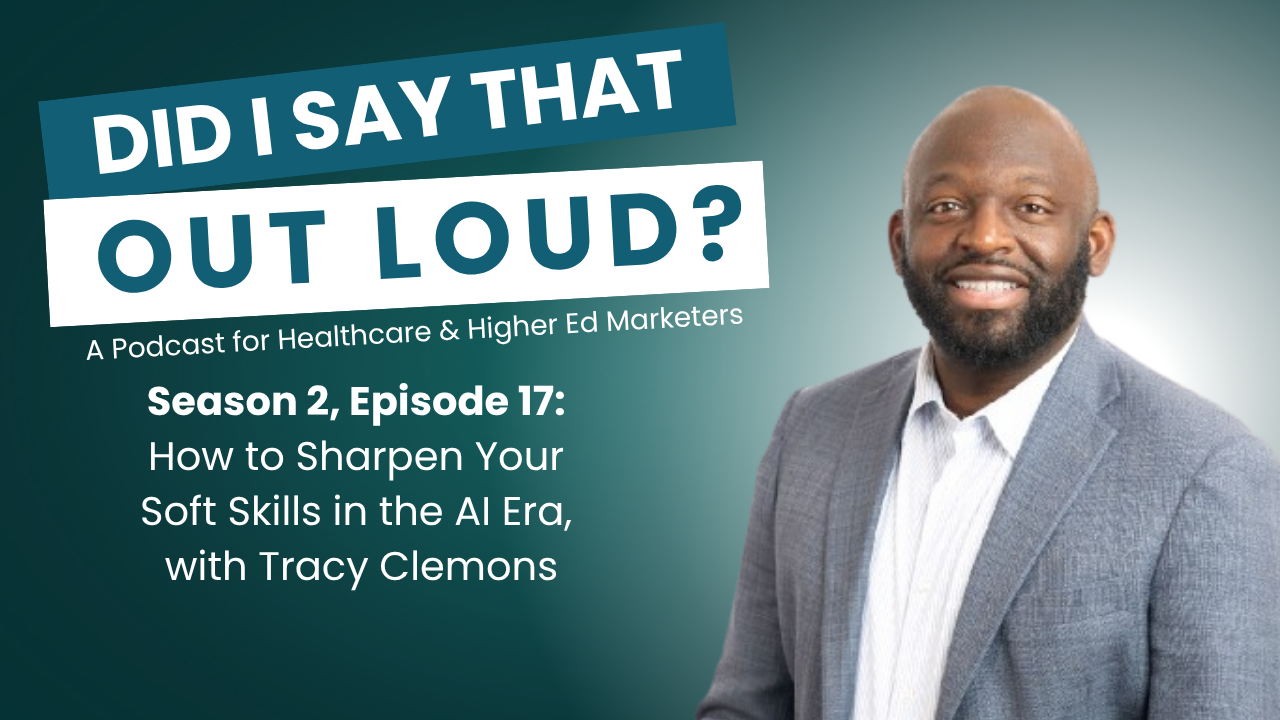
Season 2, Episode 17
Even with its speedy text synthesis, AI can’t tell a story like a human marketer can. Tracy Clemons sits down with Mariah Tang to discuss tips for honing your soft skills in the AI era, how TSU’s Studio 1927 gives students real storytelling experience, and why he believes in the power of the pause.
Tracy Clemons, M.J., is a higher education marketing and communications leader specializing in media strategy, reputation management, strategic storytelling, and problem solving. He is the Associate Vice President of Marketing & Communications at Texas Southern University, where he has also served as an adjunct professor in broadcast journalism.
Listen to Episode
Show Notes
Transcript
Mariah Tang: Did I say that out loud? Welcome to “Did I Say that Out Loud?”, a podcast where Stu Eddins and Mariah Tang reflect on agency life and answer questions from our higher ed and healthcare clients about the latest in digital marketing, content and SEO.
Mariah: Hi, welcome to Did I Say That Out Loud? We have another fantastic guest this week. We’re talking with Tracy Clemons. He is a higher education marketing and communications leader. Tracy specializes in media strategy, reputation management, strategic storytelling, and problem solving. He is the Associate Vice President of Marketing & Communications at Texas Southern University. And he has also served there as an adjunct professor in broadcast journalism. Tracy, thank you so much for joining us today.
Tracy Clemons: It is my pleasure. Thank you so much for having me.
Mariah: Yeah, yeah. I’ve seen your posts out on LinkedIn and I thought, this is a person we need to talk to. Storytelling is so important right now in the higher ed space, really in every industry, but especially in higher ed, there’s just so much pressure on universities and institutions, pressure on students and families, and really telling those authentic stories is vital to the success of everyone really going forward.
So, you know, you have such an interesting background in storytelling. And let’s just kind of rewind to the beginning. You were the press secretary for the Houston Independent School District in Texas. You’ve been a morning news anchor. Now you’re an adjunct professor in broadcast journalism and an associate VP of Marketing Communications. So, you’ve just really covered all of the different bases, Tracy. In that time, what are some of the important skills that you developed in storytelling that really set you up for success in your role at TSU?
Tracy: Thank you for that question. Yes, I have been all over the place. In addition to being a morning anchor previously in North Carolina, I’ve been a reporter in Charlottesville, Virginia, Shreveport, Louisiana, St. Louis. I was a reporter here in Houston for the night shift. Every job I’ve had has taught me something different. And then there are some things that I would say are kind of the common denominators, and that is just emphasis on people, right? Stories are about people.
And as long as there are people around, there will always be a story. And one of the things, you know, storytelling itself is a skill. you know, being able to, you know, in all of the years that I’ve done news, being able to go from a crime scene at three o’clock in the afternoon to a school board meeting at seven o’clock in the evening, you know, I’ve learned how to pivot quickly, and in pivoting, I’ve learned how to really be able to take in a lot of information and digest it quickly and turn it around into something that is understandable and that people can take in and understand why it matters to them. I always ask the question, you know, there’s your who, what, when, where, why, how, but then there’s the question of why should I care? and when you are telling a story, you have your audience, you know, shouldn’t even have to ask the question of why should I care, right?
My goal as a storyteller is always to just give it to them so it’s easy for them to just walk away with the intended message. For them to understand, all right, this is why I need to care and this is what I need to do next. but I would also say just human connection. it’s easy to just write stories and I was telling a student this morning literally just about how to streamline processes. It’s so easy to just get caught up in the story and how long it needs to be and what the kind what the subject matter is?
But the book that I started using with my class is called Aim for the Heart. It’s ways to really reach people where they are. How can we make people resonate with the story? And one of those ways is to really aim for the heart and make that connection with people. So, finding characters with whom the audience will resonate. And you know, we understand that there are different audiences within higher education, so how do we find those human connections?
That check multiple boxes, whether it be a student who has a story of overcoming obstacles, or a student who you know came in as a transfer majoring in English but found a love of finance. Like those are stories that people I think can appreciate and respect. Like, what is the story that’s out of the ordinary, and how do we communicate that and articulate that? And then the other thing is just the importance and the value of relationships.
As a news person, I’ve interviewed, senators and governors, I’ve interviewed civil rights icons, and I’ve interviewed, you know, your everyday worker. and all of their stories have to be treated with respect and with dignity. you find sometimes that the administrative assistants hold the keys to the to the high-powered person, I say high-powered with air quotes, that you’re trying to interview and so you find that you gotta build relationships everywhere and I’ve taken that same approach you know in terms of that’s a skill I would say that has helped me succeed here as a storyteller at my university.
Mariah: Those soft skills, that really translates to the agency world, too. You know, when we work with clients, we’re a business, but we’re in the business of relationships. We’re not out just trying to sell you something because we want you to buy it. If we’re gonna suggest something to you, we do so because we feel like it’s important for you, for your clients, you know, for students when it’s when it’s a higher ed institution. And those relationships matter. If you haven’t built that rapport with someone, it’s just gonna be like, what’s Mariah coming to sell me now? Instead of, you know, what could we possibly do better? And you know, the same goes with you and your students and people who are prospective students thinking about coming in. you know, on that note, and I love that you are coming fresh out of the classroom to talk with us today, you have really seen students grow in their storytelling abilities and helped them develop those skills.
Even if, like you said, they’re headed towards a finance career or something where you wouldn’t necessarily think storytelling would be important, but it absolutely is. So when you’re talking with your students, you know, of any age, those traditional college age students versus adult students and grad students and so forth, what’s really the correlation between having those soft skills, especially now with you know the dirty word of AI, we always have to slip that in there. What’s that correlation for students in their careers?
Tracy: I’m glad you brought up the dirty word. I host a radio show here on KTSU, our campus radio station, and one of my co-hosts, she hates AI, right? And we say hey it’s here. So, we may as well embrace it and figure out how to make it work for us. And so, the key as I work with our students is to teach them how to not rely on AI, right? Because those soft skills are what’s gonna make them the most successful.
AI can write a story, right? But I can tell when I’m grading assignments, I can always tell when a student just popped their stuff into AI, told it what to write, and then AI popped the story out. And every AI story is almost always gonna sound the same. It’s gonna have the same template, it’s always gonna follow the same kind of trajectory, if you will. So, our thing has just been, AI can write your story, but it can’t capture the emotion like you can. And again, when you aim for the heart of the person that you’re interviewing, or when you even aim for the heart of your viewer or your audience, AI is not going to be able to do that. AI can’t dictate or determine or decipher, rather, emotions in the same way that you can as a human being. So, you know, we teach them, all right, use AI to streamline your process, right?
So, for me, I teach them, you know, when you’re writing a story, it may take you 30 minutes to transcribe an interview. Whereas AI can do it in three minutes for you, and then that’s that helps you make your deadline. Number one, it also gives you more time to dig into the story and make it good. And the same lesson that I share with my students, I use for myself as well. I have my own process as a reporter. And there’s some things that I’m like, I just gotta do it myself.
But I’ve taken the chance and taken the risk of allowing AI to do some things for me that then allow me to A, do some other things and check off a few other boxes while it’s doing the thing that would have taken me an hour to do, but also it gives me more time to really massage the story and make sure that it’s good. And when there’s such a demand for more stories and more, more, more, you have to lean into the AI. But again, those soft skills of understanding human nature, understanding emotions, being able to convey emotions, those are things that AI will never be able to replicate.
Mariah: But the thing I always say is if you’re just publishing to publish, don’t publish. You know, you don’t put some something out there that’s just a thing that is coming out with your branding on it, make it something important. Yeah, every once in a while you’ll have a high-level piece that you just have to put out because institutionally or politically you are asked to, and that is okay if it’s the exception. But like you’re saying, Tracy, if the story is not there, it’s just a thing that you’re feeding the beast with. What’s the point of putting it out there?
Tracy: If we’re gonna ask our audience to consume it, it needs to be good.
Mariah: Yes. Yes. Yes. Or why are we making them do additional work? Like we’re saving ourselves time by pumping out something easy, but we’re making our audience work harder. Absolutely. You know, one of the things that you had shared that I thought was just so cool when we talked ahead of ahead of time is that you had created your own GPT to start streamlining some communications for one of your executives. Do you want to share that story?
Tracy: One of the first things that I did when I started to embrace AI was to train it on our institutional voice. And I do a lot of executive communications, and I built it out to where it can understand the voice and it knows the voice, the voices for which I write the most. and something that used to take me four hours and I would have to just block out a whole day to sit and write for these executives.
Now I can pop it in and I at least have a good working draft that I can then take those soft skills and apply those, right? Because AI, even though the voice that you build can get the gist of it, there’s a level of nuance that goes into really making sure AI understands and into making sure that the communication or the remarks or whatever it is that you’re writing sound like they came from a human and that they sound like they came from that particular human.
And so, you can train it to speak the language or to sound similar to the voice, but when there are real time things, you know, things happening in real time that may be applicable or relevant to these particular remarks. Or if there are stories, for example, that can be added to these remarks to personalize or humanize them. That’s where those soft skills come in. There are ways to train AI to really understand the voice. And I don’t rely on it. You never ever want to be the one that says, “All right, I did this, AI gave me that, here’s my draft.” No, that’s not at all how this works.
Mariah: Thank you for saying that.
Tracy: That’s not how any of this works! But it can give you a good basis or a good baseline from where you then build based off of your institutional knowledge, your knowledge of you know the mood, the audience, because everything that AI may write, based on, even if it’s in the voice, may not necessarily be for a particular audience, right? So, if I’m writing for a vice president and they are giving remarks to students, they are not going to sound the same as if they’re giving remarks to prominent alumni donors. And so again, soft skills of being able to understand different audiences. AI doesn’t necessarily it may think it does, but it really doesn’t understand.
Mariah: Yeah. Yeah. I love your approach to this and it it’s very similar to the one that I follow and that my team follows. We really use AI as a bookend. So, helping us do kind of the more boring grunt work at the start, the research part. You know, some people love research. I don’t want to be a jerk and say like that’s boring. To me, it’s not the most fun part where you’re digging up the key terms and you’re digging up all the, you know, all the foundational things that are very important. Sorry, Stu, my co-host who would be mad at me for saying that.
Well, we use it on the end too, you know, like you said, to create that draft. We set up our own outline. We know what the key points are that we or the institution needs to be in there and we know the voice that it should be. If you use those tools to do that work that’s less creative or that your team doesn’t want to handle and use your skills to build it, it becomes something that is much more streamlined, much more efficient.
And I love that you brought up like the real-time news events. Things are happening all the time on campus. You can’t just, like, I’m gonna block off this whole day for this press release because by the time you get that out and it goes through the ten layers of approval, new news is already come and gone, right? I really like that pivoting, that agility.
Tracy: Yeah. Yeah. And I gotta say, as a small team, people don’t always realize how small our team is because we produce so much. and it takes a lot to do that. And in in ways, you know, my chief of staff who had our division at one point, she’s the one who really pushed me to do to really embrace AI, you know, because she’s like, “Tracy, we know that you have no staff, right? We know that it’s only four of you to do the job of 20, but that doesn’t mean the work doesn’t still have to get done.” And so, it has really become almost a necessity for us.
And then just realizing things that are AI that we didn’t even think about it. You know, I’m a millennial, so of course we think ChatGPT, right? There are other forms of AI that our team has been able to use in order to just get the work done because if my creative services manager is working on something for the president’s office that is his only project and only priority, somebody else on the team needs to be able, you know, and his backup is on vacation. Somebody on the team needs to be able to create a graphic for somebody. And AI has been able to help with some of that. You know, Canva is AI. I didn’t realize it was AI when I first started using it, but like, you know, there are so many forms out here that really can help streamline processes for small and mighty teams like ours.
Mariah: Yeah, it’s everywhere. I mean, even in just your basic use of Google, your basic use of social media, it’s out there. So, it’s built in. Why not leverage it? You’re not gonna get an extra gold star on your chart by being a purist and gutting it out, you know.
Tracy: Not at all.
Mariah: But use it, use it appropriately like you and your team do. And you know, I think it’s really cool that you have scaled so much, Tracy, with a small team. And one of the things I just love that you shared with me a couple of weeks ago was your authenticity of your content because it’s really a lot of it is coming from your student-led efforts. You had mentioned I don’t want to get the timeline wrong, but not too terribly long ago. You turned over the reins of some of your content to a student team. Tell us about Studio 1927.
Tracy: Yes, I’m excited to tell you about Studio 1927! So, 1927, the significance is our founding year. We are on the road to 100 at Texas Southern University and our centennial is next year, but 1927 is when we were founded as an institution. And so that Studio 1927 is an ode to that. We had an idea, my communications manager and I, we were like, “We need to do more student-driven content.” And I went to a conference and saw Alabama A&M University, they built out a student team to drive their content, and they saw amazing results. And so, I came back from that conference and I’m like, we need to do this.
And so, we started the conversation, and we started with kind of a pilot cohort, a small cohort of three students. And one is a radio television film student who is an amazing photographer. Two of them were marketing students, one who’s very strategy-minded and helped our communications manager with a lot of our strategic planning for their content. What’s the strategy behind the content and how can we execute it? And then we had another marketing student who is also a content creator, and so he’s an excellent photographer but he also has really good content ideas, and so those three formed the first cohort.
One of the things that we did to really build morale was a daily post called It’s a Great Day to Be a Tiger. I had a former student worker who every time you would ask her, “How are you doing?” She’d say, “It’s a great day to be a tiger.” And I’m like, “That’s not what I asked you. We know every day is a great day to be a tiger, but how are you doing?” But she planted a seed in my mind. So, we deployed our student team to just get candid shots of students enjoying life on our campus. And there’s a daily post that it’s a great day to be a tiger. And it shows our student experience just in real time. And that was their first kind of ongoing project.
We understand that our office is multi-generational. And we also understand that students and what they like and the things that are trending and the things that they want to see, all of that changes quickly. I say I finally get hip to something that my students tell me about, and they’re like, “Mr. Clemons, we don’t say that anymore.” I’m like, “But you were just saying it two weeks ago.” They’re like, “Mr. Clemons, that two weeks ago. We’re saying this now.”
So having these students who understand not just our current students, you know, their peers, but who are close enough in age to prospective students, they are a voice that we were missing. And we have now given them voice and given them access. And so, they now, when it’s a student event, nobody from our main marketing and communications team has to be there. We send our student team, they know what to get. They know what the end goal is, they know what we need them to gather, and we give them parameters, and then they bring back gold. And they turn it around, and it is in their voice.
And so, we don’t necessarily always speak the language, but we give content through our student team that resonates with the students and that has completely elevated our brand in the eyes of our current students and our prospective students. And to hear students come say, stop me on our tiger walk, our main drag through campus and say, “Mr. Clemons, who who’s doing y’all social media?” And I get to say, like, well, depending on what you’re looking at, but I mean Studio 1927, and now we have more students who want to be a part of it because they see that they now have a voice. They see that we are sharing the student story in a way that is relevant to the students.
And on the flip side of it, our students are getting really great experience, hands-on, like experience, learning opportunities that they are able to carry with them. For example, one of the members of our first cohort, she just graduated and she was able to take this experience that she got with us. and now she’s working with the NBA HBCU program for the summer, and she’s accepted a full-time job in New York City, right?
Mariah: That is so awesome.
Tracy: She got relevant experience that helped her along her journey. So, it’s not just about the content that they can create for us, it’s about the experience that we can provide them that helps them and sets them up for success when it’s time for them to go out here and get a job. Yeah.
Mariah: Yeah, yeah. I mean that’s the goal, right? Creating those experiences. And with your studio, with all of this amazing stuff that your students are doing, the strategy and the content creation and the institutional voice matching and the audience research, everything, Studio 1927, like that’s such a cool thing that you offer and it’s that bi-directional experience exchange. You’re resonating with your audience. You’re resonating with the institution. Just cool. So cool.
Tracy: And I’m learning from them. I’m learning a lot from them. Like they’ll, you know, they keep us connected. They really keep us connected.
Mariah: Yes. I love that. And it is so fun hearing young people like the traditional student age people telling us what’s cool, telling us, you know, do people say cool? They don’t. We’re millennials, we can say whatever we want, right? But hearing them say, you know, “This is not gonna work, this thing that you invested a lot of your time in, please don’t do that. Do this instead.” And then watching them have that success. It’s just awesome.
Tracy: They have no problem saying what’s not gonna work. And when we give them the freedom to say, “All right, you bring us something back that will work, and let’s go. And let’s see how it goes.” And seeing the growth has been fantastic.
Mariah: We’re seeing less and less hesitation from institutions to give the voice to those students. Kudos to TSU and to you and your small but mighty team for doing that. So, I know we’re coming up on time here, Tracy. What are maybe three to five key pointers you could share with other MarComm leaders at higher ed institutions as we’re rolling into fall 2026?
Tracy: Get over your fear of the unknown. I know we, you know, AI was a part of this conversation. AI is here; it’s not coming. and if you are not embracing AI, you’re gonna get left behind, right? The only place AI is going deeper into our processes and deeper into our lives.
And so, you know, either we embrace it or the world is gonna move. And I really do believe the people who are gonna survive and thrive are those who can use it to their advantage, but who can also mix it with those soft skills that AI will never ever be able to replicate. So, there’s a level of humanity that AI can’t get, right? And so, tap into that. Know what you do well and know your lane in which you are an expert and operate in that and figure out how to utilize AI and don’t be afraid to fail with it, right? You’ll fall a few times and then that one time it finally works, you’re like, that’s what I was doing wrong. Now I got it. Now let’s now let’s roll. Let’s rock.
I say trust your team also. Once you have set the priorities, trust your team to operate and execute on those priorities. If you have built the team with the right people in place, trust them to operate in the thing that you hired them to do. I learned this the hard way as a Marcom leader, you know, sometimes we can have this linear idea of what we want something to look like and how we want it to work and how we want it to end up. And we can micromanage our team into a half-hearted effort. Whereas when you let them loose and you just give them, hey, this is what we’re trying to accomplish, and make it very clear, you let them do what they do and operate in their expertise, and they’re gonna bring you something back that is beyond anything that you could have ever thought for yourself.
And then I would say the last thing is just pause. The word pause. I have an old boss, and she used to say, “Tracy, pause.” And I literally had post-its all around my desk that just reminded me to pause because as we’re under pressure to do more and more faster and faster, and then more and more, even faster, than human capability allows, we can sometimes become overwhelmed. We are all being asked to do more but not being given necessarily all the resources to do the more.
My boss used to say, “There’s power in the pause,” right? Pause before you respond to that email that might have rubbed you the wrong way because your first response is probably not the right response. It’s not the most professional one. Pause before you answer a question and just make sure you’ve thought it through.
And for our team, you know, we’ve had a lot of really big things happening, right? Our marching band was just featured in Vogue magazine. And it was the first partnership of its kind with the university. And while that was happening, we had a major gift that was occurring. So, there was an event that was happening with that. There were other things that were happening that if any one of them was happening, it could have taken all of our energy. But we had like four things at one time. And it was overwhelming. We had a meeting where we were talking about it all and everybody just walked away, just like eyes crossed, like, how are we going to do all this, and I slowed everyone down. And I let my vice president go like, hey, we got this. You go do what you have to do administratively, we’re gonna take care of this.
And I called a meeting just with myself and the editorial colleagues who are kind of on the ground doing the work. And we took a step back, we allowed ourselves to voice the frustration that we were feeling, and once it was out in the air, it’s like, all right, cool, now what are we gonna do, and how are we gonna do our best to leverage all of these things that are happening to elevate the institution? And just taking that moment, even with all the things that were on the to-do list, to pause, share, and listen to one another, and then just talk things out in an un-siloed way.
I don’t know if un-siloed is a word, but it’s gonna be one today, that we walked out of that with strategy. Actually, action items, timelines, and a whole plan, a whole written document that we presented back to our VP and she was blown away. And we are now in execution mode for that. And we are seeing the results of that strategy that all came because we chose to pause. So even when things look overwhelming, even when we’re on tight deadlines, sometimes that pause, it may feel like you’re slowing down and it’s delaying you, but that pause is sometimes going to be the thing that prepares you to accelerate and execute with excellence. And in a way that checks all the boxes, that gives you the desired result and elevates your, not only not just your team, but elevates the institution or the organization at the same time.
Pay attention to your people. As leaders, we’re all caught up in all the things we have to do. But when your team burns out, the work’s not getting done, and you want your team to enjoy what it is they’re doing. Right. One of the things that is hard as we work with our small team, one of the reasons that we are able to do what we do is because we find joy.
Everybody on our team loves the students. And we love them so much that that we don’t even pay attention sometimes to, we’ve worked three weekends in a row. You know, I just worked 13 hours on a Saturday, and I’m still taking these calls on Sunday, and I’m still gonna be to work on time on Monday, right? Like we don’t even pay attention to it because these students are our joy. Like, find your why and stick to it.
And when you let that why be your North Star. And while you’re on this road and following that North Star, you know, definitely just pay attention to your people, listen to them, listen to what they’re saying, listen to what they’re not saying, and give them the space to take a day. They need it. Because when your team feels heard and they feel valued, they’re going to work harder for you and the organization, and everybody’s going to be better for it.
Mariah: Yeah. Tracy, I’m gonna bookmark the last 10 minutes of this podcast and listen to it every week. That was so on point. Like in this world where we’re so busy and we’re all asked to do so much and we all want to do so much that taking that time, building those processes, building those relationships that keeps the ball rolling, but keeps everybody sane and happy and in the moment, priceless. But thank you so much for sharing your insights, Tracy. All the best to you. All the best to your students and I cannot wait to see the next things that come out of Studio 1927. Super awesome.
Tracy: Thank you. Thank you so much for the opportunity.
Mariah: Thanks for listening to “Did I Say That Out Loud?” with Stu Eddins and Mariah Tang. Check out the show notes for more information about today’s episode. And if you have any questions, concerns or comments, hit us up anytime at stamats.com.
Let’s talk
You have questions, we have answers. We will customize a solution that is guaranteed to impress.