Written by
on
October 9, 2026
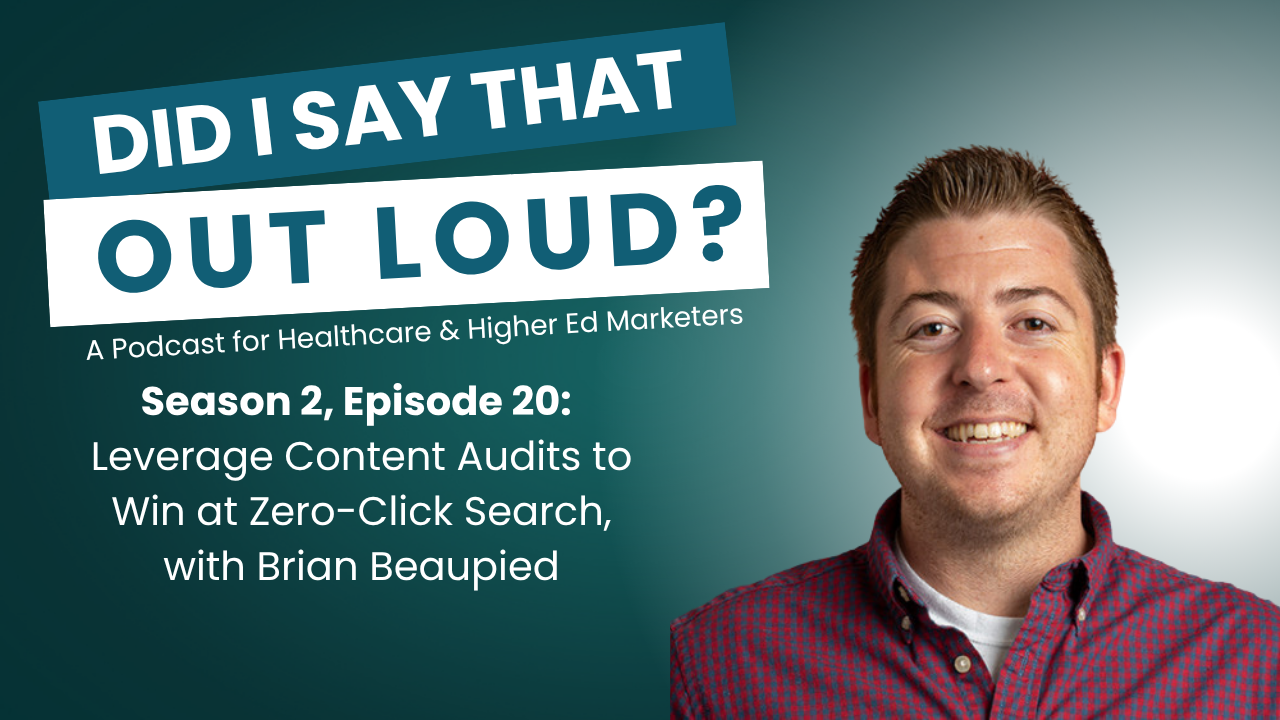
Season 2, Episode 20
Discoverability starts with clear, differentiated, and answer-driven content. And how do you find the gaps to fill? Through a user-centric, SEO/AEO-focused content audit. Brian Beaupied shares how Oakland Community College leverages their audit findings to achieve clickless search visibility.
Brian Beaupied is the SEO & Web Content Manager at OCC. He is an owned and organic content marketing leader whose career has taken him from award-winning sportswriter to agency leadership, professional services, and higher education.
After transitioning into digital marketing from journalism, he helped grow revenue and reputation for his digital agency by onboarding Fortune 500 clients and capturing North America Partner of the Year honors. Today, Brian leads SEO/AI, content strategy, and user experience initiatives at OCC.
Listen to Episode
Show Notes
Transcript
Mariah Tang: Did I say that out loud? Welcome to “Did I Say that Out Loud?”, a podcast where Stu Eddins and Mariah Tang reflect on agency life and answer questions from our higher ed and healthcare clients about the latest in digital marketing, content and SEO.
Hello, everybody. Welcome to Did I Say That Out Loud? You might see a formally familiar face on the podcast. Stu’s back.
Stu Eddins: I am. I actually my front. but yes, I
Mariah: Stu’s front!
Stu: But I am back. I’ve been absent a little while for “overwork” and I haven’t had a chance to have these good, fun conversations.
Mariah: Yeah, well you picked a good day to come back because we have Brian Beaupied. He is the SEO and web content manager at Oakland Community College. Brian is an owned and organic content marketing leader. His career has taken him from award-winning sportswriter to agency leadership, professional services, and now higher education. So after transitioning into digital marketing from journalism, Brian helped grow revenue and reputation for his digital agency by onboarding Fortune 500 clients. And capturing North American Partner of the Year honors. That’s pretty awesome. Today Brian leads SEO and AI content strategy and user experience initiatives at Oakland Community College. Thanks for joining us, Brian.
Brian Beaupied: Morning gang. Thanks so much for having me. super grateful to be here and to jump on. So
Mariah: Yeah, we’re tickled that you made some time for us. You got a busy day, so we’ll just jump right into the questions if that works for you. And Stu always works with Brian and his team and has for several years, so don’t let me hold you back if you’ve got some questions you’d like to jump in on too, Stu.
Stu: Well, I think
Mariah: Let’s jump into my favorite part first. I’m gonna cut you off. How about that?
Stu: Hey!
Mariah: Brian, what are some of your favorite parts of doing a content audit?
Brian: Well, I think for starters and somebody like me, you know, it’s just such a great opportunity to really get into the weeds with our content. I think we’ll produce stuff, we’ll put it out there and we’ll set it off into the wild and you know we might not come back to it for a bit. So it’s a good opportunity to kind of circle back. and again, really get into the weeds, whether we’re talking about, you know, more technical elements, the content on the page itself. How the design and content interplay together, you know, it’s kind of a choose your own adventure in that way. And it’s a really great opportunity just to kind of level set on things. And yeah, I think there’s some other ancillary benefits too. We always do a really good job, I think, of inviting a pretty large crew to our content audits. So there’s good knowledge sharing that occurs there, good takeaways for other marketers on our team. And we get to like open up the hood a bit on our web strategy for some of our clients and different partners across the college. So that’s always really great. And I think just the maintenance aspect of those audits, regularly committing to them. I think we win a lot in the margins there with the equity on the site and really, focusing on, you know, making things best practice as easy as possible, and easy for our users.
Mariah: Yeah, one hundred percent. And I know you and Stu work pretty closely on these projects with, the data analytics components of doing an audit and you know, which pages to prioritize and so forth. So Stu, I don’t know if you w wouldn’t mind jumping in and talking maybe about your side of the project on these content audits with Oakland and similar clients.
Stu: Yeah, and the one thing that I’ve always appreciated is that first off, we have a regular schedule of content audits that we do. Oakland works through what their priorities are and they give us a good list of pages to take a look at, often grouped by a theme. It may not be a specific page, but it but an array of pages underneath a particular program or the underneath a particular service. And first off, the one thing I’ve really appreciated is that we deliver the audits, we discuss what the solutions may be, and they actually happen. and the one thing that that we’ve really kind of found is that where we have access to things like analytics, we’re seeing that on the content in general, Oakland’s traffic from organic is stable to growing, where so many others are falling off. and I think some of that speaks to the focus on content refreshing, staying relevant to the to the way people are searching, what they’re searching for. And I think the audit process plays a key role in that. and especially, Brian, as you pointed out, bringing in some of people who may be stakeholders from a different point of view, not necessarily marketing, but content or simply even the program stakeholder and getting them involved.
Brian: Yeah. Yeah. And what we find out is they’re really looking for that partnership from us too. You know, not in all cases do they know how to engage best with us, and just with the amount of programs and departments across the college, they may not even have met us in all cases, right? So we find that it’s not a yank. while it is a challenge sometimes coordinating everybody, they’re really looking for that partnership from us too.
Mariah: Yeah. In several years of working with this group, you all are so engaged and we really appreciate that and it just makes the whole process fun for everybody. So in that in that vein, what are the strategies that you and your team use, Brian, when you’re prioritizing which content to work on for that month or for that quarter?
Brian: There’s a couple ways we go about that. And Stu hit on one of them. You know, we work closely with our office of institutional effectiveness and they’ll provide to us as a marketing department, you know, a list of priority programs for the year. So that’s always a good place to start. Reasonably that’s where we’re gonna put our marketing emphasis for the year, right? Behind those key programs. So start there. we have high usage and high traffic pages that we always want to look at, right? Like our registration, the journey to apply, financial aid admissions. so those common high traffic pages would be another place that we look. Third, I would say, you know, just those key business moments and major activations, you know, if we’re restarting a or launching a new brand campaign, making sure we’re looking at those pages. And then last, and as there’s room, you know, what are those pain points and friction points that we’re just like anecdotally feeling on the day to day? and I think we do a pretty good job of staking out enough of a plan with that, but also having the flexibility to move things around as we need to as well.
Stu: And one thing I have noticed in going through the analytics of the website itself, I’ve also noticed that the updated pages are also performing better in AI chatbots as well. It was never really the specific goal to be AI ready or anything with an audit, of course. but we have noticed an uptick. AI traffic is not huge to begin with. The upticks are present. No one’s writing home about them, but we are noticing that that the content we touch and move does do better. And I’ve noticed that your team has begun to understand how AI might interact with your content more, and I think that’s been an important distinction as well.
Brian: Yeah, we’re just beginning to really start to understand that. I mean, really with your team’s help. and while it’s maybe not something to really get on a soapbox and really scream about just yet, it is interesting to follow and understand from a trends perspective. And it still doesn’t stop us from communicating about it internally, too. something we do every semester is we’ll put out a performance report just on the state of the web and as part of that, we’ll try and include a case study on something we’ve done over the semester too. and with your help, you know, we’re talking about what we’re seeing coming into the site now from AI and just anecdotally that they’re coming in with pretty high intention and they’re pretty engaged. And, you know, that’s something to follow. So for our team, that’s still a call to action, right? You know, we can we can make sure our content’s clear, make sure it’s written in a way that it’s easy for users to understand. And as well, something I try and represent on the team is technology as an audience. So making it easy for AI search engines to consume that content and surface it elsewhere.
Mariah: What a time to be alive. Brian, can you tell us about some of the key metrics you’re looking at now in your reporting? I I mean you always touch a lot of data points, but with some of those nuances that you and Stu were just talking about, what are some of the, you know, tried and true and then maybe some of the newer like cross-platforming metrics that you’re looking at?
Brian: Sure. So, you know, obviously always looking at, you know, an intake perspective, what’s coming in, the volume around it, the channels people are coming from. I think that’s interesting to me, especially as we try and understand what AI is doing to these student user journeys. You know, I think we’ve always done a really good job of being intentional around making our content helpful for whoever’s consuming it. And Stu, you mentioned it’s like a side effect is that it’s appearing better in in AI.
That’s I think that’s just from our starting point of trying to make it usable for both humans and technology audiences. So structuring it well, making clear topics, that constant call to action to our team to, you know, look at their content, make sure it’s accurate and up to date. From an AI perspective, I think that’s probably the best that we can be doing right now while still keeping our ear to the ground and trying to see what’s coming next. From a search perspective, again, we see some leveling off there. But really I think we’re also trying to be more efficient with what we do with that traffic. So I think a lot of people will kind of lose sight of things, they get the traffic to where they want the traffic to be, whether it’s an ad or a search engine. All right, we got them there. So we’ve accomplished that goal. But we know we need to be more efficient too with getting those users to the finish line. So what are we doing on those pages to make things as easy as possible with our CTA placement? Again, the order of information of that content starting with the most important and kind of working your way down.
Something we’ve run into as well with some of these bot-like audiences is, you know, our financial aid and admissions team, they fight a lot of fraud. Our IT team is doing a lot to stop some of these bots from accessing our content. but some bots are good bots. So we’re working with IT to make sure the right bots are getting through, being able to scrape our content. So those are just a couple of strategies. You know, we’ll look at a lot of search data as well, more granularly. That’s just a gold mine for somebody like me in terms of our content and where we need to go with it.
Mariah: Yeah, like following what the people are doing and following what the bots are doing, it’s just kind of a whole new ball game out there.
Brian: It’s a lot to balance for sure, right? You’re trying to support organic discovery for people, you’re trying to support organic discovery for bots, you’re trying to support now more paid traffic coming in. So what’s the interplay between that paid traffic versus organic discovery and making those things all work together? So it’s definitely a lot to juggle.
Mariah: Could you talk a little bit, Stu and Brian, about how you perform that competitive market data in kind of a lean way? And then how you’re combining those findings with your content audit data to really move the needle on your SEO/AEO.
Stu: One of the best applications where we work with Oakland community college specifically. It’s not “is the competitor being found for something we should be found for?” It’s discovering the gaps where nobody’s being found and trying to fill that with content. Brian, you hit on something very specific there a few moments ago. Content, the content has to be useful, usable, and accessible.
No matter what the platform is, whether it’s search engines or whether it’s whether it’s an AI agent. And I think that the direction that that your team’s been going fulfills that, and in fact hits all three points of that. so yeah, it’s been really interesting to see some of these things develop. I’m kind of I’m kind of interested to find out. We keep reporting in in in our discussions that your AI traffic is converting at a higher rate than most any other channel out there. And I also notice that your enrollments are hitting targets that they’re supposed to and so on. Do you get the sense that the work you’re doing that is being scraped by these AI agents is actually being beneficial? Or do you think or do you think it’s just been talking to the people you would have you would have resolved anyway? Do you get a sense you’re getting new business from this or is it just getting the people you would have gotten anyway?
Brian: You know, that’s a great, great question. And I’d like to think so. I think really what it is, is the top of the funnel I think is pretty well-defined. I think the bottom of the funnel is pretty well-defined. And I think in the middle it’s just craziness. and it’s occurring somewhere, and our website needs to help facilitate that discovery wherever it may be. Something’s coming in to grab our content to show it somewhere else. We’d like to be on top of how that appears and the message over it.
But yeah, that that discovery and engagement, I think, is still occurring in this era of the like zero click searches and answer engines. and I think it’s just our job to facilitate it and our understanding of and our measurement capabilities with AI is only going to continue to grow. I don’t know that we can tell that right now. It’s just another kind of tool in the toolkit, I guess, as for us and for our users as they as they discover.
Stu: Yeah. And the discussions we’ve had again, referring to those. I do get a sense that there is that missing middle of understanding where AI is fitting into it. But I think that what you are probably doing from the conversations we have, you’re trying to figure out whether the content changes are actually at the end of the day affecting student counts. Or affecting the quality of the leads coming in, not and kind of agnostic about where they came from. Do you find that the people that you have to talk to outside of your immediate content and marketing team, do you feel that your stakeholders are understanding that the real measurement is the outcome versus what the keyword or the click was. Has that been a conversation that that’s been easy to have or is it something that you feel you have to teach your stakeholders about day in, day out to get them on the right page?
Brian: I think we’re definitely working there. And I think that’s something thematically that popped up with us in our calls this summer, right? It’s like there’s a lot of data that’s out there. So separating the real signal from the noise, and you know, really framing it around really good measurement at the top of the funnel, good attribution for these campaigns and where people are coming in from, and you know, with our stakeholders, there’s still a certain amount of education going on there. Like, we’re at the forefront, right? We work in this stuff every day.
Maybe some of our stakeholders, they’re building in their digital literacy, but they’re still lagging behind in some ways. And they can get hung up, I think, on metrics sometimes, but they’re just trying to move the needle and make things better for their users at the end of the day. So we’re focused more on I think, and rightfully so, top of funnel. What are we doing to bring people in? Are we facilitating that middle the best that we can without fully understanding it? And then again, it’s really about those business outcomes. Vanity metrics at the top are great, but they’re just indicators of how well you’re bringing people in. It’s really about what you’re doing at the bottom of the funnel to convert people and turn them into students.
Stu: And I think your selection of the content that we audit reflects that. because we are I haven’t really put two and two together here. I don’t want to say we just do what you tell us, but to some extent it’s like, okay, now it makes sense. some of the pages you get you’re giving us to audit are that top of funnel content. It is that initial handshake about what the heck is Oakland Community College. And then others are on that pointed end of the funnel. That’s more about the program and call-to-action side of things. So yeah, I come to think of it, I am seeing that in your content audits.
Brian: Yeah. And I think it’s important to look across all of it, right?
Mariah: And I mean one of the one of the tools that that actually Oakland helped us pilot several years ago is our Data Studio dashboards. And these are these can be very light, these can be very complicated. They can have multiple tabs or one tab, whatever kind of data torture you like to do for yourselves. Could you talk both of you about how you use that data on top of you know other student acquisition and retention type data that you’re getting from your internal teams as part of your ongoing content strategy, website strategy, social strategy?
Brian: Want me to start that one Stu?
Stu: Why don’t you kick that one off?
Brian: Okay. Yeah, it’s great to have that shared view. And again, it’s you can really get into the weeds with all the data points that are at your disposal. I think the data studio dashboards do a great job of trying to consolidate or combine some data from different sources to put it in one place, and that certainly makes things more useful for us. and our dashboard is pretty robust in how it’s set up for at least I think organic discovery. We’ve got views for you know, just top-level web metrics, but we can really dial into specific program content groups and study the performance there. I think just an example of how we use that, using some of the search data that we see in these reports, you know, we see a lot of branded search terms for OCC and specific campuses that we have. but we don’t have specific campus landing pages.
So we see that as a gap and we’re actively working to fill that right now by creating these campus specific landing pages based on search data that we were seeing month over month. so that’s just one way I think we use it. There’s obviously ways to inject more keywords and try and increase your visibility in some ways. and it also helps to understand, you know, just the demand for that content overall too. And then, you know, I think it bleeds over into other areas too, like social and AI. We talked about what we’re seeing there from traffic coming in, it being more motivated and likely to convert in that session so far based on what we see. socially, you know, I think it’s we don’t have as tight of measurement in these specific dashboards for social, but it gives us talking points when we’re meeting with our marketers, things that we could suggest or recommend that might be helpful for them, for example.
Stu: Yeah. Well one thing that we have talked about also is the and for those who haven’t seen it, the dashboard that that we’re referring to is one that brings in data from a platform called Search Console, Google Search Console. Now the Google Search Console platform itself is gonna show you the top thousand search terms or keywords and that’s it. However, if we bring that information through the API into a dashboard, we get tens of thousands of keywords and search terms. It’s not abbreviated, you get the full list. One thing we’ve discussed, and I think that this has helped us on our audit side, is we’ll take the group of pages and extract all those user search terms that got impressions and look at that.
Then we use AI to feed that list into a tool, perhaps Gemini, perhaps ChatGPT, and figure out the intent behind the searches. And I think that what we’ve been able to do is give you some recommendations about, you know, you you’ve got great informational content here. We need something more transactional. Let’s talk about next steps. Let’s talk about getting them involved. And in the last three or four months, when we’ve done these audits, I get the sense that it first off it’s pretty soon on the pages to notice a lot of shift in performance. But I am getting a sense that it’s in small ways already having incremental impact on visitor satisfaction. They’re staying around a little longer, on taking that next click and so on.
I think the dashboard can be applied in a in a good number of ways given the breadth of data. I also think it can feel like you’re taking a drink from a fire hose if you’re not careful. Your team really looks at that second chart we have, which is all the stuff all the all the terms that are at the top of page two and haven’t made page one yet. And I think putting emphasis on that has helped your content as well. You know, it’s this thing is gives it an easy nudge, get it up on page one, earn that additional traffic. And I think that’s been quite beneficial.
Now, I’m Mariah, unless you object, I’m gonna ask a critical question here that has nothing to do with dashboards. You can edit me out, edit me out later if you wish. Brian, Mariah, the three of us are here. We own this particular platform at the moment. We’re gonna make a decision. Is it AEO, GEO, or something else? What should we be calling this? What do you think? Brian, what do guys call it internally?
Brian: I mean it’s still AI here. I mean, I like GEO personally, but I think it’s more encompassing.
Stu: Okay. Well, GEO it is then for the rest of the world. We’ve just made that decision. So there we go.
Mariah: Nice work, everyone.
Brian: I don’t wanna make it on my own though. Like, let’s hear some other voices on this topic.
Stu: Well, I just wanted to give Mariah something that she could edit out and put out there as a teaser at the beginning of these things so that people come angry to begin with. That’s always useful. Yeah, yeah. That’s the non sequitur that I bring to the conversation.
Mariah: Good. I’m so glad your back, Stu. That’s right.
Stu: We’ve got a lot of methods and tools that we’re using. I think it’s great that you guys have been doing it. The one thing that that we didn’t ask that was actually at kind of the top of our list, what’s the stuff about a content audit you don’t like? What what’s the stuff that you don’t look forward to having to do? Is there a negative side to this where you look at it and go, geez, this is the job I just don’t want to do again?
Brian: In my role, the content itself is where I live. So it’s nothing about the content or the page itself. I think the things that are kind of more of a yank is just coordinating the big group of people that we involve. Trying to find those times that work for everybody. And we do want their involvement. We want their questions, we want them very involved in the process. And we find that when they are involved, you know, it’s easier.
You mentioned now I was gonna circle back to this, but you see those changes taking place pretty quickly on the page. When they’re there, and they’re bought in and with your team’s oversight and support, you know, it really greases the skids for us to make those changes quickly. It’s kind of like a handshake deal out of these content audits, you know, you don’t have to do anything. We’re gonna take these and we’re gonna start working on them for you. So,
Stu: It occurs to me it’s a great trust building exercise internally too.
Brian: But yeah, so I think coordinating the people and I think something we could just do a better job at and this just gets lost in the day-to-day routine, right, of fire drills. But w I don’t think we always go look back at what we might have impacted there from a measurement perspective. but I think we believe we’re making it better.
Mariah: Well, I know we’re coming right up on the end of the time here, Brian. I wanna get one more squeeze of expertise out of you. So if you had maybe three to five takeaways that you would share with individuals who are in a similar role to yours, or maybe who are just starting out in the SEO/AI/GEO alphabet soup career of content marketing and strategy, what are some tips that you would provide about how to turn that data into action steps to improve your content.
Brian: Sure. I think while talking about some of the competitive stuff that we did here today, I think if you’re not looking at what your competitors are doing, you should start. I think it’s a great way just to, if nothing else, hold your content up and see where you might have informational gaps, things where you could be making things better, or maybe even differentiate differentiating yourself over your competitors. So if you’re not doing any sort of competitive monitoring or looking out there,
You know, that’s a good place to start. And it’s not just rip off and duplicate, right? That’s we’re not racing to the bottom, but it is important to look and see what’s going on out there. I think if you if you don’t look at your search data, start doing that too. There’s a wealth of it out there depending on what you’re working with. whether that be from Google, whether that be from your search appliance on your own website. If you’re using an AI chatbot, once a week I sit on our AI chatbot and try and focus on making the content there better for users. And that is an eye-opening experience if you’ve ever had to sit and manage and monitor a chat bot. You’ll learn a lot about user behavior there, but you’re also going to see where the sticky points are for your users, the content that they’re looking for, and if you’re getting into I’d say this is number three. If you’re getting into all that data, it can be very overwhelming.
Try and organize it by themes. The more things pop up, that’s gonna be a theme. You know, you can reasonably ascertain that that’s gonna be a good place for you to focus some of your efforts, it’ll be it’ll be certainly worthwhile. and I think lastly, in terms of prioritizing, if you’re a content person, that’s checking in on AI or looking at your pages.
Another thing that can be very overwhelming is you see opportunity everywhere. there’s not a page on our website I think I could go to and maybe not find something to make better. but really try and prioritize what you’re doing around what the college is doing and where they’re trying to move the needle. It’s just gonna make your work that much more effective and drive that much more actual bottom line, you know, outcomes for your organization.
Mariah: Yeah. That’s the hardest part for me is just making you know, making good enough and letting good enough be there and waiting to measure that and not resisting the urge to edit everything all the time, right? It’s kinda how it goes.
Brian: Yeah. And don’t just react to the metric, right? If you can’t find something actionable to do about it, maybe it’s not worth your time or not just yet, right? But try and try and match those metric movements to things that you can actually affect in in action items.
Mariah: Absolutely. Well, Brian, it was a pleasure. As always, thank you so much for taking some time and visiting with Stu and me.
Brian: Thank you so much for having me. Really grateful for the opportunity.
Mariah: Thanks for listening to “Did I Say That Out Loud?” with Stu Eddins and Mariah Tang. Check out the show notes for more information about today’s episode. And if you have any questions, concerns or comments, hit us up anytime at stamats.com.
Mariah: Take care. Thank you. Thanks for listening to “Did I Say That Out Loud?” with Stu Eddins and Mariah Tang. Check out the show notes for more information about today’s episode. And if you have any questions, concerns or comments, hit us up anytime at stamats.com.
Let’s talk
You have questions, we have answers. We will customize a solution that is guaranteed to impress.