Written by
on
October 23, 2026
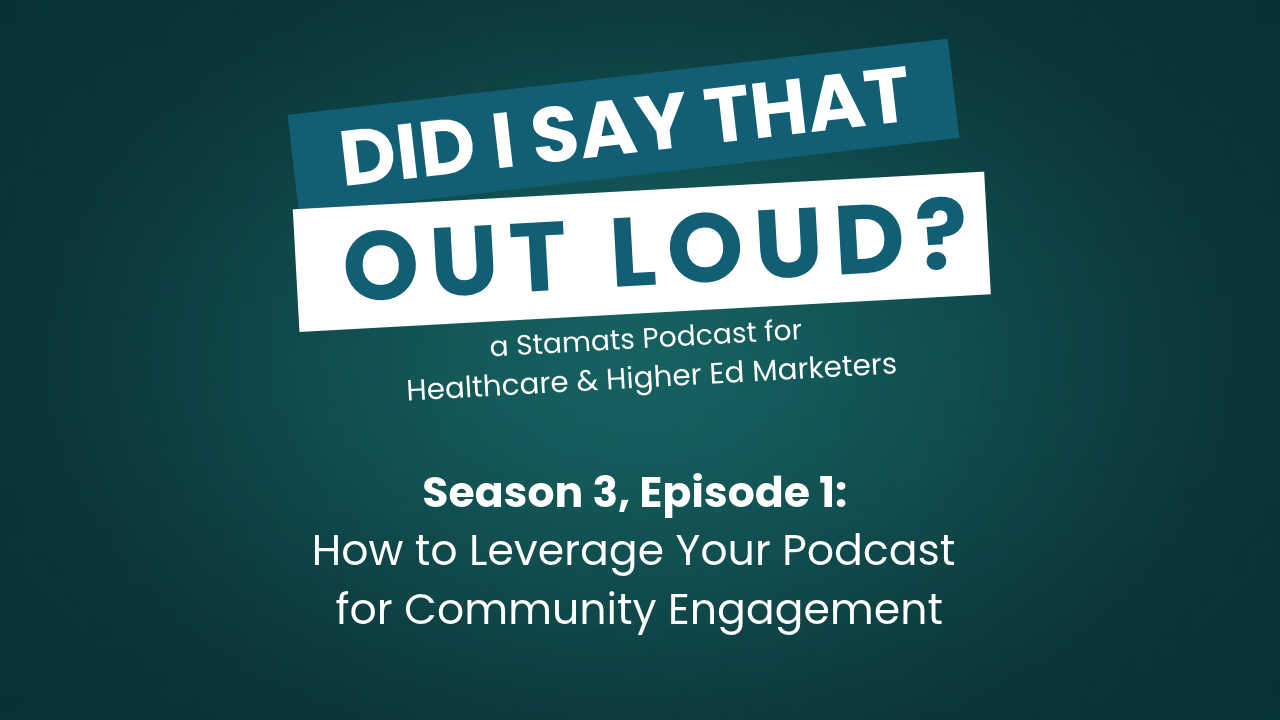
Season 3, Episode 1
What’s it take to create a higher ed podcast your community wants to engage with? It’s no small feat … but it starts with great stories, fearless students, and trust from your campus stakeholders.
Matt Thompson and Sarah Dias, two of the leaders behind the What’s Up Warriors? podcast at Indian Hills Community College, share tips about getting started and generating on- and off-campus engagement.
Matt Thompson is the President of Indian Hills Community College. Sarah Dias is the Senior Online Instructional Designer at Indian Hills.
Listen to Episode
Show Notes
Show Notes
- Listen to the What’s Up Warriors podcast on the Indian Hills website.
- Follow What’s Up Warriors on YouTube or on Spotify.
Transcript
Mariah Tang: Did I say that out loud? Welcome to “Did I Say that Out Loud?”, a podcast where Stu Eddins and Mariah Tang reflect on agency life and answer questions from our higher ed and healthcare clients about the latest in digital marketing, content and SEO.
Thank you everybody for joining us for Did I Say That Out Loud? This is the first episode of season three, and we are so tickled to invite a wonderful pair from Indian Hills Community College right here in Iowa. We have Matt Thompson, the president of Indian Hills, and Sarah Dias, a senior online instructional designer. And we have a really fun topic for you all today, so let’s just get right to it.
There are so many questions that we wanted to ask you, and we know that we can only steal you away for a half hour. So we’re just going to plow right into this if that’s okay with you all.
Matt Thompson: Perfect, thank you.
Sarah Dias: Absolutely.
Mariah: All right. Beautiful. Love it. So let’s zoom back to the very beginning of this podcast. So your series is called What’s Up Warriors. How did you come up with that name? Tell us a little bit about the origin story.
Matt: I’ll just jump in and start with this and hand off to Sarah. We had a really great strategic planning process that involved a lot of our faculty and staff. Really everyone on campus was able to be involved at some level, and one of the things that we wanted to really promote was a new level of communication. You know, we send emails and we have an intranet that has a lot of posts about things happening on campus. And really challenged the strategic planning committee to talk about new ways of communicating with faculty and staff members, alumni, our community members.
We serve a 10-county region in South Central and Southeast Iowa. And so what are some new ways that we could provide more communication about things happening on the college campus? And so we also are very fortunate to have an interactive media program that has a tremendous faculty member who Sarah and I talked to and he said, you know, be really cool if we could get our students to help produce this and be involved in it. And it was actually his idea, What’s Up Warriors. And so we kind of ran with that and just thought it was a really cool title, incorporates our athletics programming and we are the Indian Hills Community College Warriors. And so What’s Up Warriors it was.
Stu Eddins: You talked about a process internally to get to get things ideated and up and running. Did you have a lot of buy-in immediately or did it take some convincing people to think that a podcast would be a good idea?
Sarah: How about let’s say that’s twofold. We had a lot of people who thought it would be really cool to have a podcast. And that was one of the things that as we were coming, our specific goal for this particular strategy was to communicate better with not only our internal faculty and staff and students, but also with external constituents. And so the podcast had come up as an idea. We do of course, obviously, have things on the website, we’ve got newsletter things, stuff like that. But everyone is like, a podcast would be great.
And then you ask for content and … crickets. And it’s like, well, okay, if this, if this is good, let’s try to do that. And so we’ve had to really try to actively go out and promote. And I think once the first episode came out, people got a lot more excited about it. And then we were able to just release our second episode. And so I’m really hoping things will kind of snowball, especially as they see what kind of content is, because I think there are a lot of people out there who look and say, no, I shouldn’t be on a podcast. What am I going to say on a podcast?
And then when they actually see what others are saying on a podcast, they realize that it’s just talking about your passions and what you believe in and what you want to communicate to everybody around the college and, you know, put that message out.
Matt: It’s a great idea and people want to be involved and we all have a story to tell. We have over seventy academic programs, highly successful athletic programs. Top in the state in performing in visual arts, but there’s also sometimes just that concern about being in front of the camera and what if I don’t do it the right way or I say something wrong and I think that’s where our program faculty member and our students have made people feel more comfortable.
And I think as more of these come out, more people are going to say, you know what, I should go and talk about the successes that I have with my program because it you know it’s being pushed out in social media and it really gives an avenue for future successes of individuals that may see it and might inspire them to want to attend Indian Hills or maybe inspire their child or their grandchild to be a part of some of the special things that we have going on here at Indian Hills.
Mariah: I love how podcasts has evolved beyond just an audio program into video. You know, our first season of Did I Say That Out Loud was all audio as well. And then we decided people need to see our beautiful faces while we’re giving these hot takes. Stu loves video. Don’t let him fool ya.
Stu: Yeah. Hey, my mom always told me I had a face for radio, anyway. The thing I find interesting is that you’re getting buy-in and it it’s almost like the topics are coming up organically too. Did you did you hand out anything that that might have been like leading questions, something that might get people’s ideas flowing, or did you are you just taking what comes at you? How’s that going? Okay.
Sarah: A little bit of both. So our strategic planning committee is called Powering Progress. And so of course, you know, one of our things is to try to put out more information to people and connect with people. And so I’ve got a fantastic committee and they are contributing to ideas and trying to say, hey, let’s do this, or maybe this would work. But then it’s also been organic. We actually came up with a QR code that gets posted with every single podcast. And that goes to a forum stack that goes directly to me. So any ideas that people have off the cuff, they can just send that my way and I’ll be able to kind of connect them and put them on the list.
I’ve got a running list of people that I’m trying to make sure are kind of in the pipeline so that we make sure that we have content ready to go and then we can fill in with whatever we don’t have. We’ve also tried to kind of focus on kind of three separate parts of things. So we wanted to do activities, academics, and access. And each one of those is very deliberate because we wanted to make sure that we were representing across the college and it wasn’t just anybody show up and be on the podcast. How can we do some of these specific different avenues and highlight what we’re doing at the college?
As far as our academics and our activities, obviously. But then the access, we wanted to make sure that, you not only for our own people here, but for the community, they know that there are things going on. For instance, our last podcast, our new band director, he wants to do a community band. And so he’s saying, you know, anybody in the community who wants to come play in this band, he’s wanting to get and and so to be able to put that out there for people and just show some of the things that we’re doing at the college that are different, but also help engage, I think is really important.
Stu: One thing that I’ve noticed, you have a lot of consistency in your presentation, and it’s not like it’s drilled into people how to say things. but I do get the sense, as I mentioned, it seems like a very organic conversation happening during them. is it the type of thing where you where you have to prompt people to keep going to start filling up your podcast time or does it seem to everybody has mic fright in the beginning, but does it seem to get into a stride quickly and and and move along in a way that production is easy?
Matt: The first session we did back in I think it was early April that we recorded, we just kinda called and prepped people a little bit and said, Hey, talk brag about what you’re doing. I think we had performing visual arts, Dr. Jennifer Boyenga was on and we had a play that was getting ready to showcase the following week or the week that we were going to release the podcast. And one, she’s a performer. So she knows the cadence, she knows what to say. She’s also very thoughtful about how to market what we do at the college. She’s been here a number of years. And so I just think that there are good questions that are being asked and there are genuine people that are involved that are going to talk about it and they’re going to be very straightforward about their knowledge and you know they want to share more.
I think Susan Wilson was on the first one as well. Susan’s been with the college for over twenty-five years and runs a very successful program and has had students that have really stayed in Iowa and they’re making a wage of over seventy thousand dollars after two years of education. And she wants to tell that story because she knows how great that program can be for so many people and their families. And so I think our people just find it pretty easy to talk about the things that they know best. And so it just comes off pretty natural.
Sarah: I think that’s absolutely right, Matt. know, the stage fright that anybody has when they first come on, once you just start asking them to talk about what they do, the passion that comes from people who work here is just amazing. And to see that come about and then I think the other piece of it is involving our actual student program, the Interactive Media Technology program, because, you know, we’ve got an instructor there who is extremely enthusiastic about it, but then he’s got students there who actually wanted to host.
You know, we had students who said, yes, can I ask the questions or, you know, and they were taking pictures behind the scenes and to give them some of that hands-on experience coupled with the fact that they’re excited about it too. just made it that much better. And so it’s just been a really cool experience.
Mariah: It’s really neat how your campus community has rallied around this podcast and this initiative. When we were chatting before the recording, you told me about having standing room only in your first session. Could you describe that for the audience?
Sarah: So it was an incredible experience, both our first and second podcast. I think we had more students present than we had actual people that we were interviewing. and they were there to switch cameras. They were there taking pictures behind the scenes and, and they’ve posted all sorts of things about what they’ve done on the backend. They were rotating in and out at, as hosts and to be able to just do that and then have our faculty and staff in the wings to come in and then just get welcomed by students who are here just as excited about the college as everybody else is. That was just wonderful. And yeah, the room actually, we’re talking about putting a fan in there now because the room is an amazing room. In fact, it used to be the dark room for our photography program.
Our maintenance staff did an amazing job repurposing it and they’ve turned it into this beautiful podcast room. We’ve got cameras and microphones and couches and you know, so it’s just evolved into this really cool space that now our students get hands on time with being able to interview, talk to people, doing some of the editing after the fact, and then they’re able to learn things along with us as we’re promoting some of these different things at the college.
Mariah: That’s so cool. Stu, we gotta get with our local maintenance fella and migration extraordinaire Chris Johnson and have him build us a a nice little room to record in.
Stu: You know, yeah, I’m missing a couch back here. We could do that. Wouldn’t hurt my feelings any. I I’ve got two in front of me, but I can’t yell that loud to get near the microphone, so it won’t work.
Mariah: I love it. I love it. So what’s next for you two, Matt and Sarah? Tell us about the next couple of episodes that are forthcoming.
Matt: Well, we just released the latest version and I think when we first approached this one. This what a tremendous learning opportunity for these young people, as Sarah was just describing. I think that’s the beauty of community college education. we try to find real-world hands-on opportunities for our students, whether that’s in health science programming at a local hospital or a long-term care facility, or in advanced manufacturing at one of our tremendous manufacturing facilities. Or in this case, this this program really is about preparing the workforce for the media and having social media presence.
And understanding the value in what’s, right now podcasts are huge, and so I think they’ll continue to be that way. But giving them the opportunity to be a part of it is just a great learning opportunity. So we’re proud about that. When we originally talked about this, we looked at doing this multiple times a year, and I think that’s probably going to be where we’re at. We don’t want to overwhelm the students to the point where they feel like they have a a full-time job working for the college for free while they’re paying their tuition. But getting the right amount of experience that helps set them on a successful pathway. So I think we’re looking at quarterly releases now.
If we have more students that want to have more involvement we would consider doing that more often, but we really feel like having quality content that gets put out and can be sent out to alumni via social media is a really good starting place for us and it’s probably a happy medium that satisfies the requirements of the program. So that’s kind of where we’re at right now and then we’ll see. If they want to do more, I’m always game for doing more.
Stu: Yeah, you’ve obviously had a good experience with this, and it’s something that you look forward to building on. Were there any potholes or accidental missteps that happened to you along the way that you might warn other colleges about before they try to do the same thing?
Sarah: One thing that shouldn’t have surprised me that did was the fact that we didn’t have people knocking on our door ready to just come volunteer to be part of the podcast. It’s a big ask for people to go in front of a camera. It’s a big ask to go in front of microphone. And then you get that added thing. then, of course, everybody has things going on. We’ve also, this last podcast, we were able to introduce a virtual aspect, which was really great because we were able to get some of our coaches on from our wrestling program. And they’re an hour away from us. And so they were able to be on the podcast and be part of it. And that was really cool.
But just the content, mean, that’s that, and that’s the biggest piece because of course you don’t have a podcast if you don’t have content, but you don’t have content if you don’t have people stepping up to be able to say things. And so I think that’s one of those things that, you know, Matt and I kind of wrapped our heads around it at the beginning and we were like, okay, who, who could we get to kind of kick this off and really get it started because we had the student support. We had support from people. We just had microphone- or camera-shy people.
And I think once we were able to get some people on and then now after the second episode, I’ve actually had, a list of emails that I’ve started to compile so that when we get ready to do our next one, we might actually have enough content for two or three podcasts. And so that’s what’s really cool is, once people get over the fact that it’s not as bad as it could be. And I really do believe that once we get people talking about their programs or what they’re involved in, it’s just a natural reaction. We have such wonderful people here that care so much about student success and, you know, making sure that we’re part of the community and highlighting the college as a whole. Indian Hills is a great place to be and we want to make sure that we highlight that. And I think as we keep going with this, it’s just going to get better and better.
Stu: The thing we’re looking at with the number of different colleges we work with, outreach is always a challenge. It’s always the thing that can scare the pants off some people, but it also can be a difference maker. It can be the humanizing effect that happens when people that care about what’s going on, step up to the microphone as you’ve said and talk about it. It sounds like quite often there’s faculty involvement. Are you looking to try to bring some alums on and get them to talk about their life after school and such?
Sarah: Absolutely we do; as a college many years ago, we used to do kind of a campaign that we called One of Our Own. And we went out and highlighted graduates of different programs. We would put them in the local newspapers and that really dates it, sorry.
But it was one of those things where we went out and tracked down people who had gone through different programs at the college. And we were able to highlight that and show people, okay, there are real people in your communities that have taken courses in whatever program it is that we offer, and then they’re out there. So we’re trying to now hopefully bring that in so that we’ve got that visual aspect. And of course, now that we’re able to do the virtual recording, I think that will be a whole lot easier to be able to bring in some alumni. But we want to make sure that we’re not only highlighting our alumni and graduates so that they can tell us their stories and show what the college helped them become.
But then we also want to take some of our current students. And so we’re looking at trying to involve like some of our student ambassadors. So not just the interactive media program, who’s actually doing recordings and stuff like that. But we want to bring in some of our students so that they can show some of their experiences. Because this podcast isn’t just about one thing. We purposely did kind of the three prong approach so that we were able to highlight a lot of different things and I think that’s going to be part of the success is making sure that it’s current students, it’s current projects, it’s current people here, but that it’s also the alumni and people who have been here for a long time and just combining all those experiences.
Matt: I was in a meeting this morning at our largest employer in in Ottumwa, and the individual I was meeting with is a product of Indian Hills Community College herself and has been just a big contributor to our advisory programming. We have a great business partnership where we’re training existing workforce on our campus here and has just been supportive in so many different ways and some of the content is us when we see things, maybe just put it away and saying, that’d be kind of a really cool feature. We honored a small business that just got off the ground here and fulfilled the need in our community where we used to have a grocery store that was close to campus and that went away and now this couple has started their own grocery store within walking distance for our students. They’re tremendous partners of ours. We had food service closed one day and I called and said, would you be able to cater for us tomorrow?
And they said yes. So we honored them with an Outstanding Lay Citizenship Award. And I thought that would be a really cool story. Like, how do you how are you helping meet the needs of our students as a community member? And you want to be involved in the successes of the college. And so that was another one that popped in my mind. That’d be kind of a fun feature to do. What drove you to start your business? There was research that they had done, talking to us about the need that exists for our students and the community overall, and so we play a a key factor in so many facets of the community and so having a community segment or having members of the community that come in and talk about their relationship with the college could be awesome as well.
Mariah: I love that so much. That’s awesome. People will love to hear those stories. I know we’re cutting our close on time here, folks. So I I want to ask the big question we always ask our guests. If you had three to five tips for your peers who are considering starting a podcast or whether it’s worth it or how to get going, what would some of those tips be?
Matt: I would say for us it’s a lot easier because we have content experts on campus. And so depending on what colleges are thinking about, if they have programs that are related to as happens to be interactive media as I mentioned earlier, if they have programs that they can incorporate into the development, that’s the key. I don’t know that we’re where we are today if we don’t have that. So I think knowing what resources a college has internally to make this possible would be something to really vet and make sure that it makes sense for them. Two, I think making sure you have the right location. I know we had to buy some equipment, and so that happened pretty quickly, but it was great for the program. They got what they needed to be able to do this, and it allowed us to get this off pretty quickly. Those are two things that come to mind immediately. Sarah, I don’t know if you have anything else that you’d consider.
Sarah: Promote so that you have engagement, because if you don’t have that buy in and people who are saying, maybe I’d like to be on this now, or I can see what this could do. Again, we go back to the scary you’re on camera type thing, or, you know, you, you have to talk in front of somebody.
That’s a big deal for a lot of people, even though, you know, all of our instructors do it every single day, but this is a different type of environment. Just to be able to go out and make sure that you’re hyping it up. It now helps us that we’ve got two podcasts that we can go out and be like here. Yeah, this is what it looks like. This it’s so easy. All it takes is about 20 minutes of your time. And, you know, to be able to talk about that now is, is really nice. But at the beginning, trying to just hype it up and get those people involved so that they knew that this was something that was more than just check the box. Because that is absolutely what we didn’t want to do. We didn’t want to be a strategic planning committee goal that has, know, we’re going to check the box and just do this a couple times. This is something that we see as super valuable to everybody across our college and across the community. And so we want to make sure that this is then sustainable in the long run.
Matt: And I think obviously, you know, being in Iowa, if you build it, they will come. And so now we’ve built it and they’re going to start to come because they’re going to see that it it isn’t that hard and it is fun and it’s just overall a great opportunity.
Mariah: If anybody wants to follow What’s Up Warriors, we’re going to put a link to your show in our show notes. Thank you both so much for joining Stu and me.
Matt: Thank you.
Sarah: Thank you so much.
Mariah: Take care. Thank you. Thanks for listening to “Did I Say That Out Loud?” with Stu Eddins and Mariah Tang. Check out the show notes for more information about today’s episode. And if you have any questions, concerns or comments, hit us up anytime at stamats.com.
Let’s talk
You have questions, we have answers. We will customize a solution that is guaranteed to impress.