Written by
on
August 7, 2026
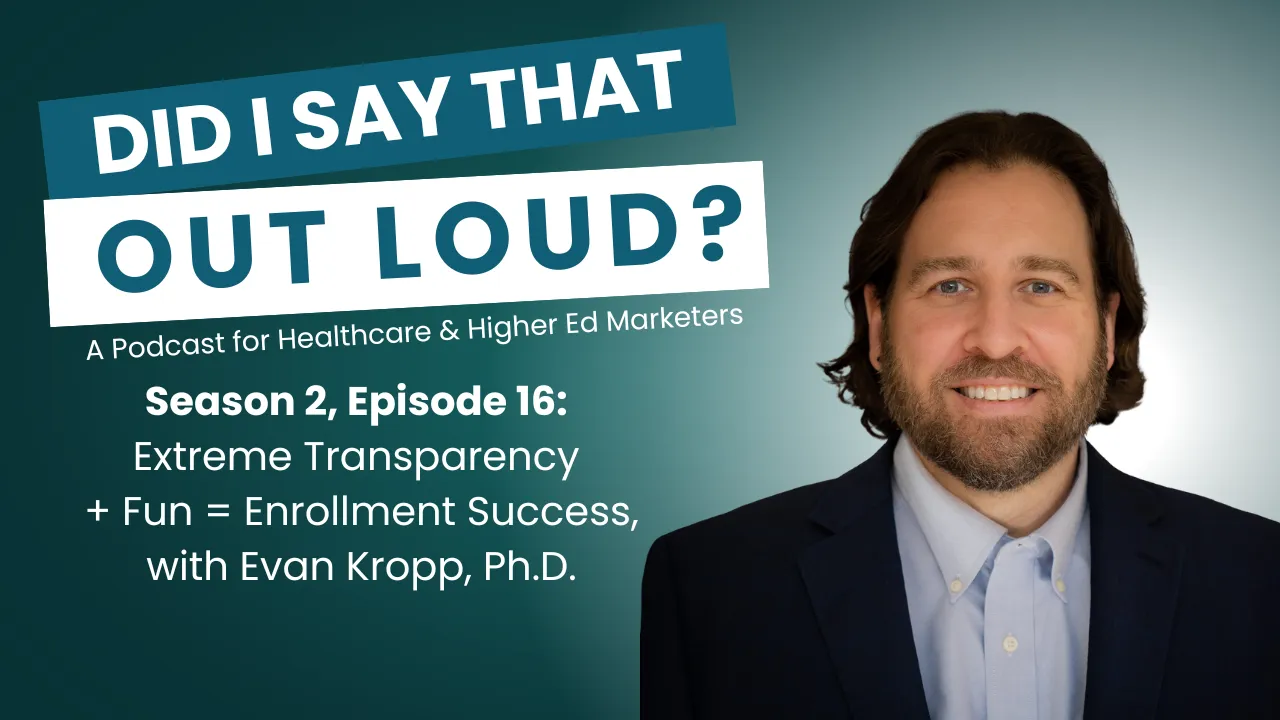
Season 2, Episode 16
What’s the key to enrollment success? Dr. Evan Kropp shares the secret sauce for the University of Florida Distance Learning’s graduate program success. See how his team right-sizes their student capacity and keeps alumni super-engaged in an era of enrollment cliff-related challenges.
Listen to Episode
Show Notes
Transcript
Mariah Tang: Did I say that out loud? Welcome to “Did I Say that Out Loud?”, a podcast where Stu Eddins and Mariah Tang reflect on agency life and answer questions from our higher ed and healthcare clients about the latest in digital marketing, content and SEO.
Mariah: Thank you for joining us on Did I Say That Out Loud? Again, we are Stu-less, but he’ll be back. I promise. He had his knee replaced, so he’s going to be the bionic man when he comes back. Anyway, you’re stuck with me. And thankfully we have visiting with us today Dr. Evan Kropp. He is the executive director of distance education at the University of Florida College of Journalism and Communications, where he oversees one of the nation’s leading online grad communication programs.
So, his work focuses on online learning, teaching, innovation, artificial intelligence in higher ed, and the future of communication. Evan is also a faculty member, speaker, and an author of the forthcoming book, University Teaching in the Digital Age. So, we’ll be asking about that too. Evan, thanks for joining us.
Evan Kropp: Well, thank you so much for having me.
Mariah: Yeah, it’s always fun to have a J school person around. When I went to Mount Mercy University here in Cedar Rapids, Iowa, they didn’t really have a journalism program. So, I did like, I was a double nerd. I was an English and communications double major. And so, it’s like, I got to read poetry and write news stories. It was a good time.
Evan: What’s better than that? I was a journalism and communications major for my bachelor’s, my master’s and my PhD. And I love the field. And it’s funny how our education differs from school to school. When I went through the program in the nineties, we had one standing television camera in a studio that we had to push around with all of our muscles. And now it’s so fun to go out and the students have everything they need on their iPhone in their pocket to just do everything. It’s so awesome how technology has changed our field.
Mariah: Oh yeah. So tiny sidebar, as I’m known for, when I was in J-school or comms/poetry school, whatever. We were still learning how to glue on the little strips of typeface and things onto paper. And then we thought we were really cool because we got, I can’t even remember. It was some kind of a publisher program and we’re like, we’re entering the new digital age of the early 2000s. I think the paper at Mount Mercy. I think that they’ve gone fully digital in the last couple of years, which is really makes my little old lady heart kind of sad, but it’s pretty cool.
Evan: Yeah, I think it keeps a lot of the papers alive too. Printing costs are so expensive that it’s awesome that school newspapers that might have otherwise folded can stay alive because of digital. So, I love that aspect of it.
Mariah: Yeah, 100%. And it brings us here today on our little video podcast. So, I think it’s a good place to start, Evan. So, you know, with your position at the University of Florida online graduate school. And it’s an interesting kind of concept to think about when, you know, 20 years ago, if you wanted to go to grad school, you had to go somewhere local to you where you could go on campus. You could do all of the things. You know, meet with your peers and your faculty face to face. And now that’s just a completely different world. And there are a lot of universities and colleges that are struggling right now to fill undergrad seats, let alone fleshing out those grad programs. So, at a time when higher ed is really under a microscope, you all are just crushing it in your online program. So, tell us a little bit about how the past year has been for you all.
Evan: Yeah, you know, the past year, the past several years, and we’ve been really fortunate in our program. We currently have eight concentrations for one master’s degree and four graduate certificates and total enrollment across all of those programs, hovering right now between 600 and 650 students, which makes us one of the largest graduate programs in communications in the country. And you know, as you say, in a time of shrinking enrollment and enrollment challenges, we kind of had the opposite, which was a really cool problem, but kind of lonely because I was the only one with this problem. And the problem was we had too many students and we had really after COVID blown up to about 950 students total in our program. And I had a meeting with the deans, and I said, hey, you know, this is, this is pretty large.
And do we want, we’ve scaled up so far. Do we want to scale up further? Do we want to try and maintain this enrollment? Should we meet that need? And that’s the biggest thing about the administrative side of the work is when your enrollment fluctuates, can you adjust to it accordingly and maintain quality and control over the program? And he said, yeah, he goes shrink it. And I went, really? He goes, yeah, we need to right-size the program. And I love that about the way that they think.
And it’s really allowed us to focus on quality and improving the program and making the program really kind of like cutting-edge and making sure that we’re addressing all the student needs. So, as I said, it’s kind of unique that I’m not out here scrounging for students. But at the same time, we get to make so many investments back into the program to continue serving those students. It’s really been a fun ride.
Mariah: Yeah, yeah. And when we talked ahead of our conversation today, Evan, you talked about your marketing plan and some of the really cool things that you’re doing with UF. But one of the biggest things that stuck in my mind was like, have fun. And that was at the top of your list. And I just find that so funny. Like, we always talk about, you know, loving your job and doing, if you love your job, you never work a day in your life. And we all know that’s not true in higher ed or in marketing in a lot of ways, but it seems like it really is true for you. So, tell us about how you and your team have fun in your job and is it as easy to do as you make it seem like it is.
Evan: You know, it’s easy to do if you have the right people. And I’ve really been blessed with an amazing staff and an amazing team. And, you know, in leadership training, we talk about are people motivated, are they capable? How do you manage them depending on those two factors? And my team is all highly motivated, all highly capable. I can give them projects, we can bounce around ideas and we can run with them. And it really, that part makes it a lot of fun. But we partner also with an outside marketing firm, and we’ve spent a lot of time talking about who we are and what image we want to put off to our prospective students. And you know, one of the things that I recall from when I first started, one of the marketing managers said to me, hey, we’re not thirsty for students. And I said, you’re right, we’re not thirsty, enrollment’s great.
So, we don’t need to go out there and go to market with the same kind of like, come to us, we’re the best message that everybody has. And I said, you know, let’s have a little bit of fun with this. Like we’re fun people, we’re relaxed. Grad school can be intimidating, especially in the news when you hear University of Florida is a new Ivy of the South. And for undergraduate, it takes a 4.5 GPA to get in and near perfect SATs.
And that’s scary when people then apply to the graduate school, they go, my goodness, you know, it must be so hard to get in, and it must be so serious there. And I go, no, we’re gonna have some fun with this. So, in our marketing, we try and make that come through. And we do a lot of, first of all, fun things. So, during football season, SEC football is huge in the Southeast. And our alumni office prints about 2500 special “beat” t-shirts and it’s beat Kentucky, beat Georgia, whoever we’re playing and there’s ads on the back for three sponsors. I go, we’re always going to sponsor that. And you know, for years we’ve been putting our ads on the back of the t-shirts and it’s so much fun because you see people walking around campus with them and they give campus tours and they’re wearing the t-shirt with our logo on the back and for me, the marketing has not been all about like just throw out a digital ad, put a UTM tag on the end of it, make sure you track ROI of every investment, make sure we know where people are coming from.
Like we do that, you know, like that’s part of marketing and data and the scientific kind of decision making that we do. But we have a lot of fun with it. So, we put it on the t-shirts and we get excited. go, hey, yeah, go College of Journalism, when we see it there, we see the ad on TV. If they catch the fans, the background.
We put fun Spotify ads and we put those ads on campus. So, I imagine, like the students are walking around campus listening to us talking and not everything is, come to the College of Journalism where you will be educated. We use Albert and Alberta are our mascots and we have fun things with them, and we have them do like social media trends. probably the biggest difference that we make is we don’t treat our prospective students as prospective customers, right? So, a lot of the schools out there are hiding their information, put limited information, fill out a form. When you fill out the form, we’ll call you back in 4.5 seconds. And, you know, we’re going to dig into your immediate questions and needs, and we’re going to be the first ones. I remember I bought a mattress once and the mattress salesman said, I can’t let you leave. I said, why?
He goes, research shows that if you don’t buy a mattress in the store, the second store you visit is where you’re to buy the mattress. He goes, so you can’t leave.
Mariah: I mean, that’s one way to look at it.
Evan: I’m like, thanks for being honest, you know. But, but we kind of said, we don’t want to, we don’t want to do that. So, we put all our information out on our website and people can show up and they can self-serve if they fill out a form.
We give them a call back in 24 to 48 hours. We don’t rush it. When we call, we don’t sell the program. It’s what questions can I answer for you? And let’s make sure this is a good fit. And I don’t want all of these people applying if this is going to be a bad fit for them and they’re eventually not going to come because that’s a lot of work, right? You have to take in the application. You have to process it. You have to go through the decision-making process. You have to send them an answer. you know, so if we can save work too, you know, not bog ourselves down with a ton of work for people that aren’t a good fit or aren’t gonna want to come anyway, we relieve ourselves of that burden. So, it keeps things more fun for us too, right? In that sense, not just processing paperwork all day long. And that comes through in the way we talk about ourselves.
Mariah: Well, yeah, I mean, obviously this has worked for you. have five extra online grad programs over the year. So, clearly, you’re doing something right. That, people first approach really makes a big difference in efficiency, in brand loyalty. And one of the things I love about the t-shirt concept that you were talking about is, yeah, you know, it costs a little money to do that, you know, to put that out into the market, but you’re really showing the undergrads, the people that are out watching on TV, the people that are in the stands, people that are walking around on campus, that grad school is here and it is attainable and it’s not like this far-reaching thing. You know, it’s a thing that you can really have a conversation with somebody about and I think that’s my favorite component of it.
Evan: Yeah, we kind of started that. was, I met with somebody who runs a graduate program at an Ivy League school, and he raised the problem to me. He said, we’re an Ivy League school. He goes, but if people only applied to the graduate school, we let in almost everybody that applies to the graduate school. We’re so desperate. And I thought to myself, wow, okay. Like I could go apply to an Ivy and get in like that. That’s different. That’s not the way we think.
So, I said, so how are people thinking about us? Are they running into the same questions, challenges, problems? So, I kind of took that idea and ran with it and adopted it for our own kind of situation that we have. And for us, while we’re very well regarded as a university, one of our great advantages is that we’re the Florida Gators. And that means a lot. And for people listening who maybe don’t live in the Southeast or don’t live in Florida, it may not relate automatically, but everybody wants to be a Florida Gator in Florida. I hear stories of people coming, I’m the only one in my firm who’s not a Gator and I’m so tired of everybody talking about it and all this camaraderie and them doing things and I feel left out. I want to be a Gator.
And you know, or my dad was a Gator or my whatever, you know, automatically, maybe that’s not the best reason to choose a graduate program just because like my dad was a Gator, but what it does is it brings them to us, right? So, we play that up and we go, come be a Gator, come be a double Gator, come be a triple Gator, you whatever it may be. And for us, that’s one of our unique advantages. There’s such love for the university and such respect for the people who have the degrees that we can simply play up on those things. And it’s allowing us to not hard sell anything but have fun with those types of situations.
Mariah: For sure. one of the things the University of Florida is really known for is alumni engagement, too. Like you said, you’ve got people in their law firms and in their businesses and in their family reunions, ripping each other about, you I went to Florida. So, can you talk a little bit about how you have kept those grad students engaged after their programs and how you partner with them as champions for the university?
Evan: Yeah, I’ll start with a statement. It’s hard. And it’s hard to engage with alumni. I mean, first of all, at a big school like ours, we have limitations in how we can reach out to and contact our alumni because the advancement and the alumni office really want to control communications to the alumni. Otherwise, we’re all overwhelming them with a million messages on our own personal endeavors. So, we try and curate groups and ways for people to give back. So many of our master’s graduates are people who’ve worked in the field for 15, 20, 30 years and wanted to come back to that credential. But at the same time, they wanted to teach and they sometimes just come to the master’s because that’s the credential they need to be able to teach. So, we get alumni coming back to the program teaching, which I think is incredible. We get them coming back and wanting to participate in lectures or give talks and other things, which is great. They bring us ideas, which I love.
We’re going to be starting a military communications course soon. And that grew out of one of our graduates from our online undergraduate program who started a military veterans association at UF and is very heavily involved in military activities at UF. And I got to know him over the years and we’re looking at our population and we’re looking at our program and we’re saying, hey, we should build a military communications course. But there’s a lot of people that would love that, but also what could we learn from military communications in public communications? I think there’s a lot of lessons to be learned both ways there. Having alumni who are active in the school in other areas allows us to pull them back into our area as well. So that’s been really nice.
We go out, we I mean, I always carry with me a bag of special Gator pins. And when I go to events, whether we’re tabling and marketing at an event, or I’m just attending, inevitably people are coming up, I’m a Gator grad, went to college of journalism, da da da. And I always give everybody a pin. And we all wear our little Gator pins and they’re so proud and they’re so happy. And they just want to do anything to give back to the future generation. And that’s what I really love about our alumni is that they recognize like somebody gave back for me to have the quality education. I want to give back for the next generation as well. So, it makes it kind of easy to engage with them when they’re that interested and motivated already.
Mariah: Yeah, and what a cool way to future proof your programs. I hate using cliches like that, but it’s the one that came to my brain. But, know, when you have when you have recent graduates or even graduates from a few years ago who are out in the field using the skills that they learned in the program and then gaining new skills and then bringing those right back in, it’s like this boomerang of knowledge. And I think it’s just really a remarkable way to keep that engagement going, but in a way that is mutually beneficial for everyone. What do you think the students think when their teachers are also graduates of the program that bring any sort of like, this is weird, am I drinking the Kool-Aid kind of vibe? Or do you think that they’re like, wow, I could really be doing something awesome like this when I graduate?
Evan: Yeah, you know, it’s a good question because a lot of universities traditionally will shy away from hiring their grads, especially right out of, you know, finishing their degree for exactly that reason. Everybody’s drinking the Kool-Aid. Everybody’s on the same page and there’s no disagreements and we need to have different points of view to be able to challenge each other and things of that nature. For our program, it works a little bit differently because we are a professionally focused program and a graduate program.
So, our students tend to be a little bit more experienced. They’ve been in the field for many years already. They have that professional experience and a lot of them are coming back just to upskill on certain areas. So, it’s not like they’re in one field, going to another field and don’t want to teach that field. They’re upskilling in the field that they’re already working in. Then they’re taking those skills and applying them and getting even more experience in those areas, combining that with their past work history and then bringing that to the table.
So, they’re bringing, yes, a lot of times the education as the same, but they’re bringing in all of those different professional experiences to the table. And I mean, we get the coolest faculty, let me tell you, I mean, our faculty are running communications at professional football teams and basketball teams. And, you know, they’re working at the leading media agencies. And when I read our applications, I’m just blown away. I’m like, I want to know this person, I want to hang out with this person. And, you know, it’s so much fun. And then to be able to engage everybody in those conversations in class, and you get the person who leads social for the small up-and-coming women’s softball professional league in the Midwest combined with somebody who’s running NHL social media. And now they can share ideas and engage with each other, which is like, love that, love when those things happen.
Mariah: Yeah, what a remarkable networking opportunity too I mean, in the 20, 25 years ago, grad school world, you’re kind of not stuck with but you’re limited to your geographical area and the people you may already know professionally. But in a situation like online grad school, your peers, your cohort could be endless. Like you said, people from all corners of the country, all corners of the world in some programs coming together sharing those types of insights from their own industry is really cool. You know, you have shared a bunch of really cool tidbits with us, Evan. If you had maybe three to five recommendations you’d make to a higher ed marketing team, probably aiming towards that grad market or even undergrad market.
If they’re really looking to up their enrollment marketing game, like I want to be cool like the Gators, what would you tell them? Maybe three to five hot tips.
Evan: Yeah, I think first you need to make sure you have your administrative back end in place. A lot of schools that I talk to people are making the mistake they want to grow or, you know, they’re not ready for the growth and they don’t know how to do it. So, I think first we need to anticipate and build our structures to support, let’s say 50 students or 500 students. How do we adjust accordingly? Because if you do all this marketing and you bring in all these students and your program is horrible and not ready for it.
You’re not doing yourself any good. You’re not doing the students any good either. So, I think being ready for it is number one. I think also we found out who we were and we found our voice and that’s been working well for us. I don’t suggest people copy that. And I’ve seen a lot of people try and copy our messaging and I’m like, are they really doing that? And one example is, everybody says “affordable, affordable degrees.” And I know people who say, whose degrees are 20 grand and whose degrees are 80 grand, and they both say they’re affordable.
So, I’ve tried to cut through the noise and tell people really what we want them to know. Now we say master’s degrees from $17,500. Wow, that is very, very clear. I think that more schools need to be more transparent with their information, especially financing. Financing is a big, big issue, especially for graduate students. They’re sometimes left out of conversations because they do focus on undergraduate. So, making sure that we understand what people’s needs are, that we’re explaining to them what their options are, that they clearly understand what they’re getting themselves into is very important. We want to make sure that when people come in, they have a clear picture of getting employer support, I’m getting federal loans, I’m paying out of pocket, you know, how’s that going to come together?
And what is that going to cost me on a monthly, quarterly, semesterly basis? I think being very clear with people helps them build trust. It helps them understand that you’re here to help them. You’re not trying to just sell them and get them into the program. It either works or it doesn’t work. And we’re going to take the time to help you figure those things out. And I think that, you know, that, personal service when they reach out, but also allowing them to self-serve. And like I said, we put all this information up on the website and you’d be surprised at the number of applicants we have that we’ve never even engaged with that have never spoken with us that all of a sudden just boom, the application appears and we’re like, great.
Because they can do their own research and for graduate school, they’re adults and they want to dig in. They want to understand their time, their money. You know, if I’m not spending time with my family, if I’m not using my money on, you know, groceries or whatever it may be, and I’m going to make this investment into graduate school, I need to understand what it is and how it’s going to pay off. And, you know, simply having those conversations for people and making sure they’re going to be able to achieve what they want to achieve is terribly important from a marketing perspective. You know, the marketing doesn’t just end at, hey, here’s an ad, hope they show up or hope they call. For me, marketing takes place all the way through enrollment. And then it even continues on and keeps them happy and proud of the program because they’re going to graduate and they’re going to recommend us to others. 90, I do a graduation survey every semester.
We have over 2000 graduates right now. Every semester, 96% to 98% of our students say if they had to choose again, they would start over. And if they had to recommend the program to their friends, they would recommend our program to their friends. So, for me, that’s marketing, right? That is people who are incredibly happy, who are going to use their degrees. We’re going to go out and tell other people about it. So, we need to think marketing is the whole ecosystem. It’s not just putting an ad in Google pay-per-click and hoping somebody applies. That’s not really gonna work.
Mariah: I’m so glad that you said ecosystem because that’s where it my brain is all the time is it’s just it’s not just content marketing. It’s not just ads. It’s not just, you know, cold calling or reaching out to prospective students. It’s everything. And it’s the things that you don’t even have control over a lot of the time that really bring those people in. So, you one of the things that we’re getting a lot of questions about now are, you know, things like Wikipedia pages, things like Reddit, things like Quora, where people are out there, you know, just giving their own opinion, giving their own unedited version of life. So, when you’re talking about putting your logo on t-shirts and when you’re talking about having this ecosystem of people talking about your brand, your program, your school. How do you feel like that kind of game is going to change over the next couple of years in this world of AI where people are maybe coming less to a website and doing that external research? Could you talk a little bit about where you see your, you know, quote, marketing programs going because it really is more than just the marketing we can control. It’s the marketing that lives outside of us and all these conversations.
Evan: Right. And that plays on exactly where I just ended up with this, like, got to give people what they want, what they’re investing in and make sure that you have somebody who wants to achieve X and you can help them achieve X. If somebody wants to achieve Y, we’re going to have a conversation with them. We’re probably not going to let them into the program because it’s not going to be right for them. If we let somebody in who’s interested in Y just because we want the money or we want the enrollment, and then they come in and they’re not happy.
Those are the people that are going to go make those comments on Reddit or other places and say, this program said they were X, but they really weren’t. They were Y, those sorts of things. So, I think if we’re doing our job well, that our students will be satisfied and that will bleed out onto the internet. And I, you know, I love being on LinkedIn. LinkedIn’s the best to see all of the students, especially when they graduate, love this program. Thanks. Thanks to these faculty members, you know, I don’t know how much that’s getting picked up on LinkedIn by like AI. You have to assume at some point in the future it will be. So really, we have to think about all of these people, what their experiences are, what they’re talking about. I think we also need to recognize we’re never going to be able to please everybody.
I mean, I, you know, I get the nasty grams when somebody doesn’t get in and they feel like they should have been accepted or whatever. And that person can certainly go out there and you know, they’re tough decisions sometimes. And I feel bad. I want to let everybody in. But it doesn’t work that way. So I think more, more than ever, we do need to control our experiences, which will control what, how people are talking about us and what they’re saying, because that’s the information that’s most likely going to get picked up by AI, which we have a lot more to learn about how we’re strategizing and making sure the information out there is what we want to get captured by all of these different AI tools.
Mariah: Yeah, yeah, and honestly, nobody trusts we have all five stars, but nobody trusts that you got to have some real realness in there too, right. But Evan, this has been super fun. Thank you so much for sharing your insights with us. And I hope that you just keep having fun in your job. Clearly, it’s working out for you, for your students and for the university.
Evan: Yeah, absolutely. Love it. And thank you for having me and I had a great time.
Mariah Tang: Thanks for listening to “Did I Say That Out Loud?” with Stu Eddins and Mariah Tang. Check out the show notes for more information about today’s episode. And if you have any questions, concerns or comments, hit us up anytime at stamats.com.
Let’s talk
You have questions, we have answers. We will customize a solution that is guaranteed to impress.