Written by
on
July 10, 2026
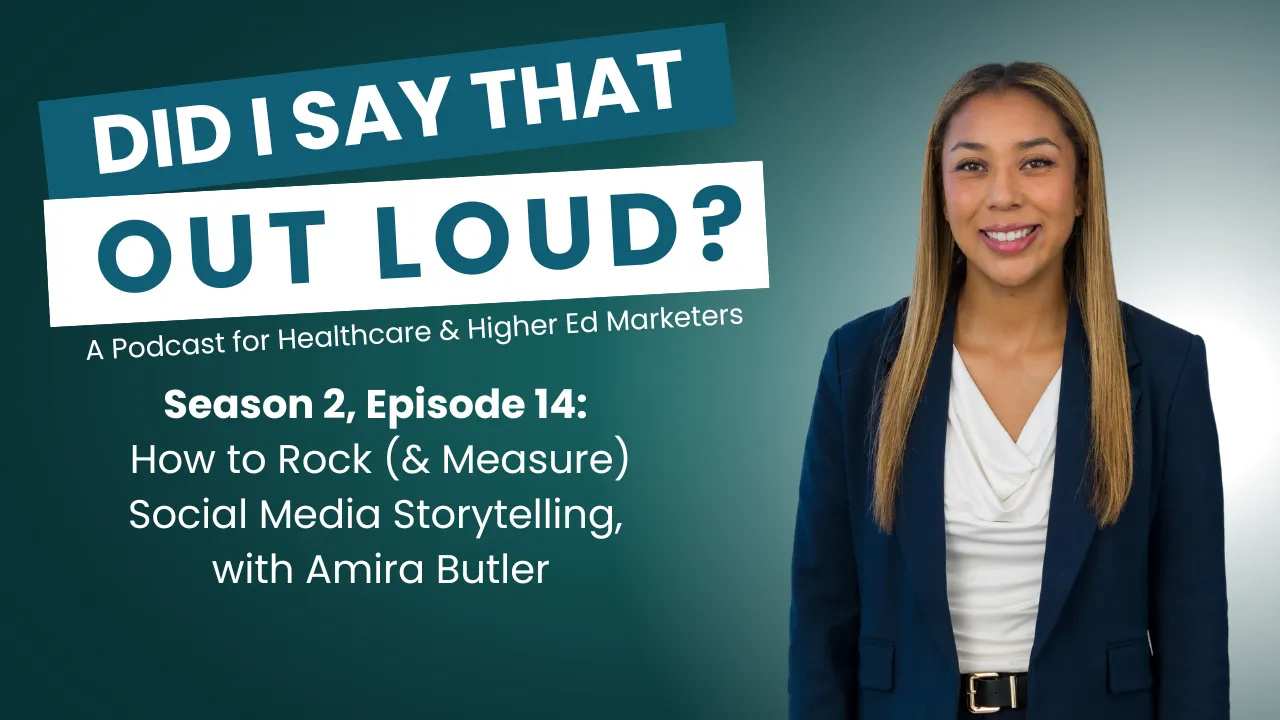
Season 2, Episode 14
In today’s fast-paced, often skeptical social media environment, storytelling has never been more important in healthcare and higher ed marketing. Amira Butler, Senior Social Media Strategist at UT Southwestern Medical Center, joins Mariah Tang to discuss tips for shaping authentic stories, earning the trust of subject matter experts, and how to measure what matters to keep delighting your audience and stakeholders.
Listen to Episode
Show Notes
Transcript
Mariah Tang: Did I say that out loud? Welcome to “Did I Say that Out Loud?”, a podcast where Stu Eddins and Mariah Tang reflect on agency life and answer questions from our higher ed and healthcare clients about the latest in digital marketing, content and SEO.
Mariah: Hello, welcome to Did I Say That Out Loud? We are joined by the fabulous and talented Amira Butler. She is the Senior Social Media Strategist at UT Southwestern Medical Center in Dallas. She oversees enterprise, social media, creative strategy, and data analytics.
So she and her team have delivered more than 200% growth since 2021. Fantastic. And at the same time, advancing communications across 20 plus clinical specialty areas, strategic brand partnerships, and a research enterprise of over 500 laboratories. So, thanks for joining us today, Amira.
Amira Butler: Yes, thank you.
Mariah: Yes, super excited to have you on. We’ve worked with UT Southwestern for a little over 10 years. It’s gone by so quickly and always enjoy working with you. So, thanks for making time.
Amira: Yes, of course.
Mariah: As we kind of chatted about before we jumped on here, this is such a, I’ll be careful how I say this, very strange and spicy time to be in working in academia and healthcare and research, which all falls under your umbrella at UT. And, you know, being in an agency, working with these industries is also it’s just a very sketchy weird time because of all of the changes that are going on, you know, politically and socially and just financially and all these areas of funding and just kind of things are wild right now.
Especially now because of those things, social media and storytelling really have bolstered in importance in my opinion and looking out at the trends that are happening in marketing. Being able to bring science to people in their terms has really never been more important in my eyes. What’s your general philosophy, Amira, about storytelling and social media, especially through that lens?
Amira: Yeah, I think the biggest thing is just like meeting people where they’re at. There’s just so much noise so many things that are circulating online Even on their TVs on their phones constantly and the biggest thing is just like being able to be relatable and breaking things down Without being scary so, you know when you see at least research of like all these different cancer studies or like things that could cause cancer I think a lot of what we do is like trying to make sure that we set the record straight, that while things may have these certain causes and effects, they might also have positives.
And so we try to break through the noise in that way. And also, again, just going back to being relatable. I just think there’s just information overload online right now. And there’s just so many things that people are getting bombarded with. So we try, or I should say we’re trying to kind of meet people there and making it more engaging. So it’s not just, I have to read this long article, whatever, making it engaging, making it interactive, making it fun so that when they are scrolling that hopefully they stay on our post or our stories for a few more seconds longer and then maybe take that extra step to click. it’s just that’s the biggest thing and we also do a lot of analytics on the people who are in our areas that we serve.
So, we have our main campus in Dallas of course, but we also have all of our regional and satellite locations that are all over the Dallas Metroplex, even far North Dallas into Fort Worth and beyond. And so just seeing what those patient populations are like and seeing what kind of things matter to those different groups. So something that parents might care about in Frisco might be different than retirees who are empty nesters that live in Dallas. So trying to make those stories relatable to all those different groups.
Mariah: Yeah, I love what you said about being real and meeting people where they are because there’s such a mistrust right now in science, in healthcare, even in education for so many reasons that we. Don’t have time on this call to go to take, you know, one concept or one really important piece of news and breaking it down across the different channels, you know, taking a bit here, taking a bit there, maybe a written piece, maybe an audio or video piece, maybe a text graphic or infographic, and just making that science and that content relatable. And you and your team do such a wonderful job. I’m always so surprised when I see you know, here’s Amira at a basketball game she is over here in a lab and it’s so fun just seeing this, you know, that familiar face and those that familiar tone across all the different types of science that go on at an academic medical institution.
You know, it’s kind of on the same lines of that. Video is really growing in relevance as a cross-channel SEO media, you know, Google picks up different types of video now. So do and Gemini and all these different AI driven tools. So because of that and because UT Southwestern really crushes it in video just across all of your different ⁓ modes, could you talk a little bit about your video strategy and that mix of media on social?
Amira: Yeah, so we’re very interesting group over here at UT Southwestern where we don’t just only do video on the social team. Like we have a dedicated video team that does the more high production videos that you’ll see that live on our website or maybe even YouTube or if like the ads that you might see like that’s them and their team versus us. We’re kind of the more boots on the ground, getting the real people, know, that are, may not be a doctor or a nurse, but maybe the chef or maybe a nurse practitioner or a music therapy person. Like we’re trying to get the real faces out there that are kind of more behind the scenes in terms of video. So we kind of have that dual front where you have the more brand reputation side that will live on like channels like LinkedIn and YouTube and then you have more of our social friendly content that is a lot more quicker bites and fast information to kind of grab your attention on like Instagram, Facebook, maybe sometimes X. So we work in tandem with our video team and we’re hoping to do even more ⁓ as the years come but that’s kind of how we have strategized video.
Oh, and you mentioned AI, we haven’t dipped our toes in AI. I know some other people that I’ve talked to at other hospitals, they’re thinking about it, but I think for now we’re a human first team and we kind of want to keep it that way just because every one of us that’s either on the social team or video team have all had journalism backgrounds and I think we all just enjoy being able to be in control of the narrative and storyline when it comes to our videos and just making sure that when people watch it, they know that there was a person behind it that was making sure to capture that moment of maybe a patient and the doctor hugging or maybe getting those tears when they’re talking about, you know, a cancer journey or something. And I just don’t feel like you can get that quite yet with AI. It might be useful for the editing process. I still haven’t even explored that. But yeah, we’re completely human first video team for both artificial video team and social team.
Mariah: So interesting that you bring up the authenticity part because so Stamats serves higher ed and healthcare. And we were just talking about this yesterday. Some of my colleagues had been at an onsite event and they were speaking with some students and those students were like, yes, we can spot AI a mile away. We know when it’s being served to us. There’s ways that you can do it well, but like you said, it’s that, it’s that layer of trust. It’s that layer of real human interaction that I don’t think people are quite ready to give up yet, which I’m super glad about as well. ⁓ You know, in our team, we use Riverside, we use CapCut, we use some of those tools to help edit, and it does make it more efficient. But sometimes you just need that human like, everybody knows that that person’s lips were synced to the video or screwing up and starting over and, you know, just being a real human. Absolutely.
Amira: Yeah, and I want to make one more point to ⁓ your point about people do know, I think, at most times, unless it’s like an animated video, that it’s AI. And I think too like, people just want that authenticity. Like we’ve tested the more high production videos and our video team does a great, great job. But sometimes we find that just those quick 10, 15, even 30 second videos that aren’t perfect, the camera’s a little bit shaky. And you just have the people that are saying, ⁓ and a lot of, you know, breaks in their speech, get so much views. And I think people are just craving that in a time where things are just highly overproduced and perfect. People want just that little touch of imperfectness to a place where, you know, you’re bombarded with like influencers and all these brands that are making all this content. People just kind of, again, want something to kind of cut through them.
Mariah: Yeah, absolutely. that I don’t want to label authenticity as a trend, but yes, I’m definitely seeing that that kind of trend towards more realistic, more, you know, human, human action riddled video and content to like, this thing has a typo in it. That probably means a human was involved, which is kind of like, that’s, that’s a relief. It makes my little editor brain hurt. But other than that, it’s a good thing.
Amira: Yeah.
Mariah: So, know, with authenticity and, you know, with just the volume of content that organizations are putting out and need to put out right now, what are some of the other trends that you’re seeing on the channels that UT Southwestern uses for like social media?
Amira: We’ve tested so many different things. It really depends on, I think, the day or what’s going on in pop culture or just in the world. That one day a graphic will do really well, one day this will do really well. But overall, having our people be front and center has done the best for us. And that’s kind of been our strategy, at least on the social side, to really try to make sure that we put a real person in front of most of our content as possible.
Like for the summer, we’re gearing up to do stuff about like sun safety and skin cancer, grilling season and stuff. So typically we might make a graphic that has text on it, but we know that people really like seeing people. So we’ll grab a doctor and get them, even if it’s just their picture and they see that that doctor and we get a quote from them or we can get them on screen for a few seconds just to give like a few quick tips. It tends to do a lot better because that person is recognizable and they have patients and their patients usually love them. And you’ll see them be in the comments talking about how much they love their doctor and how maybe they’ve helped them get past a certain condition that they were being seen for that I think just helps our engagement and I think actually helps bolster our brand recognition so that later people will be like, yeah, I remember Dr. So-and-so, he works at UT Southwestern.
So we’ve actually gotten that quite a bit. We’re out at events that people will see our name and they’ll start talking to us about our doctors. And a lot of time, I don’t know who the doctor is, but I will look them up and I’ll be like, okay, now I know who I maybe I can go ask for a quick video. So it’s been a really good for social but also like having that community outreach aspect when we’re getting content too.
Mariah: Yeah, and I’m on LinkedIn a lot, just personally and also professionally. And it is really fun to see some of the doctors that we’ve had the privilege of working with, like Dr. Sulistio and Dr. Almandoz and they’re always out on LinkedIn. But once in a while, you’ll see something with them on Facebook too, or a YouTube video, and you’re like, I know them. And excited no matter how many times you see them, because it’s like you said, that recognition and that personal connection, like I’ve talked with her and I’ve spoken with him and it’s just kind of cool to connect that offline, online thing, even if it’s a professional relationship versus a physician-patient That clickless world that we live in where you can scroll and see a video, scroll and see an image or read an article is, like you said, connecting not just in Dallas, but in North Dallas and out in Frisco and all of these other areas and nationally, internationally too, with some of the programs there. So when we’re thinking about all of that reach and all of those impressions and all of those engagements, the time for measuring how many of those people came to our website is just kind of like an antiquated look at things. Yes, that’s still important, but now it’s not the only important thing.
In some cases, it’s not the most important thing. So, when you’re looking, Amira, you and your team at measuring the overall success of a specific campaign or a specific type of media, what are some of those key performance indicators that you’re looking at?
Amira: Yeah, that’s actually a really great question because my team and I, put out a monthly metric report to our entire department where we showcase all the usual suspects, impressions, engagements, engagement rate, video views, all of that. We put out the big report that has all the breakdown for that and we do quarter-by-quarter analysis and like followers and whatnot. But I talked with my assistant director and we kind of discussed some things that, you know, sometimes these numbers don’t accurately reflect on how our channels are actually doing or how our content is actually performing. Like something that may have only one or two clicks may have a lot of comments and likes and shares. And so we create this extra little piece that highlights a theme every month.
So, we might look at all the videos that we shared if it’s breast cancer month, we’ll look at all those types of posts. And sometimes if we have stuff that just has a ton of comments, like we’ll screenshot the comments on there and share it with our leaders. And that seems to kind of help show that, yes, while the numbers might vary by post by post, we are getting that engagement. And I think that to our team is a lot more valuable than just seeing the followers or how many likes or clicks. think being able to connect with the people is way more valuable and can translate to real in-person patients than trying to get to 100,000 followers. Because, I mean, I’ve gone on and looked at other organizations and seen them have a million plus followers, but the engagement is as much as our engagement and we on Instagram only have like 16,000 or 17,000 followers so I think just being able to look at the picture holistically instead of just being so in the weeds about the numbers will give you a better picture and kind of tell you how to modify your content moving forward.
Mariah: I love that. mean, we’re talking social media storytelling, but you also implement that data storytelling when you’re speaking with stakeholders and, you know, even with your, ⁓ your physician group. And one of the, one of the things I just love about working with academic medical centers is you get the chance to talk with physicians and nurses and, know, patient facing providers a lot, but you also get to talk with those folks that are scientists, you know, basic, translational scientists, who are generally in the lab and they don’t get to share their stories too often. to tell the story, you know, when you’re interviewing someone or talking with them and they get a chance to talk about their research and their eyes just light up and they’re like, my story. It’s so fun. So I wonder if you, ⁓ if you have any suggestions maybe for folks on marketing teams who maybe are working with a stakeholder or a subject matter expert who hasn’t necessarily had the opportunity to tell their stories too often. How do you get them comfortable? How do you get them talking about what makes them excited about their work or their day to day?
Amira: Yeah, so I typically when I’m interviewing these folks, I get all of the regular stuff that, you know, they anticipate like, what’s their title? How long have they been doing this? What do they do? And I always preface before every, I call it conversations instead of interviews, that we’re going to have these lists of questions that you can prep before, but I don’t want you to memorize your answers but then I’m going to ask a little bit more personal questions and we can go as personal as you want or just stay surface level. And I think that kind of helps break it up.
For our researchers, I love to go back and ask them, okay, you started doing this research when you were a postdoc, what were you doing before? What made you go into this? Was it something in your childhood? And a lot of times they’ll tell me that it’s something like maybe they’re from a different country and they got really interested about this one specific niche type of research. And then they came over here and were recruited by UT Southwestern. And then I get to get into like, why do they love working here so much? What’s making them stay here? And I think that has been able to help tell a better story than just being, hi, my name is, I’m an assistant professor. It kind of helps, like you see their shoulders relax a little bit. I also do the same thing where I tell them like, hey, if you mess up, pause, I’ll cut this up after.
And I think also just logistically, I always try to sit directly behind the camera because I think the camera can be very intimidating. And if you have somebody that’s maybe an early career scientist or even intermediate career and they’re not earning all these super big awards and getting interviewed all the time, it can feel like very intimidating and cause them to kind of freeze or try to memorize their answers.
So, I try to be right behind the camera. So basically we’re making eye contact the whole time and I catch myself saying, oh and yeah, and when I go back to watch it, so I just cut myself out. But I think me responding to them while they’re talking kind of helps encourage. And then again, logistically, the art of silence. Like when they try to give me a short answer. I kind of sit there for a beat or two maybe look like I’m going to get ready to ask another question. And sometimes they’ll feel the silence because people just naturally don’t like that awkward silence and they’ll tell me more. And then I will, you know, ask follow up questions like, that was really interesting what you said. Can you tell me more? And again, I think it just kind of helps them relax and be able to tell maybe some stuff that maybe they initially weren’t even thinking about talking about.
Mariah: Yeah, yeah. And I can’t remember the individual’s name right off the top of my head, but we had a situation like that last year. A scientist who he seemed a little nervous about chatting with us, even just over Teams. And we asked him like, ⁓ what got you into this? When you were a kid, did you want to be a scientist? And he talked about how he actually worked in home demolition with his dad.
And something about that experience led him into the type of science that he was in. It’s like, you just gave me the best hook for this if it hadn’t been kind of like an awkward start, we wouldn’t have gotten there. you know, being awkward on camera can lead to, know, if you have a skilled interviewer like you asking the right questions to really, like you said, loosen them up, get those shoulders relaxed, get the get the stories out that they weren’t, that they maybe didn’t even think were consequential, but were really exciting to the viewer or the reader.
Amira: Yeah, and I think too is that I’m having conversations with these people for a while over email or maybe I’ve done stuff with them in the past and whether I’m interviewing somebody or just even working with my colleagues, I’m a pretty introverted person I would say, but I always try to know at least one personal thing about them or unique thing like a hobby, interest, maybe if they have kids like what are their kids into, stuff like that and I think starting a conversation like that before going into the interview part also kind of helps relax them and I know not everybody has the privilege of knowing those things about people sometimes it could be just digging on their LinkedIn like I saw you went to so-and-so school, like I knew somebody that went there I just think making that personal connection kind of helps again like relax them and they’re like okay this is not just some stranger that’s going to come ask all these questions like now we’ve already started out having a conversation and we can keep that kind of same flow.
Mariah: Yeah, yeah. I’m going to throw a sideways question at you here because that resonated with me. I’m usually more of a kind of keep to myself type person as well, which is weird because I do a lot of public speaking. I do this podcast, know, nobody’s making me do this. It’s fun. And part of my job is talking with people all day long. Why do you think, why do you think that introverts like ourselves end up in these types of jobs and end up doing well in these types of jobs.
Amira: Yeah, I think, not to toot my own horn or anything because you know somebody’s always better at something but I think just my personality like you could ask my two best friends they’ll say that when they first met me I probably said like 50 words but I know so much about them now and I think for me it’s just and I think for a lot of introverts like we’re very good at observing and like learning and taking in information before you know we start talking about things and I think that’s why I loved journalism and storytelling is like just to be able to let others talk and get their voices heard in situations that maybe they otherwise wouldn’t be able to and like being in this patient care health care world I think that that’s been like the most gratifying part about my job is like whether it’s a researcher or a student or somebody in the clinical space.
Everybody’s why is so different. Maybe there’s certain aspects that’s the same, but like every day I’m going home telling my husband like, wow, could you believe that I learned this, this today? Or I’ll brag and I’ll say, yeah, you know, I’m the most ⁓ healthcare person at our house. Mind you, I’m not my brother-in-law is a whole nurse. I say like, I learned how vaccines were made today because I learned this from this person or I learned how to put a tourniquet on somebody. like just having those conversations and just learning. And I think also just being interested, I think people just really enjoy that because again, maybe in any other situation they would not have been able to do that.
Mariah: Yeah, that hits home for sure. I there are days when I’m just like, I have spent all of my social currency. I don’t want to do this. And then I get on the phone with somebody and I’m like, why do I ever think that it’s the best day ever after you get off the phone? Even if it’s a difficult interview, like you’re pulling stuff out of them.
At the end, you’re still like, it’s like going for a run. You get out the door and you’re like, I’m glad I did this, even though it was tough. I think my last question for you, Amira, is we’re hearing a lot of questions and a lot of interest in organic search again, mostly because of these, you know, like AI driven platforms like ChatGPT, Gemini, Perplexity. People are shifting again, their attention to organic on social on all kinds of different digital marketing. So for you and for your team, what advice would you give teams about balancing organic versus paid as you’re trying to reach these different types of audiences, different types of messages?
Amira: I think my biggest piece of advice is like, pick your best hard hitting stories because I think if you just try to do paid for everything, then you’re not going to get the results that you want. I think you just need to pick and choose like what’s something that shows off like your mission, highlights what your care teams are doing, or you know, it’s just a really great piece of content. Like if it’s already performing well on the organic side, then maybe test it out to see how it does when you put some money behind it. But I just don’t think everything needs to be paid and I think you can definitely get very similar results with organic. Give an example, a few years ago my teammate.
She shot a very short but fun video at our medical school commencement and it was right around the same time as the annual Met Gala. So we had the medical students show off what they were wearing underneath their robes and we called it Med Gala and it went viral for us. Yeah, it went viral for us. It also helped that one of the students that year was like an Olympian so like she shared it. So she shared it. We organically were able to put it out to people that didn’t even attend UT Southwestern or was even in the Dallas area.
Like we were getting comments from people like all over the United States, even across the world because again, this Olympian, she played for Team Nigeria. So we were getting people from Africa like commenting and I think just being able to comment and engage with these people, making sure we’re keeping the conversation going also helped. But yeah, it’s just, it’s very interesting because I think with the algorithm constantly changing, you do want to make sure your content is getting out front with like people who may not follow you or even people following you, they may not see your content for like a week or two until after you’ve posted it.
So it is something that we are actively thinking about. But I would also say too is a lot of these social platforms are prioritizing SEO and that is something you can do organically or paid. You can look at what key terms people are using when they’re searching and just try to interweave that into your captions. So if somebody’s like, what do I do if I have a sunburn? Try to enter some of those keywords into your sun safety content. And I think you’ll get a lot more hits that way as well without needing paid, especially if you don’t have a budget. Like I don’t think you should try to pull money out of nowhere and test organic first before you start trying to spend money.
Mariah: Yeah, just like you said, you’re going to see the topics that rise and have that interest and then you can build off of that. But Amira, I could sit here and chat with you about social all day long, but I don’t want to keep you. I’m sure you’ve got another million photos to take and videos to shoot today. So thank you so much for chatting with me. If people want to get ahold of you or follow UT Southwestern, what are a couple of ways to do that?
Amira: We have all the four major platforms plus Threads and YouTube so they can just follow us at UT Southwestern Medical Center.
Mariah: Thank you so much, Amira. Have an awesome rest of your day.
Amira: Okay, thank you, you too.
Mariah: Thanks for listening to “Did I Say That Out Loud?” with Stu Eddins and Mariah Tang. Check out the show notes for more information about today’s episode. And if you have any questions, concerns or comments, hit us up anytime at stamats.com.
Let’s talk
You have questions, we have answers. We will customize a solution that is guaranteed to impress.