Written by
on
September 25, 2026
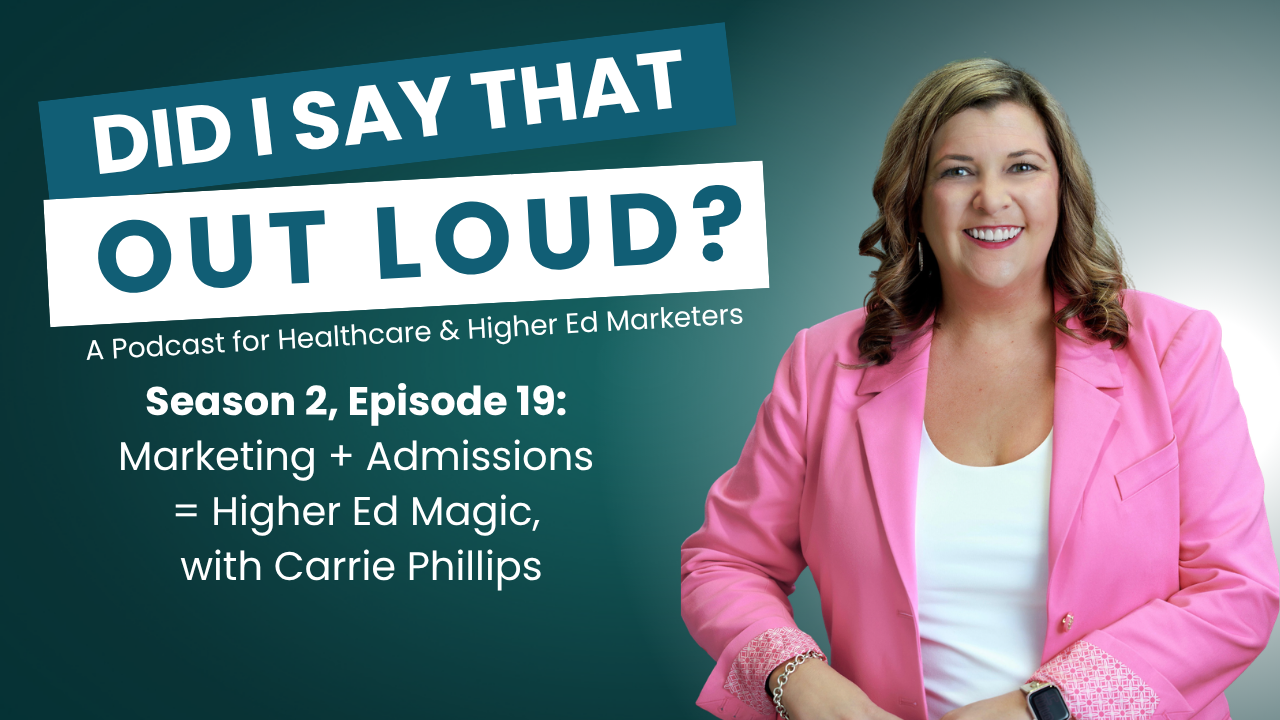
Season 2, Episode 19
When marketing and admissions team up in higher ed, magic happens! Carrie Phillips, Ed.D, APR, shares how to make inroads on this strategic alignment.
Dr. Carrie Phillips is the Chief Communications and Marketing Officer at the University of Arkansas at Little Rock, where she leads strategic marketing, communications, and brand initiatives that support enrollment and institutional growth.
A nationally recognized higher education marketing leader, she is a frequent speaker at conferences including CASE, AMA, and DigitalCollegium and shares her expertise on marketing, leadership, and organizational change. Phillips earned her doctorate from Texas Tech University, where her research explored how universities use marketing to address enrollment challenges.
Listen to Episode
Show Notes
Transcript
Mariah Tang: Did I say that out loud? Welcome to “Did I Say that Out Loud?”, a podcast where Stu Eddins and Mariah Tang reflect on agency life and answer questions from our higher ed and healthcare clients about the latest in digital marketing, content and SEO.
Hi everyone. Thank you for joining us. We have the fabulous and talented Carrie Phillips with us. If you don’t know Carrie, she is a remarkable person in the higher ed space and just in the planet in general. She’s the Chief Communications and Marketing Officer at the University of Arkansas at Little Rock.
And she is also just a dynamic speaker out in the college conference space. So, she has spoken at CASE, AMA, Digital Collegium, and many other conferences. At the University of Arkansas at Little Rock, she leads strategic marketing, communications, and brand initiatives supporting enrollment and institutional growth. Did I sum that up okay, Carrie?
Carrie: You did great and thank you so much for having me. I’m so excited about today’s conversation.
Mariah: My gosh, yes. And it’s so funny how the world works. So I spend a lot of my time here at Stamats talking about content marketing and social media and just the, you know, the connections that one can make out in the world. And so I’ve followed Carrie for years and years on social media, but had never gotten to meet her in person. And so this was very fortuitous. she actually posted something really neat on LinkedIn a while back about putting her information out into a form, looking at a volunteer opportunity, and then not getting some good response. And I was like, yes, we see this all the time, not only in volunteering, but also out in the higher ed space.
So, Carrie, let’s just start there. Could you talk a little bit about that in your personal life outside of your work as a higher ed marketer?
Carrie: Sure. So just background context. I, you know, had a volunteer organization that I wanted to be part of. They had been active in my local community for several years and then had kind of died down and they had some reinvigoration and were coming back. And I was like, this is gonna be my time.
I’ve been looking for some opportunities to be more engaged in my local community. And so as soon as I saw that news, I immediately went, this is for me. And so it was probably eight thirty, nine o’clock one night, and I saw that and immediately went to their form and filled it out. And then nothing happened. And I was so excited to be involved and really wanted to, you know, find this new way to give back to my community.
I was in that moment on a sales cycle, like I was ready to buy. and I didn’t hear anything and it it made me sad, you know, and so I started trying to look at other ways to volunteer in my community since that one didn’t seem to play out. but it was such a missed opportunity to be active and be involved. And it and I had two kind of moments like that that happened back to back. And so it just really drove home that kind of idea that if we’re asking people to fill things out and to tell us information, we need to make sure that we’re doing something with that really timely. I was ready, I get we live in an Amazon world, I was ready to buy. And there was nobody at the checkout counter.
Mariah: Yeah, isn’t that frustrating? And I think I mentioned this to you too. I’ve seen this on both sides because I’m pretty active in our trail running community and road running community. So sometimes I’ll be sitting here at work and I’ll see a message come through for my club and like, I need to answer that. my gosh. And then by the end of the day I’ve completely forgotten about it. And I think that sorry anybody that’s reached out to me, I apologize. But I feel like that happens a lot in our volunteer space but also in the professional space and it’s unfortunate because we have all of these you know tools and techniques and plans and processes in place that are supposed to help that but then you know you get tied up in the day to day and it doesn’t always happen. i do you find that at University of Arkansas at Little Rock that you that you encounter some of those before or how have you overcome some of those gaps yourselves?
Carrie: You know, I think the biggest thing as we’ve thought about gaps is really just trying to ask people, hey, where can we do better? you know, and so I wanna hear feedback from everybody. In fact, I was in a meeting about something we’re launching in a couple of months. and I was in the meeting yesterday and a huge part of that meeting was, okay, how do we create an environment where we get the feedback we want? you know, it’s a a very high touch group and so it’s like, okay, we don’t quite wanna just toss everybody a form.
So how do we curate this environment where we make people feel comfortable to tell us these things? How do we have, you know, individual engagement touch points afterwards to follow up and get feedback? But I think that’s the biggest thing is ask where can where do you see a gap? Where can something be better? And I think a lot of times people are really willing to share that information if they feel you’re approaching it from a place of curiosity and not this kind of defensive thing.
And so I think it’s really important for us as marketing comms, enrollment leaders, when we hear those gaps, to just receive the information and not necessarily react to it. And that’s hard to do when you get feedback to just take it in and not kind of immediately go into that defensive mode. But I think really just asking people from a genuine spot of wanting to be better.
Mariah: Yeah, and I think the model that you have in your institution is really remarkable. We’re seeing a kind of a gravitational pull to this happening, so for the audience, University of Arkansas has this fantastic collaboration between admissions and marketing. And you’ve really formed like a super team of of experts who work together, same goals, same processes, serving the same, you know, student markets in a lot of capacities. Could you talk with us about that, Carrie, and how you got institutional buy-in to do to do this?
Carrie: Sure. So when I started at UA Little Rock about four years ago, you know, there was I realized really quickly there was an opportunity to build really strong partnership and collaboration. You know, when you first start, you go on that road kind of listening to her. And one of the things that I heard from our partners in the admissions and enrollment spaces, we want to more regularly meet, we want to more regularly be part of the conversation. And I was like, you know, is there anything I’ve heard of before? Is there distrust? And it was like, no, we just kind of operated in two different spheres. but nobody had any issue with one another.
And so I was like, what a great spot to start with. we just have opportunity in front of us. And so we’ve started, you know, initially that was just meeting every single, you know, week and making sure that we’re aligned. Now we’ve moved to the point that like we have the sim plan and we know strategically where our focuses are, what are the things that are important. And so we’re mapping advertising to that. you know, and we talk about ways to partner in new advertising in the same way that we would talk about how to improve the experience of a visit. We’re having that around the table with everybody in that conversation, the Marcom folks and our colleagues in the admission space. And so it’s really not this your stuff, my stuff. It’s really kind of ours.
And so we don’t have this true silo that you hear about from a lot of Marcom and admissions teams. A perfect example of that, we’re working on a a new virtual tour right now. Our team wrote the copy. Their folks are loading it in, but like there was never this back and forth. We collaborated on what things needed to be part of the tour. It has been 100% really shared ownership. You know, I sit on the onboarding calls as do the folks in admissions. Like it’s really in lockstep, so much so that when we were working on our institution strategic plan a couple of years ago around marketing and around recruitment goals, those are shared goals.
If you look at our individual component plan, so the Marcom plan that ladders up and the admissions plan that ladders up both of those, we have the same things when we talk about recruitment, when we talk about advertising, when we talk about enrollment metrics, because we work hand in hand and we have to. And so we share those goals together. And that I think is something that a lot of teams don’t go that detailed in their shared partnership.
Mariah: Absolutely. And putting it down on paper, I think just solidifies that commitment for everybody. You know, when you when you’re talking with your teams, when you’re talking with stakeholders, it’s not just this like idea out in the ether. it’s something that you can come back to and say, Here’s this tangible goal, here’s this plan we agreed on, are we sticking with this plan? And it’s really it’s like having that persona poster in the room when you’re working on an ad campaign. Like, is this what Charlotte, the prospective student, would think, you know?
Carrie: So it just gives you that that good grounding. And like you like you pointed out, I mean, when those groups are aligned, it just makes everybody’s lives easier. It makes the students experience easier, makes that whole enrollment journey just more streamlined and simplified behind the scenes. Like the maybe the students don’t even have any clue that this is happening, but they can feel the difference if they’ve worked with other institutions.
You know, I think students experience the university as the university, whether that is the MarComm team, the advancement team, the enrollment team, the athletics team, to them it’s the university. And I think our community partners are very much the same way. And so the more internal alignment it is, the smoother that experience as the university is for whoever that audience is. Even though behind the scenes sometimes there’s a lot of coordination and a lot of hard work that goes into make sure that that experience is as seamless as it can be.
Mariah: Yeah, absolutely. Absolutely. When you do that type of work when you’re running in parallel with these teams, it’s understandable when gaps occur because we’re all human beings. A lot of things are getting automated, but not everything, thankfully. when those gaps happen, how do you how do you identify them quickly? How do you co work as your separate work units that are that are together to really close those gaps and make it into an opportunity?
Carrie: Yeah, I think the big thing is that it has to start before there’s ever a gap. One of my best friends works in emergency management and she always has a saying that you should never be passing out your business cards at the staging scene for a crisis. And I kind of think that same thing applies here. You know, if there’s a gap or something that’s shows up and exists.
If you’re first having to learn how to work with that other team and how they do things, you’re already behind the eight ball. So it’s really important to already have relationships, already have trust built, already know how one another work in this space. And so then it makes it much easier to just go in and and kind of say, okay, here’s the issue. How are we going to tackle this together?
And so that’s one of the things that I talk about. I have our four As. So we have advancement, we have admissions, we have athletics, and we have academics. And so those are the folks that we on the MarComm team meet with regularly and are trying to work with and make sure that we’re aligned and make sure that we know how we best operate together. And so it makes those gaps much easier to solve and to get ahead of. And I think the other thing is really about assessment. You know, I love this idea that we’ve never arrived. We can always be continually improving.
So we try to do what we call stop, start, continue. So when we do projects, what are the things at the end of that project we’ll sit down and say, okay, what are the things we need to stop doing? They didn’t work well or they spent a ton of time and maybe we didn’t get a whole lot of value for them. What are the things that we need to continue? You know, the the adage, if it’s not broken, don’t mess with it. And then what are the things that we could start? And so after you do that a couple of times on projects, people start to kind of think about that throughout the cycle of that thing.
And so all of a sudden you’re thinking throughout it, how could this part be better? How could this part be better? And so what I find is that makes it really fun to come in and continually innovate, but that also sometimes helps you solve those gaps because you’re already thinking throughout the entire thing, how could we make this better?
Mariah: Yeah. Yeah. I love that. And I think that that agile process of identify, update pivot is so important, we work with a lot of smaller community colleges with lean teams. And so for those folks who are listening who maybe feel like, this is great Carrie, but I don’t know if this will work for my team because it’s me and two other people. What are some ideas that you could share with those groups that they could really start this across the aisle type collaboration?
Carrie: I think the first thing is reach out. You know, find who is that partner that you need to partner with and reach out to them. You know, make the time to go have a cup of coffee and talk about how can we work better together and and build that plan with them, I think is kind of the first thing. And then I think the second thing is stay the course. you know, change takes time, change is scary. And so if you’re going from working in complete silos to really trying to build this intersection moment, that’s not gonna happen because you as a leader and the leader across the aisle said, we’re gonna do this.
Like that takes time to build that into the culture. I was at a prior university and our admissions team and our mark on team did not work well together. in fact in it felt like sometimes both sides were guilty of almost having animosity at one another. and so that leader and I decided we were gonna solve this. And so we did exactly that. We reached out and had that conversation. It took a good two years to get the rest of our team on board and and lined up and dialed into that culture shift we were trying to create. And that was two years of meeting every single week.
So I think sometimes it’s gonna take time to do it. And so I think we can do it sometimes and we think, it’s not working and we give up. But the reality is we just gotta keep doing it and keep doing it and keep doing it. And eventually there’s that moment where it starts to click and you see, yes, this is gonna work. So I think my two things would be reach out to start the conversation and then stick with it.
Mariah: Yeah. I I mean that’s golden advice too. And like you like you said at the top of our call today, we have this immediate gratification, immediate expectation in our society, just like all parts. And I will admit I have been guilty of that, like, okay, we tried this thing that I didn’t really want to do and it didn’t work, so let’s move on. But when it’s something that you know.
Carrie: Right? We all do it from time to time.
Mariah: Yeah, like and when it’s something that you know is worthwhile, I mean that’s one thing I’ve…this my LinkedIn moment for the day. One thing I’ve learned about from running and how it applies to my business, but like the if it’s worth doing, it’s going to take time. You’re not gonna wake up one morning and just be able to run 20 miles. It takes that incremental progress and getting something as historically, I guess, siloed as admissions and marketing on the same page.
I mean, that’s a huge undertaking and one that you and your team have just excelled at. So there are so many questions I want to ask you, Carrie, but I can’t keep you very long on a Friday here. So if you had maybe three to five pieces of advice for higher ed marketers looking to improve their internal communications, those relationships that you were just talking about, what are a couple of easy ways for them to get started?
Carrie: I think one is I love this idea of two degrees of change. So every time I do a project, I try to change it two degrees. So think of and I’m gonna use a view book because that’s really a tactical kind of thing that you can see this. So maybe year one you really work on we’re gonna update all the copies so it’s in, you know, the right tone, it speaks to our brand tone. Then maybe year two, we’re gonna get great new imagery.
Then year three, we’re gonna kind of shift the look a little bit. And so over time, you craft this entirely new thing, but you don’t give anybody heartburn because you threw the baby out with the bathwater and did it all at once. and so I think that’s a really good way to every time you do a project, what are the one or two things that we can do to make this better, this go round? And all of a sudden you’ll find that you make big shifts, but you’re able to bring others along board with you. And I think that’s really important.
I would say another piece of advice is own your own sphere of influence. You know, I think sometimes if especially as we’re middle leaders, we are wanting something from the top down, and that may or may not come, but there’s a lot that you can do to build collaboration, to build partnership within your own sphere of influence. So do that with the spaces you can and then manage up as you’re able to help others see that value. and I think the third thing is be a little scrappy.
You know, I I love the tools and the tech that are out there, but I also get being having worked in really small shops before, sometimes you just don’t have those resources to buy those things. And I was, you know, really determined that we were gonna do personalization and we needed to really lean into that several years ago. And we had no money for a CRM. So I got into the the spreadsheet exports and figured out how to do it and worked with a print partner that could help us do it.
And we did massive amounts of personalization without a CRM. But it was really we just had to figure out a different way. We couldn’t work from this scarcity mindset. We had to get a little scrappy. And I think that skill is really important as well.
Mariah: Well absolutely. And I think that resonates so much because even at some of our partner organizations that are that are in that larger market space, just the budget considerations and things that are that are new in the last three to five years and will probably continue for a few years have made all teams have to get a little bit punchier, a little scrappier. Carrie, before I let you go today, is there anything cool that you and your team are working on that you want to give them a little love for?
Carrie: Yeah, you know, I am really proud of our team. We started in July at UA Little Rock celebrating our centennial year. and so what a special moment to be part of the institution and to get to do that work. And so we’re really proud of that. Our enrollment numbers, we are continuing to push that. A couple of years ago, we stopped a 13-year enrollment decline, and so we’re on the upswing there and so proud of that work. And then personally just really love getting to talk about higher education, marketing and leadership on my website andcarrieon.com. So all great things that I’m really proud of.
Mariah: Amazing. Well Carrie, thank you so much for your time. It’s lovely to chat with you and hope to get to run into you at a conference in the next couple of years.
Carrie: Yes, I hope our paths cross soon. Have a great day. Thank you again.
Mariah: Take care. Thank you. Thanks for listening to “Did I Say That Out Loud?” with Stu Eddins and Mariah Tang. Check out the show notes for more information about today’s episode. And if you have any questions, concerns or comments, hit us up anytime at stamats.com.
Let’s talk
You have questions, we have answers. We will customize a solution that is guaranteed to impress.