Written by
on
By Sandra Fancher and Christopher Lott
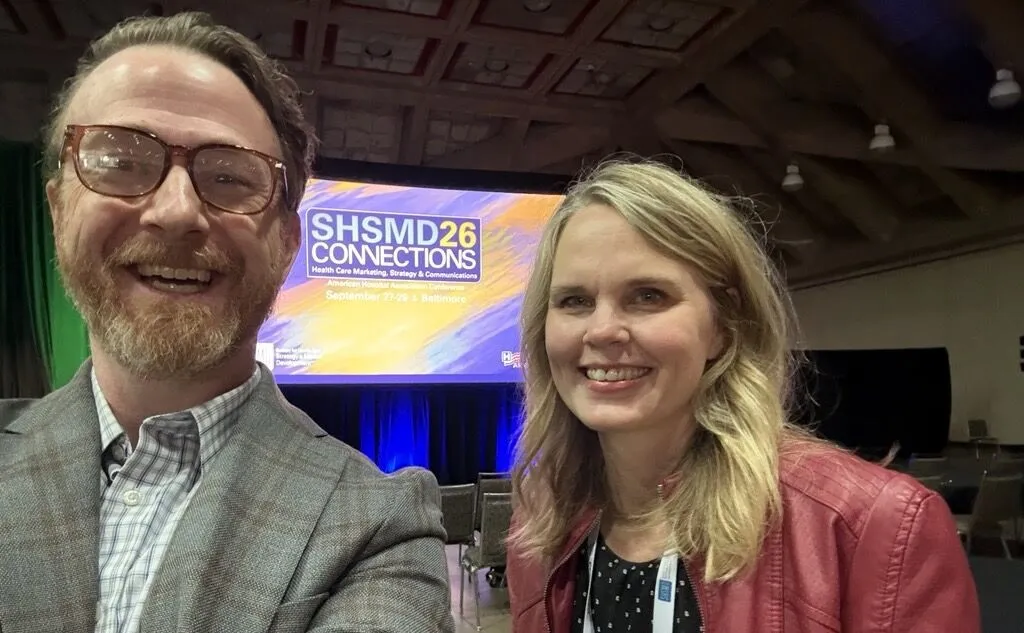
AI has dominated seemingly every marketing conversation for the last few years, but we noticed something different at SHSMD Connections 2026 in Baltimore, MD: People were talking about people again.
AI was still a big topic, of course. We attended sessions about AI recommendations, digital experiences, authenticity, and how emerging tech is changing the way patients find and use healthcare information.
But so many of those conversations came back to questions healthcare marketers have grappled with for years:
- How do we earn trust?
- How do we make room for new ideas while protecting the brand?
- How do we create content that’s genuinely useful for patients?
That was fitting for a conference designed around the challenges facing leaders in healthcare strategy, marcomm, and growth.
Here are four ideas we brought home from Baltimore that will continue to inform our work and how we help our clients answer those important questions.
1. As AI Grows, Authenticity Matters Even More
Some of our most interesting conversations about AI moved beyond what the tech can do. Instead, people were asking where and when it belongs in healthcare marketing.
In sessions and keynotes, we heard about how human experience is central to growth and trust. Presenters and attendees explored those connections and their role in communicating with patients, families, employees, and the community at large.
For content marketers, authenticity becomes particularly important when we can generate such large volumes of information quickly with technological help.
Healthcare organizations have something that generic content can’t replace: the expertise and experience of physicians, researchers, nurses, and other subject matter experts. Interviews can bring that experience directly to patients, answering real questions with insights grounded in years of care.
Remember, an interview doesn’t have to end with an article. Short videos and other formats can let patients see and hear directly from clinicians, adding a recognizable human voice to the expertise behind the content.
The result? Original content with a point of view, not a summary of information already available online.
What you can do now: Look at your recent clinical content and ask a simple question: Where is the human? If you could substitute any organization’s name and the content would still work, you’ve uncovered an opportunity. Work to make that content more specific to the people and expertise that set your organization apart and leverage it across every channel you can find.
2. Make Room for Small Risks
SHSMD 2026 opened with improv. And yes, it makes so much sense.
The Sunday keynote, The Improv Playbook: Taking Smart Risks and Adapting Fast, explored how listening, trust, rapid response, and recovery can help teams make decisions even when the outcome is uncertain. These concepts were reinforced in a follow-up session on Monday, and the ideas have stayed with us because of what they tell us about the work of strategy.
Healthcare organizations will always need long-term strategic plans, but marketing tactics sometimes need to move faster.
That doesn’t mean betting a year’s budget on an untested idea. We’re calling these “mini-risks”: Identifying relatively small opportunities to step beyond the way it’s always been done, see what happens, and adjust from there.
For example, your team could:
- Try a more casual approach to short-form video
- Tell a familiar patient or provider story in a different format
- Speak up for an idea or point of view that challenges the way your team has always done things
- Test a content adjustment with a limited audience before applying it more broadly
A small test won’t always work. That’s part of why keeping it small is useful. You and your team can learn something new and potentially impactful without making every new idea an organization-changing commitment.
What healthcare marketers can do now: Think about an idea your team keeps discussing but hasn’t tried yet. Is there a version small enough to test without a long-term commitment? Give yourself room to experiment, use what you learn, and decide what comes next. And don’t be afraid to “mini-fail.” There’s lots to learn.
3. Make it Easier to Create Content Without Losing Control
We heard healthcare marketers talk about the challenge of balancing increasingly accessible creative tools with the need to protect the brand.
You no longer need to be a designer to make a polished graphic, and you don’t need a production crew to shoot a video. That opens a lot of doors for organizations where expertise is decentralized across service lines, clinics, or hospitals. But tools like Canva and accessible video production platforms also mean more people can create public-facing materials, making clear brand guidance even more important.
Trying to stop that creative impulse isn’t much of a strategy, so how can you tap into that energy and opportunity without brand risk? Give people the tools, training, and boundaries they need.
Templates and workshops can help your team members understand what they can adapt while protecting those sacred brand elements. So they know where to find a PNG of your logo—and why they shouldn’t stretch it out.
Clear answers make it easier for more people to contribute without leaving a mess for the marketing team to clean up later.
What healthcare marketers can do now: Look for an area where content creation is already happening outside the central marketing team. Make sure those creators have useful templates, clear standards, and enough guidance to represent the brand consistently.
4. Search is Changing, but the Fundamentals Still Matter
One thing we were listening for at SHSMD was how AI is changing search for healthcare organizations.
Traditional SEO hasn’t gone away, but patients have new ways to look for answers, and the content they find is changing, too. Video is an increasingly important part of that mix. So we’re thinking beyond how an entire webpage performs to consider how individual answers, video, or other content can help people find the information they need.
In conversations in sessions and the exhibit hall alike, the reality on the ground reinforced what we’ve seen in our own work: Good healthcare content starts with understanding what people want to know.
That still means article content that answers patients’ immediate questions and thinking through the follow-ups that matter to them. It means interlinking to connect people to relevant content elsewhere on the site. And it means looking for opportunities to bring useful answers to formats such as video, podcasts, and social media.
What healthcare marketers can do now: Pick an important question and examine the content you have available as an answer. How quickly can someone find the answer? What will they wonder next? Make sure your content zeros in on those needs you’ll create a stronger foundation for SEO and AEO.
What We Brought Home from Baltimore
Despite all the expertise gathered at SHSMD, nobody had a roadmap of exactly where AI, search, or healthcare marketing will be a few years from now. We certainly don’t. But just because we don’t have all the answers, that doesn’t mean we’re standing still.
Healthcare organizations already have many of the most important ingredients: knowledgeable people, valuable stories, established brands, and marketing teams that understand their patients and communities.
The opportunity is to use emerging tools to improve the experience and deepen engagement for patients. Because after all, that’s who the technology (and our work) is intended to serve. It’s a challenge we’ll be thinking about and working through with our clients well beyond the conversations that began at SHSMD 2026.
Let’s Keep the Conversation Going
How is your team approaching AI, search, content, and brand strategy? Get in touch to plan your next step.