Written by
on
February 6, 2026
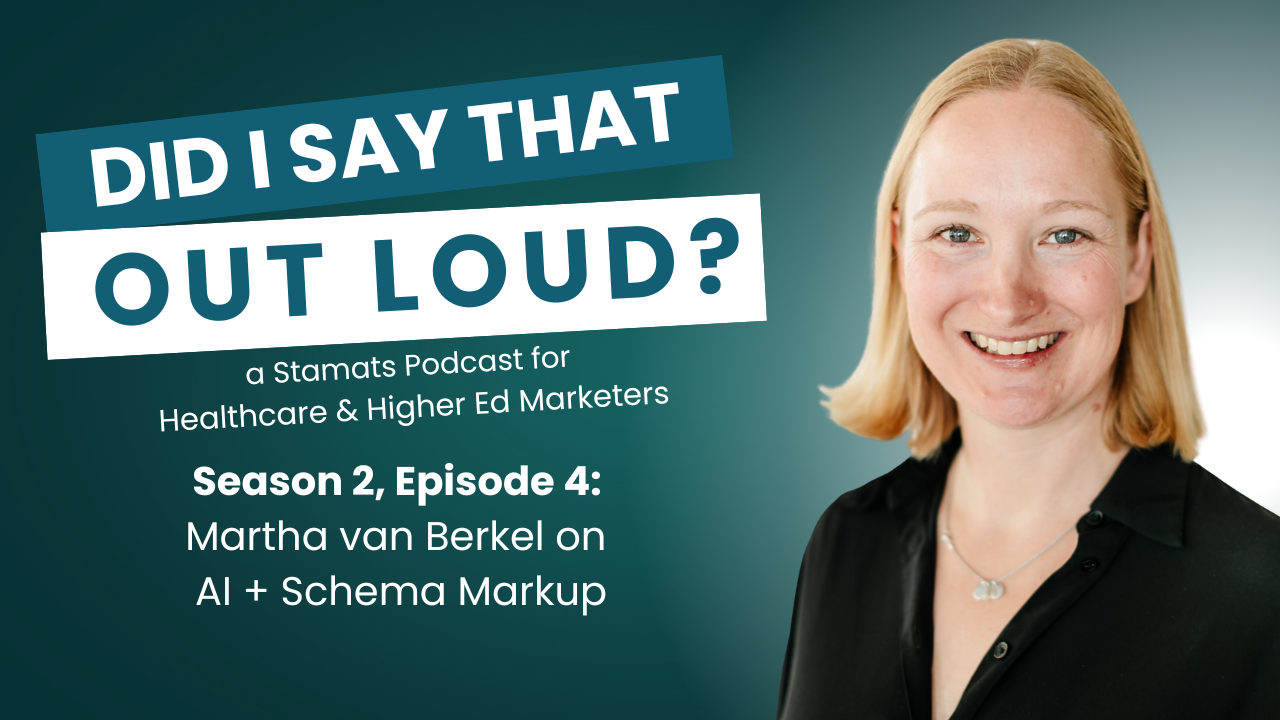
Season 2, Episode 4
Martha van Berkel, CEO of Schema App, drops hot takes on SEO, AI, semantic technology, and the future of web content in this episode of Did I Say That Out Loud? with Stamats friends, Stu Eddins and Mariah Tang.
Listen to Episode
Show Notes
Transcript
Mariah Tang: Did I say that out loud? Welcome to “Did I Say that Out Loud?”, a podcast where Stu Eddins and Mariah Tang reflect on agency life and answer questions from our higher ed and healthcare clients about the latest in digital marketing, content and SEO.
Mariah: Hey, everybody. Thanks for joining Stu and me again. Thanks for coming back. We have a fantastic guest today, Martha van Berkel, CEO of Schema App. Schema App is a semantic technology company that leverages advanced schema markup to build content knowledge graphs for enterprise marketing teams. Martha is going to talk to us about what that means. She focuses on helping marketing teams globally understand the strategic value of Schema markup and thrive in an ever-evolving digital landscape. And outside of Schema app, she’s a mom of two and she’s an avid rower. So she’s all around awesome. Martha, thanks for joining us.
Martha van Berkel: Thanks for having me. Super excited to be here.
Mariah: Yeah, yeah. We were just chatting before we flipped on the recording about how all of our worlds have connected over the years. So, Stu and I have worked together, you know, tangentially over the years at various agencies. And then Martha is, if anybody is listening to this, they know this.
She’s a prolific speaker on a lot of the marketing circuits in higher Ed and healthcare and all across the board. So that’s where I have been fortunate to cross paths with Martha over the years. So we put together a few little questions here to run through with you, Martha. But as any of our listeners know, Stu and I tend to get off the rails and go on different tangents. So maybe let’s just start with the top. Would you give us a, you know, just an intro of how Schema app became to be? What’s your origin story, Martha?
Martha: Oh, where do we start? Well, it all starts actually with my co-founder, who’s a semantic technologist. And semantic technology is like kind of finally having its day now that AI is there. So semantics is really where you define relationships and context in things. And while most people know schema markup from like sort of like search engines.
Understanding things we started because it was a semantic technology. So schema.org, the vocabulary that sort of is the basis of schema markup was really defined with this idea of understanding and bringing context and relationships. And so my co-founder was looking for a nail to hit with his semantic hammer.
And so we sort of discovered schema markup and we started back in this like 2013, 2014 was when we were first kind of exploring schema markup, when we first built our editor, which is really great for authoring sort of a single page. But we were really both of us had grown up in enterprise. I grew up at Cisco.
Were really wanting to say like, how do we do this at scale? And so then we sort of evolved our work. I grew up at Cisco, so I spent 14 years there sort of doing a bit of an intrapreneurial kind of lifestyle. So I was asked to kind of solve hard problems and got to start organizations and I think it was really my.
Safe training to being an entrepreneur so that when Mark, my co-founder, was like, hey, I want to go solve this problem and figure out how we do schema markup at scale. I was sort of in and it was like, OK, this is an adventure. And I always think of my parents weren’t super excited for me to leave sort of the big corporate life and sort of start out.
Kind of from ground zero, frankly, but it’s been super, super fun. And now we’re a team of 45. You know, we work with some of the largest organizations in North America and the schema markups now important, right? Back in 2013, no one cared about it. Maybe just you and the team.
In your previous teams, but people now care. And it’s because I think of the reason I mentioned the semantic pieces. I actually think that plays a more strategic role than people just thinking about search now that we’re in this AI world.
Mariah: Yeah, it’s remarkable how things have changed. Like we talk sometimes about I I started at A at a previous agency around in 2015 and it feels like a million years ago in technology terms, in content terms, in semantic terms. It’s just really wild. Stu, were you gonna say something? I’m a good interrupter. That’s how I roll.
Stu Eddins: Oh yeah, I’ve been looking forward to this for like days and weeks now. The plain fact is there’s not a lot of clarity on things like schema markup and how it affects the AI world. In fact, it’s real fun because if you ask one of the AI tools chat bot, you ask it.
Martha: Yep.
Stu: I get the question on Monday. You asked the same question on Thursday. How does schema markup help you? You’ll get two different answers. So the there’s a little opacity in exactly how schema can help. I’ve seen it. I’ve seen it. I’ve seen the benefits of all of it. But I hope during this conversation we can uncover some of that. That would be very helpful.
I’m a convert. I believe that this is something that websites truly need and it may be the most technical thing they have to think about, but it’s good to have a partner vendor that can think about it for them so.
Martha: Should I define what schema markup is like just from the basics?
Stu: Please do that, yes.
Martha: I think that’s always a good start. So especially if you’re like a more senior person, you’re like, what’s this thing? So I always like the way I explain to my mom is like basically it’s a vocabulary that translates what sort of is in the human web experience into like a.
Language machines understand and so this schema markup or people also call it like structured data. Structured data to me is a bit generic because lots of things can be structured data, but it uses this standard vocabulary called schema.org and it allows you to describe things and its relationships to other things.
And it’s the relationships to other things that I think is actually where the benefit to AI comes from and most people know it as the outcome of it. So if I was joke about like if you’re searching for a new pair of shoes or maybe a snow blower, it’s winter here in Canada and you see star ratings in the search results.
That’s actually because there’s schema markup on that page giving confidence to Google that like this is the rating, this is the star rating and then it it shows this what’s called a rich result. And so that’s still valid and those rich results still drive a higher click through rate today and higher visibility in Google search, but it really now is also playing a role in.
Understanding. So when we translate it into this kind of common vocabulary, this like structured way, the machines have confidence. And recently I was speaking at a conference in North Carolina and I was the gentleman from Microsoft who manages Bing.
Was talking about you know actually the entire kind of AI process and how they look at data and they were saying they were they’re using schema markup as sort of a guide or a pointer to introduce confidence to give the right answer. And and you know what’s interesting is like Google and Microsoft since May have become very.
Very vocal about structured data again and I say again because like it’s it hasn’t really been since like 2023 November 2023 after they retired FAQ and how to they kind of talked about it more and then prior to that it was really during COVID 20/20/21. I watched these things. My business is building schema markup at scale and part of this.
They’ve started using language of like, it helps us understand, it helps us have confidence. And most recently in November, when Google talked about a Google Search Console live, they actually talked about efficiency. And I do think this is something that’s really interesting with regards to sort of Google and Microsoft who’ve been sort of, I’ll say, like translating and understanding.
The web at scale more than the perplexities and ChatGPT, etcetera, right? Like they’re the newcomers, they haven’t sort of figured out the at scale play and both Microsoft and Google is saying like it helps us understand it and do it efficiently. And I think when we think about like the cost of understanding and doing inferencing, which is like even.
A higher level cost than what we previously had in being sort of answer engines. You know, efficiency and cost effectiveness is actually very important. So I really think part of the reason why these, you know, large organizations care about this in this new world is, you know, they’re trying to be as efficient as possible and if they can put.
The burden on the marketer, on the brand in order to give them sort of a data layer that they understand that to me makes total sense. It’s not that different sort of than how we’ve been operating for the last decade. And so I see schema markup really as that data layer, right. So that data layer that allows you to control how your brand is understood in sort of a machine language. That helps them also do things efficiently. And I have some data on like how we’ve seen it impact AI overviews, how we’re seeing it sort of impact sort of brand visibility across different functions where we can measure because there’s lots of things that we can’t measure today.
Stu: Right, right. Yeah. And I think that you hit a lot of key points in what you just discussed. We started out using schema, and in in particular your product, back when we were trying to rate put doctor rating stars inside of inside of search results.
Martha: Yes.
Stu: That was our first use of it. And from there it became the other things like the other rich content that was being used. You mentioned a few of those. Yeah, yeah. People also asked, you know, it was getting involved with more than just the blue link in search.
Martha: No, FAQ was super responsive, like super popular.
Stu: We actually saw at that time an immediate improvement in performance for having it and that reward was there for a while and then it became kind of daily stuff. It was, it was kind of expected to some extent. I’m very interested in the fact that they are talking about it as aiding efficiency for AI.
A part of me has suspected, and maybe you have an opinion on this, that if I have two pieces of content out there that are essentially the same, the one that has schema markup has more credibility to the to the AI tool and will probably get cited more often than the one that does not. That just feels like the direction it’s headed. Does that sound like a valid thought?
Martha: Yeah, the language that I saw, the gentleman’s name escapes me just for a second that from Krishna Madhaven actually is a gentleman from Microsoft and he was actually talking about that word trust in sort of how he was describing the overall sort of workflow. He was saying that they’ll look for schema markup to help build confidence in sort of what the page is about and what the brand is about. And I do think like one of the things I’ve been sort of looking at a bunch is a lot of people are testing like how single pages perform. But what’s really interesting is that the way that people are interacting with your website is less sort of about a single page and more about like a system of information. You know, the questions I might ask from a healthcare perspective is like, hey, I’m looking for a Doctor Who takes this insurance, who specializes in this, you know, specific type of condition.
Who is within 5 miles of where I live? You know, all that information, if you’re a hospital network, is on many different pages, right? And so it’s not just then about optimizing the page, but connecting the dots between them. And so when we think about schema markup, we’re actually connecting those dots like very specific.
So if we think, I love your example of a physician page, you know that physician practices at a hospital, OK, that gives us the location. You know this physician has this specialty. So that might give me confidence in sort of you know what they service or it might be like it offers these services, right. So you have like your medical conditions or your service pages that are linked again to that physician page, but have much more detailed information that would give the robot confidence and sort of what that is.
And so now we’re as we’re answering these, you know, and the prompts now are like 700 words, right? Like these aren’t sort of like keywords like we used to do in search, right? It’s much, much, much more detailed. And so the way I think about like I’ll say advanced schema markup. And when I talk about a content knowledge graph, it’s actually when we sort of optimize a page and then connect the dots through the schema markup to define those relationships.
And I think it’s that, Stu, that’s actually building the true trust because the answering of that question comes from, again, understanding all those connections. And we’ve been doing some testing on, you know, even sort of like deepening the connections. I would say like a lot of our product investment over the last two years have been around, we call it connecting entities or like you know, being able to connect sort of in a more advanced ways, making the graph more robust would be ways that I talk about it and we’re seeing that move the needle.
We’re seeing it sort of drive higher clicks, higher click through rate, you know, when we sort of like build that sort of like data system in sort of a more robust way.
Stu: Right. And most of the AI interactions I’m seeing don’t lend themselves to the model of ranking. It’s not like search where I rank on page one or #3 on page one and so on. So I can imagine where the AI tools themselves. It makes it easier for them to not offer what might be a hallucination or an incorrect answer.
Martha: Yeah. Well, exactly. And we have seen it solve hallucinations. So we actually published a case study with Wells Fargo where Google AIO was referencing this super old article. It was like 23 years old about and saying that this location was closed. So it was like a significant problem and we basically just added schema and connected it with the rest of their schema markup.
And within like that next crawl, Google was pointing to that direct page. And so again, this is where I think like connecting all the dots is important. And you know, one of the questions, Mariah, that I saw that you had asked was like, you know, historically, Stu, when we worked, you know, 5-6 years ago, we would look at like look at converting pages, right, as a priority for what to optimize the schema markup. Now we’re telling the brand story. So now if there’s pages on the website that are important to tell your brand story, which is most of them, right? Like you shouldn’t have too many that aren’t really part of that. We’re now looking for coverage because we want to make sure that like any question or context that we need across the brand is sort of connected and understood. And what’s cool is that when you also build this schema markup in A and I say like with a semantic technology company like us versus just thinking of it as an SEO tactic, you can now port that knowledge graph and reuse it.
So this is like some of the stuff that we’re testing now. So on-site search right now that MCP is a model context protocol which is like an API for AI schema app house and MCP connector. Now you can now connect it to any of your on-site search your chat bots you can use and now you have this like structured data source.
Which was really interesting because Gardner called out in like, I think it was like the report in February that CIO’s biggest problem with actually realizing benefit from doing the AI initiatives was data readiness. And so for marketers, good news, if you’re doing structured data and working with an organization like ours, that’s like building it in a portable sort of standard knowledge graph like now that that data can be reused and portable in really cool ways. So that’s like another area that we’re excited about.
Stu, there’s something you mentioned and you’re on to something I want to kind of. So you talked about like how, you know, like it brings them confidence and then also how search engines, it’s like more than just blue links. Could they use it to train is sort of where my brain went. So Microsoft announced last May. OK, the timing of this was so interesting. So Google and Microsoft start getting on stage in in early May this one week and say, oh, that like, yes, start using structured data. That same week they announced something called NL Web. Have you heard of NL Web yet?
Stu: No.
Martha: OK, this is super fun. So NL Web, the leader of NL Web is RV Guha. RV Guha was at Google for 20 years and he created schema.org. So he’s the guy that started Schema Markup. He’s also known as the creator and founder of RSS. So he left Google, went to Open AI for about 6 months and then ended up at Microsoft. He now works for Kevin Scott, the CTO. And what NL Web is, is basically a conversational interface for your website in order for you to sort of almost like have a built in chatbot.
Now what they’re trying to do is also prebuilt-in for the agentic web and do it in an open source way. So this same interface that you can use sort of as a chatbot, it’s on the schema app website, so if you want to go try it, you can try it is also going to be the agentic endpoint for websites. Guess what they’re using to train it? Structured data and RSS
Stu: Structured right, man. OK, yeah. One thing I’ve been, I’ve been thinking about it where I think schema is going to be very helpful. Even starting now is getting your getting the data you have structured in such a way that a non website application of your online data becomes second nature. I I I’m kind of excited because I look at something like a notebook LM which can take anything I give it and turn it into a video, a slideshow. But I’m think but I’m thinking if I have on my phone my personal AI agent.
Martha: Yeah, I love it.
Stu: And it knows that I assimilate information best as a slide presentation and I ask it a question. Rather than delivering me to your website, it’s going to take the data that’s there, put together with structured data and pull it into a slide deck for me like that.
Martha: Absolutely.
Stu: That it helps me get the information I want. That’s years and years away, probably, but.
Martha: So NL Web is looking to be like an agentic interface for that and it’s what’s cool is it’s got an MCP server built into it and it also is like has an orchestration layer, right? So we’re testing it and sort of looking to be early adopters of it because it’s like.
If we could help our enterprises then be ready for the agentic web and do it in an open way that allows lots of different applications to interact with it. And we have all the data, so we’ll just actually integrate directly into NL Web so that like that becomes sort of ad hoc.
This then sort of not just prepares people for Google search, for AI search, but now this like next sort of piece where people are just going to, you know, I really think like, I thought your example was great, right? Like we’re gonna have like a personalized way. Whether it be verticalized or task based of ways that we want to interact with with data and so the data layer then becomes sort of your interface.
So Schema App’s like right in the middle of that. Like I said, we’re we already have MCP, so people can integrate it internally. NL Web’s on our website. We’ll be actually putting NL Web into schema apps so people can test and see what it’s like from an interface perspective. And then again, we’ll be looking to help our enterprises like be early adopters of that to be ready.
Stu: And my thoughts are also going toward headless CMS and using schema to organize the data necessary for that.
Martha: Yeah. And we see Drupal kind of going in that direction a little bit like like they were interesting. We work with people who use Drupal and they’re like, oh, Drupal does schema. I was like, well, yeah, if you want to rewrite your whole content kind of vocabulary to be on schema.org, which most organizations aren’t going to do. And so you kind of still need that sort of like middle layer, right? Going to take your content at is, build that out and then be able to kind of go from there.
Mariah: Can I interrupt the flow of genius for one moment? My eyes are going. This is all amazing and I and I love it. I I know we have a subset of individuals who are like, you know, high level content people, marketing people and so forth. Can I ask for just a high-level definition of what you mean by schema versus what you mean by structured data.
Martha: The same thing. So it’s like and I would say like in the context of what we’re talking about, they’re the same thing. So if you’re saying schema markup or structured data in the search context, now let’s take it out of the search context just to kind of be really pragmatic. Like a schema can also be how you define a database, right? So this is very different, right?
This is a vocabulary that we’re applying, sort of like where we’re defining relationships in a standard vocabulary. Structured data, also to be pragmatic, could be like a table of things, right? So that’s actually why at Schema App, we primarily use schema markup. So those two words together because it’s much.
More specific and sort of for a sort of strategy that’s about being specific and adding context like that’s important. I thought you were going to ask though was like how schema plays in with content writers because there is like a really sort of key play here and it’s relatively new. So people will talk about like in the last year.
SEO has become like a thing.
So the way I like to describe an entity versus a keyword is it’s sort of multidimensional. So like if I were to describe a shoe like you can all picture like a different shoe, but like an entity is like a hot pink 5 inch pump, right? That’s made out of satin, you know, like it’s giving me all kinds of different information that’s allowing me to know that in more detail. And so like the picture you’ll picture when I say those words is very different, right, than if I just say shoe. So that’s sort of how I think about sort of entity versus keyword. And so entity is like much more, you know, it’s almost like a topic, like if you were to think of as a content writer. And so what’s cool with schema markup is that there’s something called entity linking, which is like where you actually define these entities within the content and then you can kind of define it in the schema markup and how it relates. And so most people know the ones like same as, right?
So people will be like, oh, this is the same thing as perhaps it’s like a social media profile or you’re defining. You’re using like a Wikidata or Wikipedia definition for something. So obstetrics is maybe what I’m talking about on my hospital webpage. You know, this is the same as obstetrics that I’m talking about sort of in this kind of defined vocabulary. What’s cool though, is if you actually do that entity identification across all your content, you can start to understand what you’re an authority on. And what’s interesting about that is in this world of AI and even in search, content writers are always saying like, well, what do we need to write about that would help us?
This like gain traffic, visibility and authority sort of with regards to these different entities and topics. And so what’s cool is like in schema markup, sort of by doing this sort of tactic of doing entity linking, you can now give a sort of living breathing. You know, data report on sort of like what entities and what groupings of topics are you actually an authority on. So as you’re publishing more, you know, different content, you know, how is that changing? And so that’s something that schema app does now, something we call Entity Hub that we released in July really to sort of leverage again that data layer.
To give insights into the marketing pipeline to help content teams then build the right content and have again that living, breathing data layer or that data system sort of then be able to kind of give feedback because most of the tools out there today, so whether you’re looking at like Profound or Air OPS or Semrush, etc.
Looking at sort of like how is your brand showing up in sort of answers in Google or in ChatGPT and etcetera. But it’s like they’re not telling you like how your like your actual content is representative of that. And so again that’s sort of like where we’re playing and sort of where we’re trying to help content writers be able to kind of have that authority.
Mariah: Yeah, I love that. And we all have a hot take on the show, as you as you might know. So I want to throw one at you, Martha. What do you say or what do you fume about when you see headlines like SEO is dead? Websites are dead.
Martha: I think like for me it’s like it’s just sort of like it’s just changing. Like I don’t even react to it anymore because people have said it so many times. I also think like the role of SEO is changing a lot. When I presented again at that technical SEO conference in November, it was really about like we need to think like data architects.
Our organization happens to have thought like that forever because that’s sort of like where we started like and sort of who we’ve always served. So welcome to the party everybody. But I think like it’s going to be, you know, it’s just changing, right? So like we don’t, it’s less about sort of making the search engine happy and now it’s about controlling your data and how your data is understood. So to me, like that’s it’s a bit of a shift of maybe who’s king? And I do think content is king still, because content’s what drives the data, right? So there you go.
Mariah: I’m taking the day off. Did you hear that?
Stu: There you go. There you go. You know, let’s ask another interesting question. What do you see as the biggest mistakes with schema beyond not using it? Do you see people that that that run before they walk? Do you do you see problems that crop up?
Martha: Yeah, like most times I see people still like trying to optimize a page versus like connect the dots across pages in the system. And and again sort of like or they’ll like optimize like I see tons like lots of people offer like physician optimization and so they’ll optimize the physician pages, but it’s like an island like it’s not connected and again.
And if we’re thinking how machines and AI is inferencing, I often introduce myself with my knowledge graph where I have a connection to Kevin Bacon. Have you guys seen that? So it’s like sort of I used to own a car and my car was in a movie and Kevin Bacon directed that movie and Kevin Bacon used to drive my car.
And the reason you know you can win the Kevin Bacon game is because you understand those connections. And so I think the biggest mistake people make is that they’re just optimizing the physician and they’re just optimizing the homepage and they’re sort of like and they’re using like the plug in because like that’s good enough. Now like if you’re ecom, it might be good enough because like, you know, there’s only like 4 types of pages on an e-commerce site. But if you have like any complexity to your brand and business and your content, like you need to be being very specific how you connect the dots. And I would say even very senior SEOs still don’t understand how to do that well.
It goes back to sort of the kind of like human experience really, right? Like how are we going to want to interact? And you know, it’s sort of not a natural thing, our keyword searches that we’ve been doing, which is I think why ChatGPT and so forth have become so popular because it’s so natural to have a conversation, right. We have conversations since we’re like, we can talk right when we’re three or four. So I think it’ll just be interesting how marketing evolves because we’ve been so reliant on, well, we’re going to control the visuals and we’re going to control how the words are laid out on the page. That all goes away, right?
As we get in, it’s already gone away with ChatGPT and so forth, like with this conversational piece. So I do think, like I said, I think our role as marketers is more around data, right and controlling how the data Is understood so that we can show up in those conversations with context, right and with sort of accuracy.
Stu: Thank you. That’s a good explanation. Thank you. There’s just a million things to go through with this and and as I’ve demonstrated, it’s possible to geek out on some of the technical parts, but I’m going to ask a little more practical question. We have clients who are on the very robust WordPress platform who buy a plugin to do schema at a very high level. Should they be satisfied with that or should they dig deep? Should they dig deeper?
Martha: I think it depends. It depends on the business. Yeah, I think it depends on the business, right? Like, you know, we started actually our journey as Kmap working with small, medium-sized businesses, right? Where I joke, there’s like 5 key pages on the website and then their blog, right? And in those cases, like if you’ve optimized those five pages and sometimes the plug-in, And doesn’t do them, by the way.
So you need to, you know, like your homepage organizations often done, your blogs are done, but like your products and services, often their services like those should be done sort of with a scalpel, like with some specificity. But you can do that like if they’re static pages and there’s only like 5 of them.
You can, you know, some people use ChatGPT to develop it. There’s other sort of rank math allows you to do some pieces on WordPress and so forth. I think like it’s like if your business though is more complex than that and you’re thinking strategically about how your consumer is interacting with you.
Like then I think it’s again like it. You should actually be digging in and saying how is your information, what is that? What is that translation layer explaining to the machines? And if it’s like you care about that and you like your user base is using those new tools and you know you’re going to strive to kind of be pieces, then yeah.
You should be is the plugin actually explaining what it’s about? One of the biggest challenges I have with plugins and actually the head of the old head of Yoast SEO, Jono and I used to have these debates all the time together. It’s like don’t say it’s a website, please. You can use website to get a certain an icon in search, like do that, but like it’s not a web page, like the page is about something, otherwise it wouldn’t be there, right? So I think that that level of specificity in this new world is going to be required and so people should be auditing that, whether they’re on WordPress or Drupal or wherever, like it’s really like this is how your machines are going to understand. And I think often the plugins are very generic because they’re doing the easiest thing possible.
Stu: Yeah. Can you talk a little bit about schema markup as being one and done or the maintenance required to keep it accurate and up to date because it, yeah.
Martha: Man, story of my life, right? So the first question I typically ask people is like, does content change? And the answer is yes, the content does change. So I would say like no matter what, like it needs to be dynamic in that like your content. That your content’s getting updated. Some of the key pointers we’re getting from the AI platforms are like, refresh your content, make sure it’s connected to new things that you’re updating it. You’re getting rid of duplicate content, right? So as content changes, no matter what solution you’re doing, it needs to be dynamic, meaning that you can’t do static markup and leave it there.
Unless you’re site static and like I said, some of those SMB small companies who have 5 pages in their blog like those are OK to be static. But for large organizations, enterprise organizations, often you have different lines of businesses that are making updates dynamically. And so I would say like one is like your solution needs to be dynamic.
The second thing is there’s a lot changing in this area that would allow you to get sort of incremental and I’ll give you an example that I’ve mentioned already. So one is like historically we didn’t cover everything, we just looked at converting pages or things that drove leads. Now we’re looking at things that bring context, so 100% coverage on websites.
Is actually becoming a very important thing because now we have the entire data system, especially if we’re going to port it and reuse it in different ways. The second thing is we’re finding some advanced capabilities. So I mentioned entity linking, so we are seeing that when we do entity linking that non brand.
Queries increase in performance. This is awesome, right? And so, but that’s like that entity linking is, you know, again, we have a solution that dynamically identifies the entity, nests it in the schema markup and and so that’s like.
A changing, evolving piece and it’s not even just nesting at once. We’re also now looking at internal entity linking. So think of like how historically we would look at backlinking through URLs right within a site. Well, now we want to add context to that and I think my physician example is a good one there, right? Like we want to make sure like that physician practices at.
This hospital and we’re giving context to that piece. And so again, as the website changes and the content on the website changes where we’re interlinking, those need to be dynamically updated. And again, if it’s a five page website, it’s easy to manage and like set and forget. But if you’re doing that on an enterprise site where there’s again lots of people changing, lots of.
Content changing or you’re pulling information from Kyruus or different applications, that’s going to be really important, right? So no, it’s not a set and forget. The other piece is like this stuff is changing, right? So like at Schema app, we anticipate there’ll be new kind of vocabulary things added. So like how do we then update sort of how we’re doing the mapping to be more specific, how do you you’re doing a refresh on your content, make sure that’s up to date and then things break all the time. So I would say like that’s the other element like while we do monitoring to make sure schema markups live and not kind of breaking as part of our services. Most organizations don’t. And again, if this is what we’re betting on, right, in order to be understood by AI, then you need to manage it. So again, like we need to think of this more of like this is a data system, right, that we’re managing and that’s living and breathing versus like an SEO tactic that’s one and done.
Mariah: I feel like this warrants a Part 2 and three and four and 15.
Martha: I think every six months it’s going to become more interesting, right? We’re going to, we’re going to learn new things.
Mariah: Yeah, absolutely.
Stu: Yeah, yeah. In many ways, it feels like we’re at the beginning days of Web 2.0 or the mobile conversion or yeah, and as with everything else, 95% of guesses are going to be wrong. But if you keep guessing, that 5% makes you win.
Martha: Well, and I’ve worked in tech for 25 years and it’s moving faster. I don’t know if you feel it like it’s moving faster than ever before, which to me is fun, right? Like some of those, those of us that like change, it’s, uh, it’s gonna be fun.
Stu: I pointed out to somebody that the push for being mobile ready was like a 7-year push. Being AI ready is probably going to be more like a 3-year push. And I think that helps us set the timelines here. Martha, thank you very much. This has been great. Thank you very much.
Martha: Thanks for having me. Thanks for the great conversation.
Mariah: Thanks for listening to “Did I Say That Out Loud?” with Stu Eddins and Mariah Tang. Check out the show notes for more information about today’s episode. And if you have any questions, concerns or comments, hit us up anytime at stamats.com.
Let’s talk
You have questions, we have answers. We will customize a solution that is guaranteed to impress.