Written by
on
March 20, 2026
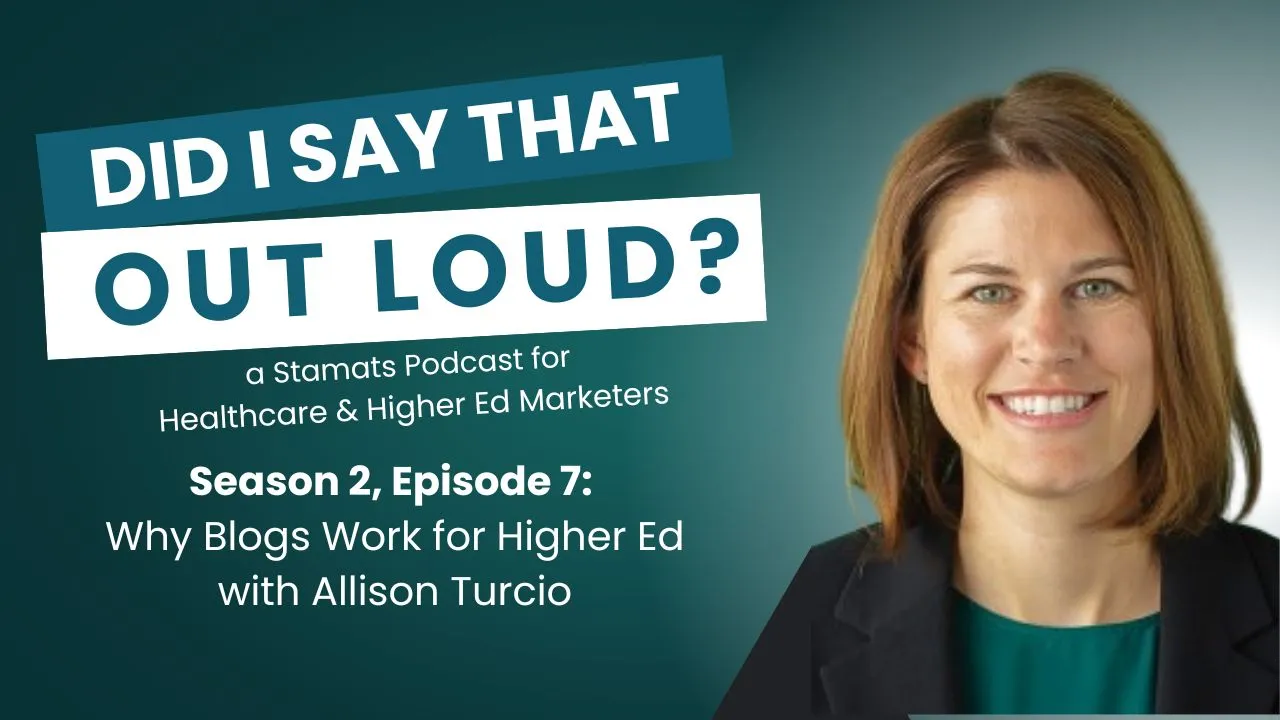
Season 2, Episode 7
Blogs work for higher ed—especially when it comes to AI search visibility. On this episode of Did I Say That Out Loud, Allison Turcio reveals how Siena University leverages content marketing best practices to win at SEO.
Listen to Episode
Show Notes
Transcript
Mariah Tang: Did I say that out loud? Welcome to “Did I Say that Out Loud?”, a podcast where Stu Eddins and Mariah Tang reflect on agency life and answer questions from our higher ed and healthcare clients about the latest in digital marketing, content and SEO.
Mariah: Hey, welcome to another episode of Did I Say That Out Loud? Today we are graced with the presence of Allison. She is a legend in the higher ed marketing space. She’s the Dean of Enrollment and Marketing at Siena University in New York, and she is the host of The Application podcast. Allison is a frequent higher ed marketing presenter, and she’s a guest on fun and fabulous podcasts, not unlike Did I Say That Out Loud. So welcome, Allison. Thanks for joining us.
Allison Turcio: I’m so happy to be here.
Mariah: Yeah, we have been looking forward to this and we were chatting just briefly before we clicked record that January is bananas for higher Ed institutions.
Allison: I know we’re only recording this on the 20th of January, but it really does feel like it has been bananas so far.
Mariah: Yeah, good old J term. I remember those days. We are today talking about one of my favorite topics and one of Stu’s as well, which is storytelling. And in higher ed, sometimes it’s a kind of a leery, murky waters to tread for some reason. So Stamats, just for a little background, we work with higher Ed and healthcare institutions and like a decade ago we saw healthcare organizations really just jump at content marketing. Like we want to do blog, we want to do social, we want to do all these things, but higher ed seems to not be. jumping into that pond as quickly. And I think there’s a lot of reasons for that, but enough of me talking. Siena does a fabulous job under Allison’s leadership and her colleagues. So I would love to hear just high-level from you, Allison. Why does Siena prioritize storytelling and content marketing? when so many other groups do not.
Allison: Well, I’ll start with the content marketing side. And I think the reason that people struggle with on that is because it’s not about the institution when we’re doing content marketing, right. So we do all kinds of content marketing around college admissions and financial aid that is not. centered. It’s just helping and aiding the families as they’re going through what they themselves call a very stressful process, right? And so I think that’s hard. Do you spend time and resources on something that isn’t advancing your message per se, right? It’s not touting the institution’s accolades. And I think that’s a really tough tension for people to have. And so it’s hard.
But I mean, the reason that we do the content marketing is because we dipped our toe in that water, we watched the data and it works really, really well. I’ve actually done the research on this and students that engage so. So for instance, download a some kind of material on something related to admissions or financial aid. They actually perform as well as a on-campus visit. So engaging with this kind of material is really important for the students and it does show intention from the student. And it does show it’s a value to the student. So that’s really what our perspective is on the content marketing side.
Mariah: Yeah, I love. I love that. And I think when people hear the phrase content marketing, they immediately think social. They immediately think, oh, we have to have a podcast and a video series and all these things. But your point, I mean, it can be any piece of content you put out there for marketing, right?
Allison: Yeah, well, I mean, in the summertime, we actually run what we call college admissions boot camp for a week. And we have video chats in it, we have emails, we have little like mini assignments, you know, send us your idea for an essay or send us. Your essay to look at, you know, we just embed ourselves sort of into the process with the students and build a lot of trust.
Mariah: Stu, I promise I’m not gonna hog the mic the whole time. I just have lots and lots of questions.
Stu Eddins: No, that’s fine. We’re swimming in your pool right now. So I’m just sitting here collecting my thoughts and thinking about what I’m going to ask. Well, actually, I am going to jump in here real quick. One thing I’ve noticed is, is that, as you point out, so often the content on a higher education website is about what’s on offer, how we’re going to do it for you and where to meet us. And I think the distinction I noticed the most and we saw this in healthcare as you mentioned, Mariah, it’s the extension of that that organization reaching out to meet them in the place that they’re at.
Allison: Yeah.
Stu: And I think that really going to be important going forward is that is that mid-funnel and early decision-making part of people’s lives becomes more diverse across different channels, across different touch points. Have you have you found that that your own outreach type has changed? Are you using more channels for outreach today than you were maybe even three or four years ago?
Allison: We’re definitely making a more coordinated effort among this because it really did start out as sort of marketing content, this content marketing, but now we have the financial aid and admissions team in a coordinated effort with this. So we have a great example that we started producing content last year on how to use AI the right way in your college search process. And so we were doing that across digital channels, you know, email. And then what did we do? We developed a presentation that the admissions team members would go into a school community, and they would give this presentation to that, to that school community. So we really have expanded our channels because we’re working aligned with the marketing admissions and financial aid teams sort of as one around these ideas.
Stu: Very nice, very nice.
Mariah: Starting in digital and bringing it offline. I love that.
Allison: Yeah. And just honestly, it comes down to finding what the what the need is. You know, we we knew that students were using all the research was coming out right about how students were using a I in the college search process. And so they’re going to use it. Let’s help them to use it the right way and and be that voice, that trusted voice for them.
Stu: Right. Yeah, and it it seems that quite often if we use our content and outreach properly, we do become that pathfinder for them. We reduce friction even though they’re not experiencing any friction with us directly.
Allison: Yeah, yeah. And it’s such a…and it feels like you’re not getting your message out, maybe right in the beginning, at the top, in the middle of the funnel. But doesn’t it say everything about us as an institution that this is what we’re doing and the service we’re providing? Honestly, I think it’s a really strong reflection of the learning experience they’re going to get once they’re at Siena. So it works for us because it’s on brand for us. So it’s not something this might not be…what I’m describing might not be the answer for everyone who’s listening right now, but it makes sense for us. So what’s the thing that makes sense for you that’s on brand for your institution but really opens up this idea of serving and bringing value to your audience rather than talking about ourselves to the audience.
Stu: Yeah, and I think “on brand” for your institution is important. Think about it…how many ways are there to describe FAFSA? Just not that many. But you’ve got to make it relatable and different for your own voice. It seems to me that that has a lot that almost voice and delivery is really the differentiator in this, and that again, everybody’s going to say the same thing about defining something, but do you find that the content you’re putting out there is more about helping somebody find their way? Around stuff, these common things, or more about the thing itself? Do you put a lot of content out there describing a thing and how to go through it? Or are you putting it out there more about here’s what it is, here’s what it’s going to do for you, here’s why? What type of content are you putting out there around that?
Allison: It’s really more the latter, I would say it. I mean, we do help people with those higher ed terms because you know, you might be having first-generation families in your audience that need that baseline understanding. So you don’t, you don’t want to assume everyone’s coming from a place of understanding when it comes to something like the FAFSA, right? But we really do get into more for you. Why does this matter, right? And and and we give steps and advice when it comes and when it comes to these different themes. So yes, it’s less on the definitions and the descriptions, and it’s not so much the nuts and bolts, it’s the context. It’s providing the context for that audience.
Stu: Yeah, that that that would seem to define the storytelling moment to finding your story and going through it. Yeah. And I think that may also be some of the pushback I’ve experienced from time to time when I brought up storytelling more specifically in in my side of the house, saying “well if you had a blog we could support it this way and it would help us push our message out there. I think some of the push back may be coming from some idea of what the scope needs to be because it can be everything feeling got to talk about everything, do it everywhere. But how do you, how would you advise somebody who’s doesn’t yet have a blog or doesn’t really exercise it too much to set some boundaries and some focus? To me, that would seem a good place to start. What are your thoughts on that?
Allison: Go to your audience. I mean, if you ask your audience, they will tell you. So my advice is always to start there. You can talk to students who just started at your institution and just finished and you ask them what were some of the biggest worries? What were some of the biggest barriers? What? What really caught you up? What does that look like? And they’ll surface the most important things. You don’t have to do everything. You know, you don’t have to tackle the entire admissions and financial aid process.
But what for your audience seems to be coming up again and again when you’re doing some interviews and doing some focus groups? Also I’d say look at your website search data. What are people constantly searching for on your website? It tells you a lot. Combine, combine quantitative data like that with qualitative data and you’re going to have some clarity around where to start and and just like you said, Stu, you don’t have to do everything. Start with one thing. That’s what we did, and we saw that was working. So then we saw out those other things and we kept, we kept building it from there.
Stu: Right. No. It’s funny you mentioned site search. I just moments before coming on here. I was doing some research across client sites trying to find you know the most common thing at the they search for is academic calendar.
Allison: Yeah, well, that’s not. That’s the audience they’re recruiting. That’s the audience that they’ve got. But.
Stu: Right, right. But when they get there, what I’m finding is what they’re trying to find is stuff that we should be answering in different ways. It’s not just what the deadline is, but what it represents.
Allison: They want to know when is spring break, when do classes start and those things. But we put it in. And by the way, Siena, this is how we do it too. And we really we need to rethink this. So Stu, thank you for bringing up, you know, you do a PDF with the dates. And you know, this is a job date. This is this. But we really should be putting it more in a question and answer format, especially so generative AI can pick it up and answer students who are looking for just the particular question, because no one needs the entire academic calendar for the question that they have in mind ever, right? You’re only looking for a particular piece of it.
Stu: Yeah. They want the knowledge that they need, not all the knowledge in the world. It’s interesting how it’s presented, yeah.
Mariah: Yeah.
Allison: Yes, exactly. Yeah.
Mariah: Yeah. I’m glad that you brought up the Q&A, Allison. I’m gonna take that down a little bunny trail here. So, Stu and I spend a lot of time. We work right down the hall from each other. So I pop into his office a lot and bug him about, you know, why doesn’t this client or that client or this institution have a blog about this? And we go back and forth about ideas. To present this and when I when I get the chance to visit with clients, sometimes they look at me like I’m cuckoo for Cocoa Puffs for, you know, recommending a blog in 2026. But like you were saying, those Q&A formats, the answers to like really specific, hyper-specific questions are what blogs are made for and that’s what AI chat bots are going to pick up.
Allison: Yes.
Mariah: This is what social media picks up like you’re looking on Reddit. Those are micro questions in a group of people, user-generated answers, right? So when we think about blog, I’m first seeing a big resurgence, whether it’s called blog or articles or you know, whatever you want to call it. In 2026, that type of long-form content just builds those answers together. And like you said, nobody needs the whole academic calendar. People oftentimes aren’t coming and reading a whole 1500-word blog, but they can come back to it and they can parse it out and chat bots can direct different types of audiences to that piece. And so Siena, we were, you know, looking at your blog in advance of this call and you’ve done such a nice job, you and your team, of pulling out some of those questions, like understanding the value of college, understanding the cost, specific interviews about student internship experiences in particular programs, you know, prioritizing some of these hot topics. So. Can you talk with us a little bit about your experiences in building out the buy-in for that long-form content and how it’s grown for you and your groups?
Allison: Yeah, sure. I think it’s funny when you were talking about 2026, it made me think of how everyone’s been posting 2016, like what their photos and everything from 2016. And maybe that’s like blogging was it. It feels like blogging should be a 2016 thing and not a 2026 thing. But here we have generative AI coming through. And now blogs and articles really, like you said, they really do lend themselves to the generative A I and what it’s going to pull because it’s already written in that way of of surfacing information to answer someone’s question. So it it is so interesting, right? What’s old is new again.
But anyway, you know it just again the buy in for us has come from the data. We started really small. I think our first blog posts are probably back from 2014, 2013 and if you go way back you’ll find them. But they, you know it’s they look different now and they’ve really, they’ve really grown but we. We let the data inform that that’s a place where our resources are going and we combine it with internal communication. So a lot we try to repurpose content. So a lot of what you’re seeing the internship stories for instance or the study abroad stories that we that we have on our news channels.
Those actually are produced for internal communications for a newsletter we call the Siena Scoop that goes out every other Friday to our internal community with all these great stories. And we so we repurpose those because that’s a digital newsletter, an e-mail newsletter, we repurpose them. For the website, for that exact reason, making sure it gets found, making sure it’s also presented in a way for those external audiences to see. So it really has just it’s built on itself, the data, and then the stories have built up over time. Now students love to be featured on these. I see them all the time. I wish they wouldn’t. I wish it would share the link, but they always screenshot the digital newsletter and then they put it on LinkedIn, which cracks me up and it gets the story across, but it’s not the most accessible way. But it shows they care and that it sort of has built up this word of mouth about wanting to be.
So I think it starts fueling itself a bit when you get started because people want to get featured and they can see that that it’s becoming an effective channel for the institution.
Mariah: Yeah, we see that among faculty as well. So when one group or department or, you know, service line, if you’re in healthcare, gets featured, everybody else wants a little piece of that. So it’s like, oh, then the story ideas start rolling out. Like, where have all these people been? It’s cool.
Allison: Yeah. And then they surface to you and it’s not as hard to go find it. So there’s all these other unintended efficiencies that we have found, right? Because people are more willing to raise their hand, come to us because these channels are visible and they can see where.
Where if they come to us, where something could possibly be, where it could end up. And I think it’s a really great thing and it just reinforces sort of a culture of storytelling rather than a brute force effort to get stories and put them out to an external audience.
Stu: Right, right. Now, how does social media fit into your blog scheme? Do you use it to simply spread the word about articles, or do you use it more to connect different blog articles together into a larger narrative?
Allison: You know, we’ve actually found that the sort of the content marketing that I’ve been talking about, it doesn’t serve well typically on social media, especially if we’re just sharing an article that’s on the website where we sometime where you might see us doing this content is like I said with repurposing. So we have this story that might have originated in the digital newsletter that we have internally, but then we’ll parse that out into, OK, we’ve got this post on the website and then what format can it take in social media? And a lot of times that might be a video format. One of the things that we always have in our digital newsletter is a video at the top of it. And we’ve been experimenting, actually, because we used to do longer form, kind of like here’s the news this past couple weeks at Siena, some big things that have happened and but now we’re putting them into YouTube Shorts instead and we’re getting so many more views.
So we’re putting them more into snackable, digestible rather than. All three or four stories in one we call it Saints go marching in one Saints go marching video. We’ve broken it into the smaller and it’s performing really well. It seems to be getting found by more people, but a lot of times the thing that’s in the video is also has a longer form article, right? So again, we have these base stories, but we’re reshaping the content for different channels.
Stu: Right. OK, yeah. And the question I asked about how social media relates is what I’ve handled often. The second one is how do you decide when something should be on your website versus on perhaps a third-party location such as social media or guest blog?
Allison: Yeah.
Stu: Do you make those differences or is it again something of refitting it and existing to go elsewhere?
Allison: You know, it’s a bit of art and science there. So, we are very careful observers of our social media data. We’re very focused on engagement on social media. So, we have over time built up an understanding of which of these stories will get engagement and which of these stories might not. And so social media might not be the.
Right channel or it might be a particular social media platform. That is, you know, a lot of the internal newsletter produced stuff does really well on LinkedIn, but it doesn’t always repurpose great for Instagram. So it’s an awareness of what works and on what channel. So not everything makes it to social.
Stu: Right.
Allison: And vice versa. We just have a team that’s really discerning about that and they really try to make smart decisions. And then we push ourselves here and there to take a risk because you know what has changed about our audience or algorithms? So we’ll kind of put our toes into the water of something that we normally would say, no, we would never put that on social media and we.
And we surprise ourselves sometimes. Sometimes what we’ve been doing is like we have even more confidence, right? So there’s never any mistakes. I like to say it’s always just learning which direction to go in. Yeah. So we really use the data, and I feel like the data then develops a really strong gut. Some of it has got to be the gut, right?
Stu: Right, right.
Allison: The data has informed those guts that we’ve developed overtime.
Stu: Right. Yeah, there has to be that I keep referring to it as human discernment about what’s real and what’s just a number. Yeah. And I don’t know, I was thinking along the lines of…One reason as more on the marketing side of the world, I really love blog content is it is probably the richest source of first-party data I’m going to get on interest and behaviors before there’s a commitment moment. So I love building audiences out of connected blog article…
Allison: Yeah, yeah.
Stu: Experiences and so on. That’s more like me trying to develop an advertising list, but I find it very helpful for that. But do you use? It sounds like you use that same type of a data approach to help you fill in the gaps in what you might have out there in your article. Ecosystem and find what may be missing to bridge a point. Do you find yourself going through your blog map or whatever you want your article hierarchy…
Mariah: Editorial plan.
Stu: Yeah, editorial plan. Thank you. Gosh, me love content. The editorial plan. And does the data cause you to refresh it with any frequency?
Allison: Yeah, yes, it definitely does. Or opportunities just arise like the A I in college admissions that we just saw that, you know, what data would have told us we should grab on to that, right? No, that was more just listening and understanding the audience. But yes, it does. We always are. Well, we’re always looking at the quantitative data, but also. Just keeping our ear to the ground with the audience and as pop up, you want to make sure that you’re ready for and then more globally is what we’re producing aligned with the themes and we do have and themes go both ways, the things that the audience values and the brand themes that we have.
So we have brand chapters, we call them here and we do like the editorial calendar is aligned to those to those brand chapters. It’s not an accident that you’re seeing a lot of internship stories because we’re really focused on playing up on the outcomes piece of things in our brand story. So yeah, it all of those things, but we’re just being really thoughtful and intentional. At no point is there an article that just came out of the blue and got thrown up there, right?
Mariah: Yeah, intent is the is the name of the game. It’s the word of the year. I think like you, you want to match your audience intent. You want to match the intent of your brand and your campaign schedule and things like that. But you also want to be, like you said, intentional about the way that you reuse your work. We call that asset remix around here, you know, small, scrappy team, you have this one very thought through long-form piece of content. How are how are we going to make that snackable? How are we going to break that across like you mentioned? And I think that’s something that once groups understand. I don’t want to simplify this and make it sound like, oh, it’s just easy, you know, you just do a thing, but once they understand that you’re saving yourself work in the long run by remixing that content. By repurposing that content, it opens up a whole door, you know, to a room full of possibilities that you didn’t know you had as a higher Ed marketing team.
Allison: Totally. And it’s an opportunity to break down some silos. I mean, it’s not just my team that contributes to this. We have a communications team that reports it over into the president’s office and they are the producers of a lot of this material. And then how does the marketing team work with them to repurpose the content they’re producing, so. If we think about it more broadly, it doesn’t need to be all on our plates, right? So, one, we talk about how valuable it is, but two, yes, how can we just be more effective in using our time by producing one story, but getting it out there in multiple ways?
Mariah: Yeah. Well, this is excellent. Go ahead, Stu.
Stu: Nothing. I’m just, I’m, I’m not going… yeah.
Mariah: I can’t believe it. He’s speechless. No, I’m kidding. Allison, is there anything that you wanted to share that maybe we didn’t ask about or ask in the right way?
Allison: No, I mean, I’ll share an example because I just had one this morning just to sort of hit this home and bring it full circle. I was reaching out to a student who is interested in the finance major. Well, didn’t we have a story about a student who was in the investment fund course? This past semester and he was sharing his experience and how real it felt to him and how prepared for Wall Street he feels. And oh, we got the nugget in there about how since we’ve had this fund, which was founded with just $100,000 20 years ago, it has quintupled in its growth, right? Like.
Stu: Wow.
Allison: Don’t you wish your retirement fund was being run by these students in this class? Like they’re kicking butt, right? So I was able to use that and I’m reaching out to the student and said, hey, I know you really want to study finance and I thought you’d like this story about one of the courses you’re going to take as a student here. Look at what they’re doing and I pulled a quote from the student, I mean, it really can be repurposed everywhere. I mean, it’s so it’s also like an arsenal that you’re providing your admissions team as well.
Mariah: Yeah, I love that. I love that perspective. I think the times are falling away where it’s them against us, admissions against marketing or whatever. It’s you got to go together. You got to go together. Yeah. Well, this is awesome. It’s always such a treat to talk with you, Allison. Thanks so much for joining us and for being on our little show. We appreciate it.
Allison: You’re welcome! Talk soon.
Stu: Bye!
Mariah: Thanks for listening to “Did I Say That Out Loud?” with Stu Eddins and Mariah Tang. Check out the show notes for more information about today’s episode. And if you have any questions, concerns or comments, hit us up anytime at stamats.com.
Let’s talk
You have questions, we have answers. We will customize a solution that is guaranteed to impress.