Written by
on
February 20, 2026
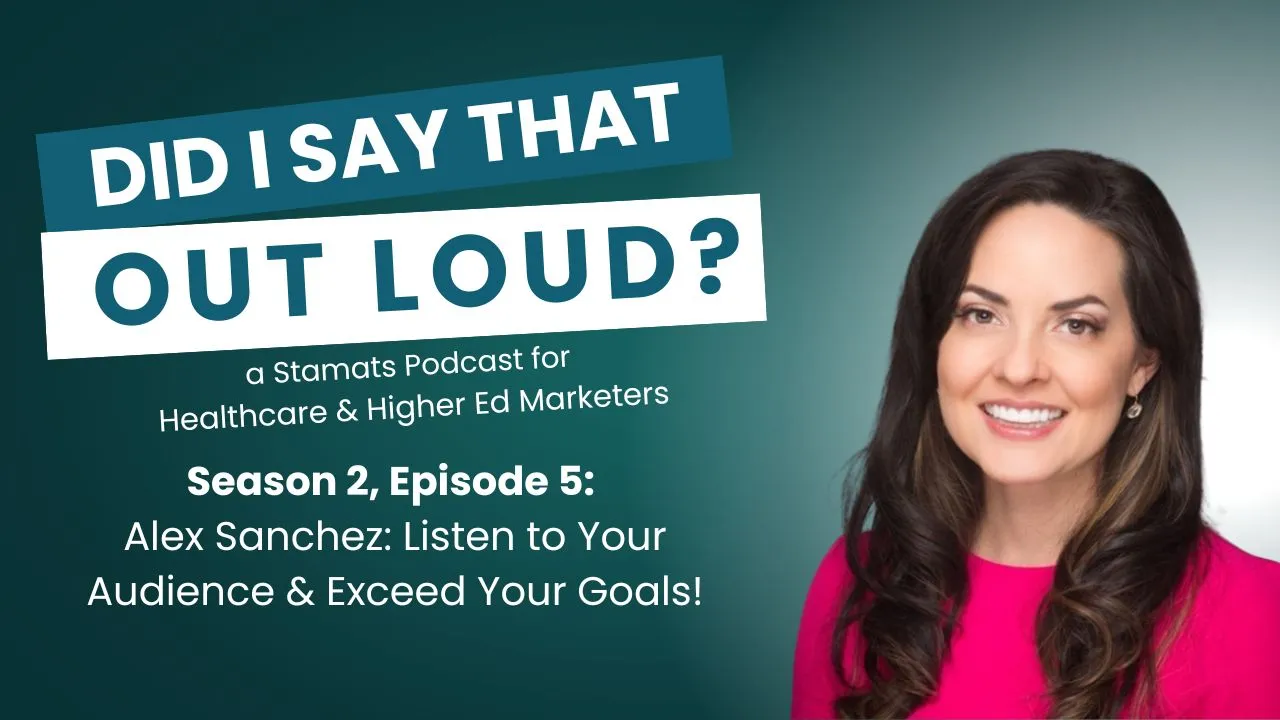
Season 2, Episode 5
Health insurance is tough to understand—and tougher to market. Despite the unique geographical and socioeconomic challenges in New Mexico, Alex Sanchez, Chief Experience Officer at BeWell, and her team secured their THIRD consecutive year of record-breaking health insurance enrollment!
See how smart content marketing strategy through video, blog, and intentional audience segmentation helped them reach the people who need their services most.
Listen to Episode
Show Notes
Transcript
Mariah Tang: Did I say that out loud? Welcome to “Did I Say that Out Loud?”, a podcast where Stu Eddins and Mariah Tang reflect on agency life and answer questions from our higher ed and healthcare clients about the latest in digital marketing, content and SEO.
Mariah: Thank you for joining Stu and me. We are graciously entertained by our fantastic guest today, Alex Sanchez. She is the Chief Experience Officer of BeWell, New Mexico’s Health Insurance Marketplace. So thank you for joining us. Alex and her team are fantastic marketers in kind of the weirdest little niche that we have worked with here at Stamats. Alex, do you want to give us just a 10,000 foot overview of BeWell and what you and your fabulous team do for New Mexicans?
Alex Sanchez: Yes. Thanks for having me, Mariah and Stu. I like to have my name associated with weird and niche, right? That’s just who I am. So be well is New Mexico’s health insurance marketplace. We’re often what people think of as Obamacare, right? After the ACA was passed, we are where New Mexicans come to find insurance if they don’t have it through their employer, they don’t have Medicaid or Medicare.
But most importantly, we’re the only place where they can qualify for subsidies to reduce their out-of-pocket cost. So we just finished open enrollment, third straight year of record enrollment, which is great more than New Mexicans than ever. And about 52% of them are receiving health insurance for $50 or less a month.
Mariah: Yeah, that is just unbelievable. I mean, Stu and I live in Iowa and so our atmosphere here is a little bit different. We’re we are a rural state, you know, and many of the many of our listeners are from rural states as well. So I think a lot of groups that hear this will be able to identify with with New Mexico with you and your team’s players.
Especially being kind of healthcare adjacent, healthcare sphere, you have some kind of interesting, I wouldn’t say loopholes, but things that you have to dance around in order to make your ads hum and sing. So I know Stu’s looking to ask about that as well.
Maybe we just start out with like give us…So we don’t want to make this dire and crazy, but everybody listening to this knows it’s been a rough couple of years for healthcare, for marketing, especially for people who are maybe in that underserved market. So tell us some good news, Alex. Like what were some of the fun highlights from your marketing year in 2025.
Alex: You know, I think the funnest highlight is that if you listen to people, they’ll get engaged, right? I think sometimes we forget that. We think about what everyone needs to hear, right? And especially in the work we do, we want you to hear that you can get subsidies we hear. We want you to hear that every plan has 10 essential health benefits, that there are carriers, you know, and trust, right?
But really at the end of the day, when we stopped and asked people what do you want from us and started sending marketing to them that mattered, they engaged and we saw it of course again in record numbers. So that was actually a really nice moment because it can feel like you’re very lost and like how do you break through the noise? How do you break through the national commercial?
Of healthcare. How do you break through the political issues, right, of different people with different feelings about healthcare? How do you just get past all the personal injury attorneys who have taken up every billboard right where you live? But when we really stopped and just started asking people, what do you need? How can we help you? What do you want? What confuses you?
It was really great to see then this campaign come from that, which is stories from our own customers saying what healthcare means to them, saying how easy it was to enroll, saying that they were able to find a plan, right? It’s not just like mythical person who somehow got the $0.00 plan. Like these are real people. So that was the highlight, I think of the year.
And then also just having fun. The team did some really cool things this year. We took over our university basketball arena, which no one had ever tried before and nobody really thought that would work. And it was amazing, right? And going to a sold out basketball game with more than 13,000 people cheering as we’re on center court. That’s the kind of publicity, you know, we haven’t been able to get before.
Mariah: Yeah, and I will say too, just watching your team grow the YouTube channel has been really fun as well. I mean, you’ve got some serious content out here, but you’ve got some really fun short videos too, and we’ll put some links to your different social properties in the show notes, but that’s something that’s really awesome to see doing something as complicated as health insurance enrollment and boiling down the steps into those little short videos. I mean, it’s a genius move and your team does an amazing job with it.
Alex: Well, thank you for saying that. I am so blessed to have some very young and creative people on my team. I can’t talk to them about movies. None of them have seen Jerry Maguire. It’s a whole thing. But when you give them the social media channels and let them run with it, they’ve done a really great job. And at the end of the day, it’s like, what’s the worst that’s gonna happen? Put out something fun. Let’s see how it goes, right? If it doesn’t hit, we try something. Next time. But I think they’ve done a really good job and it’s nice to see them, shall I say, in their element. I don’t know the “youngs” with the “sosh.” I can’t keep up, but you know, they’ve done a really good job.
Mariah: Yeah, yeah, I’m used to being the younger person in the group. No offense to Stu there, but it is fun to get schooled.
Stu Eddins: Oh yeah.
Alex: Stu, I thought you were like 22. What the heck?
Stu: I will occasionally…I do act that age but I’m not I’ll see your Jerry Maguire and raise you a Goodbye Girl then, just for, you know, age differences. So, the one thing that I noticed and and I see a lot of what’s going on with your interaction with Mariah and other people.
But you know, I can’t help but bring two things to the table when I when I look at things, marketing message and measuring the stuff that follows up. And the one thing that I’ve seen and I don’t know whether this was intentional, I’d like you to comment on it. It seems that we’ve taken a product that’s needed and a people that have a need and instead of trying to put the sexy on to get it to to match up, we’ve just simply started talking to people and and you know the the the need is there, it’s acknowledgeable, it’s everything else, but until you’re talking to the people, it would.
It would seem that you’re not going to make a lot of connections. My observation is that the videos, and everything else you did, did a tremendous amount of effort toward making that individual person connection. Was that intentional or was that something that developed from feedback?
Alex: You know, it’s a really great question where we started. So I walked into this organization three years ago and we were spending millions of dollars to try and make it sexy, right? We had like all these stock photos of people like in a warehouse in Chicago that don’t look anything like New Mexicans, right? And there’s like 16 feet of snow outside. That’s not here, right?
And when we stopped doing that, and during the Medicaid Unwinding, we really started to hear from people. We made an intentional shift, but that shift came with the realization that health insurance in general is a topic people don’t understand and nobody wants to feel stupid and nobody should feel stupid. And so when we stopped and started thinking about what is really health literacy? What does that look like in the health insurance realm?
Then we were able to start creating videos about these things to talk about what is a copay, what is co-insurance, what is your deductible mean or your out of pocket match or your network and that allowed people to kind of self-service, and once they were able to self-service and get the information they needed without feeling like they’re walking into a situation where they don’t know anything and they’re not really sure what to do and you’re asking for their tax information and you know, then it opened the door to more questions that we could help them with.
The other thing I think is we met people where they wanted to meet us. Do you want to come to a virtual event? Do you want to chat with us online? Do you want to send us a DM? Do you want to come in person, right? And you can see it. You can see our folks who are maybe just not quite Medicare age. They’re more likely to come here in person. They want to come to an event. They want to talk to somebody.
Some of our busy, you know, middle-aged people, moms and dads in their 30s, man, they are joining our virtual events from their kids’ soccer practice. They’re like, I need this. And then you can see some of the younger ones, they’re on late at night. We can track them. We see them using our chat feature, trying to get quick answers.
So it’s really been a fun time to be in this realm because we were very blessed to have leadership that said, go try it, right? Let’s step away from this kind of the idea of making posters that say $0.00 plans with fancy people on them and step more into just making videos, making content, pushing it, doing articles.
The blogs that you all help us with have been incredibly successful in really just getting down to the needs of the user and answering our questions.
Stu: Yeah, and and that’s where occasionally I’ve been pulled in by Mariah to look at some of the blog content and assess it’s. I don’t say viability, but it’s life. Blogs often have a more of a long tail life than the than the quick hit right after they launch. What happens over the time?
The one thing I’ve noticed, and it’s true about all blogs, but I think fed by your multi-front attack on this, if you will, I see so much more diversity in traffic coming to your blog content than I see elsewhere. It it sounds like it’s paying off from your outcomes that you’re talking about.
But the next question I would have for you, because you recognize the diversity of messages and different messages go through different channels, one would assume do you find that you have to be careful about creating confusion that you have too many different types of message out at one time?
The same theme or is it just kind of naturally it spawns YouTube into a blog into a social post? How do you handle that?
Alex: You know, I yeah, I appreciate that you’ve now unlocked a new fear for me because I had not thought about it that way, Stu. But you know, I think we struggle so much with this being a confusing topic in general that it it hasn’t been as much a recreating confusion. It’s more, how are we getting to the people that have those complex households? Because they’re the people that need to be touched 345 times and have those questions answered. So maybe it’s a couple living at home. He’s got insurance. She doesn’t. She just retired. Their adult child lives with them. So they’re multi-tax household, right? Maybe they’ve got a little one that’s going to qualify for Medicaid now because it’s a mixed family household. So there’s a lot of things like that that have felt sometimes like, are we getting all the information out there? And I think all we can do is take a step back and say, is what we’re putting out there making sense?
Are we utilizing the different channels, knowing the demographics and the user bases of those channels to get that information out? And then what is the next step? Because you don’t want to drop someone off a Cliff, right? Like I can, I can feed you a video of why it’s important to get health insurance, but if I don’t tell you what to do next, it’s just like, well, that’s fun video. I probably still can’t afford it.
It’s not until I tell you it’s important and we can help you and lower your cost and there’s free help and you can enroll here. So that’s where we’ve really focused. I also think we’re up against an unfortunate situation, which is marketing to the unknown. Right. We didn’t know what was going to come down in the Big Beautiful Bill, but our campaigns were already out there. Now that we know, I think people don’t realize that the law has different kind of drop points, right? Medicaid is going to change this year. New rules will come out.
There are certain rules about who loses Medicaid and that they won’t be able to come to the exchange like they’ve been previously able to. So we’re in this kind of ever-changing world, which is really hard when you’re running a campaign and thinking, well, in six months from now, these people aren’t going to be eligible because of their immigration status or their income level or whatever it is. So that’s definitely something.
Struggle with is making sure that at every turn, what we put out is authentic to that moment. This is what we know now. Here’s how we can help you right now.
Mariah: Yeah, and I want to share something too. One of the well, I think maybe, maybe we all, maybe except for the young team members, all of us developed a little gray hair last year working on this. But I thought this was really a genius project that you and the team worked on. And again, we’ll put a link to this in the show notes.
But you transformed your blog from the Health Plan How-Tos to two separate entities. So you have your blog where you do more of your narrative articles, and now you have this How To section where you’re doing just what you described, Alex, getting really niched down into those super complex journeys, picking one question or one problem and walking them through how to do it.
I mean, some of these are pretty short because the answer is short. Some of them are very lengthy because it’s super complicated. So you might have 5, 6, 7 tertiary questions that come about it, but you give them that path and you give them each touch point to help answer those really complicated questions.
So I feel like that was genius and that’s something that can last on your site for quite some time. Regardless of what changes at the federal level, you’ll have this repository to hide or update or whatever you need to do as things shift.
Alex: Yeah. And honestly, Stamats has been huge in helping us keep that fresh because as things shift, you have to go back. I mean, even the enrollment system we use now updates 3 * a year, which means all the videos we’ve made, we have to go back and make sure, is that still the process? Does that screen still look like that? And so that is a full-time gig and it’s one that’s really important.
Because if you come to our website and you get lost, you’re just leaving.
If you come to our website and you get a question answer, you may leave, but you’ll probably come back, right? And like it keeps on. But this is enough of a barrier to say to someone, I need your tax information. I need to know this. I need to know that. I need you to project these things to pick a plan to know what network you’re in is, you know, who’s your PCP? Do you need a specialist? A pharmacist, blah, blah.
If we lose them because the information we gave them on how to create an account wasn’t right and the screen looks different like that, that’s really heartbreaking actually. And so it’s something we’ve always got to be mindful of too, is like, there’s continuous work. You don’t just get to put it out there and let it go, you know?
Mariah: Yeah, I think that’s important. No matter whether you’re in health insurance or B2B or healthcare or higher Ed or whatever industry that you’re in, it’s never that set it and forget it. Things change too fast. Customer sentiment changes too fast. The intent that brings them to your digital properties, whether it’s social or YouTube or site changes too fast to just say, well, this is the thing we put out. Good luck using it, right?
Stu: Yeah, yeah. Find your own way. Here we go. I, I, Alex, you did say something earlier that struck me. You talked about healthcare insurance literacy and talking about that and I was going to ask you a little bit about that. And by the way, I’m stealing that because healthcare needs literacy and so does higher education literacy.
But you’ve also pointed out something else with how the blog is segmented now. And it would appear that you could say that on the one side you have the literacy issues with the what is, how is it all and the other side you have the what’s in it for me part. We’re talking about my needs, my, how it applies to me and so on. You’ve made this split, it was, it was intentional. And did you notice that this split might have helped with like special needs or underserved audiences that you might be trying to reach out to? What was that helpful in making sure your message penetration was better with those groups?
Alex: Yeah, you know, I’m so proud. Be Well actually won a health literacy award last year. And the whole reason we won it was because we took this concept of these common health insurance terms and proved that people don’t actually know what those mean, right? And so by doing that, then it came this simplistic kind of to Mariah’s point. Then the idea was we need to answer one thing, and we need to do it in a way that if someone wants to read it, if they want bullet points, if they want a video, it’s all served for them there, right? So it is intentional to push it apart, but it’s also really thinking through how does this, how does this mirror what they hear when they call us, right? How did we determine certain terms and terminology and definitions and ensure that the organization uses them every single time?
And then one that is close and dear to my heart is I used to work for a health system and something that was fascinating to me was how many patients really struggled following the line when you’re reading to the next line and the difference in just shortening to 3/4 of the page from a full page made for them. And so also thinking through materials we’re putting out there. Is it broken up enough? Are there enough bullets? Is it? Are the lines short enough that they can wrap or the sentence isn’t so long that they’re really trying to think through these different things, right? And that does, you know, really, at the end of the day, you can have whatever education level that you have.
If you’re a mom, even working two jobs and you’re sitting at the kitchen counter at 8:00 trying to figure out health insurance, you’re tired. We’re all just tired, right? And so the easier. You can make it for everyone. It doesn’t mean you make the material dumbed down. It means you make it relatable and understandable and then breaking those things out. So if you want to learn more about what is 10 essential health benefits, what does that really mean? OK, it’s rehabilitative care, substance use disorder care, depending on what plan you have, maybe it’s gender affirming care, ambulatory care, mental health services.
Those are all things that are in a different section so that you can kind of understand where is just what’s a network mean, just explaining that means what doctors you can see right and what it’s going to cost you versus out of network, so the separation really I think allows a user to jump on their journey and as they build confidence in what the terms mean and how the system works and how to utilize it, then I think we see them move over to those kind of lengthier blogs and start to walk through what are the difference in, you know, turquoise, gold, silver, the metal tier.
What are the difference in these more complex items? But if you throw that up in front of someone right away and it’s like, are you 300% of the FPL? Everyone’s like, I don’t know. What does that mean? Is that a disease? I have no idea, right? So like, if you start them, though, with just like, how much money do you make? Here’s how to understand how that’s going to play a factor. They really feel empowered by the time they get to that metal tier article.
Mariah: And I think we would be remiss if we didn’t talk about we’ll we’ll be gentle in how we describe this Alex’s propensity to amazingly blow things up that shouldn’t be that had never been tampered with before. So Stu, I I don’t know how much you got looked into this, but Alex had an exciting adventure with an out-of-the-box software as a service that she took national and said, hey friends, we need to make some serious UX updates on this. I know we just have a few minutes left, but do you want to give us the high level of how that started, why it mattered and what’s next for you all?
Alex: Yeah, yeah, we made it. I love the way you put it. It was so gentle. We made a conscious effort to say that it’s not acceptable. It’s not acceptable to say that every user is the same and that they’re just going to have to do it the way the system is built. No, it’s not how it’s going to work here.
Mariah: For your enrollment platform, yeah.
Alex: Yeah. And so we had more than 13,000 rows of text for our platform that had content in them. I will tell you, they told me the average organization that acquires their product changes 300 rows. We changed nearly 4000.
So, and we completely rewrote the Spanish content to make sure it was in the dialect of New Mexicans, which was a funny conversation because anytime you talk to a vendor and they’re selling you a product and you say what dialect is your Spanish in and they say what does that mean? And I was like, this is terrifying. So you know, I think.
It it paid off, it worked. You can see it in the enrollment, but more importantly, it is our commitment to authenticity. You cannot put a product out there that is off the shelf, out-of-the-box, does not cater to your specific group you’re trying to talk to, and expect them to feel like you understand them. It’s just not going to work.
Mariah: Yeah, we talked about this at Virtual SHSMD last year, so I’ll put a link to that presentation if anybody’s interested or I’ll even say this wants to talk to Alex about this crazy project. I bet she would love to share that journey with you. Well, I get the joy of chatting with Alex frequently, so I wanted to make sure I wasn’t hogging the mic. But Alex, is there anything that we didn’t ask that you were hoping to talk about?
Alex: You know, I would just say how much we appreciate Stamats. I mean, especially because you guys do different work than we’ve asked you to do a lot of the time. It’s been so helpful to hear though, like, oh, we did this in this state or we did this with this college or this with this university and how we applied that really turned out really lovely.
I think in New Mexico, you know, being so rural. An issue with access to care. We have an issue with Native American services, right? And making sure our Native American audience understands we’re not, we’re not taking over IHS, we’re complimenting IHS. Or if you are in Raton or you’re in Chaparral or someplace like that, Aztec. And it’s like, well, how am I gonna get services right? There’s no provider around here. There’s no clinic for two hours really talking through what are the benefits of the plan and those kind of little niche details to your point, Stu, of the underserved really came out in the blogs, really came out in the work you all did to help us understand our user groups a little bit more and we’re just very grateful for the partnership and we’re really excited to see where 2026 takes us.
Mariah: Thanks for always inviting us along and and we love. We love how creative you and your team are and we love the ideas that come out and how they challenge us to think outside of just, you know, the text and and some of those things. So it’s been a really fun ride for us as well. So this little love fest has come to an end, but thank you for squeezing us in. We’ll let you get back to your walking treadmill or whatever fun thing you’re doing. Bye!
Alex: Yeah, right, right here. Be glad I didn’t do it during this. Thanks, y’all. Bye!
Mariah: Thanks for listening to “Did I Say That Out Loud?” with Stu Eddins and Mariah Tang. Check out the show notes for more information about today’s episode. And if you have any questions, concerns or comments, hit us up anytime at stamats.com.
Let’s talk
You have questions, we have answers. We will customize a solution that is guaranteed to impress.