Written by
on
May 22, 2026
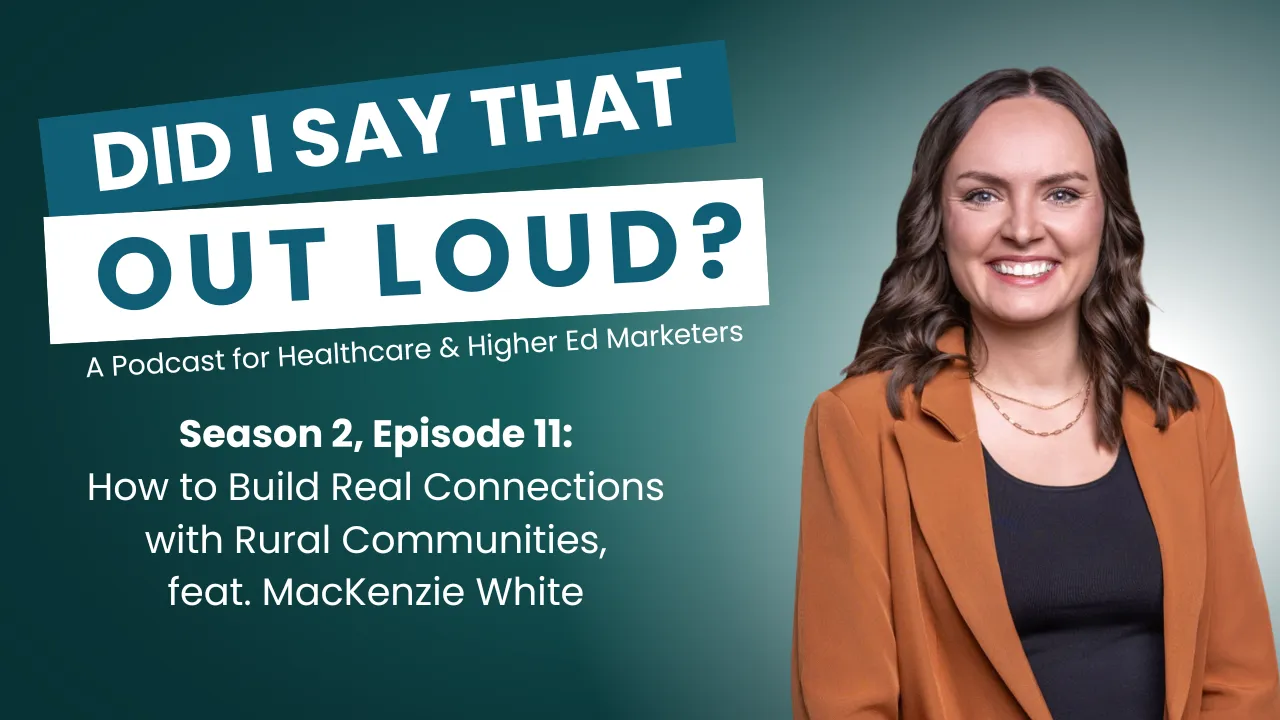
Season 2, Episode 11
Anyone with lungs can get lung cancer. MacKenzie White and the End Lung Cancer Now team are committed to spreading this message throughout Indiana. See how her team forms authentic, trustworthy connections with rural Hoosiers, including a mobile screening unit, digital storytelling, and a cool entry in the Indy 500 parade.
Listen to Episode
Show Notes
Transcript
Mariah Tang: Did I say that out loud? Welcome to “Did I Say that Out Loud?”, a podcast where Stu Eddins and Mariah Tang reflect on agency life and answer questions from our higher ed and healthcare clients about the latest in digital marketing, content and SEO.
Mariah: Hey everybody. Thanks for joining us today on Did I Say That Out Loud? I’m Mariah and Stu is not here. He’s out for a couple of weeks. So, you’re stuck with me. But thankfully we have a fabulous guest today, MacKenzie White.
She is the executive director of End Lung Cancer Now at the IU Simon Comprehensive Cancer Center. MacKenzie has a background in nonprofit leadership and public health, and she leads strategic initiatives to advance lung cancer prevention, early detection, and advocacy. So MacKenzie, thank you for joining us today.
MacKenzie White: Of course, thank you for inviting me. I’m excited to be here and to talk with you and share what we’re doing to reach our rural populations.
Mariah: I always love getting a chance to work with you. You and your team just have this amazing perspective on things. And I’ve been doing, you know, content marketing and in the, the healthcare space for almost 15 years. And I still learn something every time that I work with you and your team. So thank you. It’s fantastic. let’s just start right up at the top. What really inspired you to get into this community outreach, especially in the rural healthcare outreach space?
MacKenzie: Yeah, so to be honest, when I first started in my journey in college, I didn’t really start with the intention of ending up in a role like this. I studied event management actually in my undergraduate program. And I knew with that I wanted to create fun, memorable, engaging experiences for people, but I also wanted to do mission-driven work. I wanted to do something where I knew I was making a lasting positive impact on people and their lives and their families. And so after college, I started at the National Multiple Sclerosis Society doing some fundraising events around the state. Then I went to continuing medical education team at the IU School of Medicine and then now here at End Lung Cancer Now. And a clear pattern, I would say, amongst those roles that kept emerging really is that where someone lives could really impact their access to care, their overall health outcomes, and even just their awareness of what resources might be available or what preventative services they should be doing to take care of themselves.
And so in rural communities especially, there are clinical barriers of course, but there are additional barriers. Logistical, cultural barriers rooted in trust. And when it comes to lung cancer specifically, there are significant disparities in lung cancer. So higher incidence, so higher rates of lung cancer, higher mortality rates, so more number of deaths due to lung cancer and more late-stage diagnoses. And so at some point, learning all of these things, I stopped seeing rural outreach as just part of the job, but really my responsibility, the In Lung Cancer Now team responsibility, to figure out a way to show up for our rural Hoosiers and to help them live healthier, longer lives.
Mariah: Yeah, I think those of us who live in cities or in metro areas kind of forget how expansive the country is. I mean, there are fewer than 400 million people in the U.S. and there are several countries in other continents that have way more people than that. And we’re a big, huge nation. Like there are a lot of rural people. And just with all of the different things happening at the federal and state levels that access to care that you mentioned is just shrinking so programs like yours are so important.
I was talking with my husband the other day. He was thinking like we want to move somewhere when we retire and all these things. like, do you realize how lucky we are living where we live? are 15 minutes from an emergency room. We’re an hour away from a specialty hospital. I mean, it doesn’t get better than that, right? And so you’re thinking about a state like Indiana, which is very agricultural, a good size state where you may travel a couple of hours before you can get to a specialty hospital with a program like End Lung Cancer Now, could you tell us maybe just at 10,000-foot what your goals are with the program and some of the outreach that your team has initiated?
MacKenzie: Yeah, of course. End Lung Cancer Now is an outreach and advocacy organization at the IU Simon Comprehensive Cancer Center. We were actually founded in 2020 by a medical oncologist and researcher here at IU, Dr. Nasser Hanna. And we secured some pilot funding actually from Lilly to do some patient advocacy something. At the time, we didn’t know exactly what this would look like, but this idea has really grown into this statewide movement over the last five and a half years. Our vision is in our name, so ending lung cancer now.
Here in Indiana, we put the emphasis on now. And we have four key mission pillars, which you kind of mentioned already, but prevention. And when we say that, we mean reducing all modifiable risk factors, not just focusing on tobacco. Early detection, finding lung cancer at its earliest detectable stage. Research, but for us, that mission means enhancing awareness and understanding of research in our communities and then survivorship, supporting everyone impacted by lung cancer, patients, their families, their caregivers, and throughout their entire journey, not just at diagnosis.
And advocacy really is woven in through all of those four pillars. And I think something that makes us unique is kind of how collaborative we are, how we’re structured. We have an advisory board, which includes clinicians, researchers, patients, caregivers, community partners, industry partners as well. And all of us together as a team really drive this work forward. We are seeing progress. Screening rates are going up. We’re still woefully behind other cancer screenings, but we are going up.
Lung cancer mortality is actually declining faster than any other cancer, but we know we’re not where we need to be, where we want to be, and so we just continue to raise awareness through education and outreach, reduce stigma. Lung cancer has been historically very stigmatized, increased screening, and just make sure again that our rural Hoosiers actually have access to the care that they need.
Mariah: Yeah, was such a critical time. I love how you emphasize the now because smoking is really declining, but lung cancer is still a significant issue because there are so many other drivers and people just maybe aren’t aware of what those could be. At the same time, there is a dire need right now for people to understand the science behind the research that’s happening at institutions like IU Simon Comprehensive Cancer Center and how that translates into benefits for them, even if it’s not at this moment, maybe in the next five to 10 years. And I just think that’s such a neat thing.
Here I’m getting all content marketing on you, but because there is so much science involved with agriculture and there’s so much science involved with manufacturing, but we don’t think about it like that. It’s just a thing that we do. And hopefully at some point in the future, getting screened for lung cancer and understanding those risk factors and avoiding them will be just a thing that we do, right? What are some of the ways that End Lung Cancer Now has brought that type of initiative to the community? How are you connecting them with this sometimes really complicated health information?
MacKenzie: Yeah, and I think in some of the questions that you sent me, one of the questions was like, what are the cool things that you’re doing to meet the community members where they are with this health information? And I laughed, honestly, when I read that because One of our rules, something that Dr. Hannah instituted from the very beginning, is that everything we do has to be cool. So we have to have cool events, we have to have cool swag, we have to have cool people.
He is a pretty cool guy, so he’s like the leader of the cool kid club. But I think, you know, in all seriousness, what we mean by that is we just want to make sure what we’re doing is engaging and approachable and something that people actually want to engage with and be a part of. Lung cancer is really not easy to talk about. There’s a lot of fear. There’s a lot of stigma. And so we have to, you know, make sure that we’re meeting people in a different way. And so we do the traditional things going to community health fairs, sending newsletters to our advocates across the state, hosting our own events. But I think there are three key things that we have tried to consistently do that I believe are very cool.
First is storytelling, trying to elevate the real voices of the people that have been impacted, whether that’s the patient or a loved one, and even our clinicians, humanizing the doctors behind the scenes doing the research, doing the work, and really just humanizing the disease across the continuum. think behind every statistic is a story is what we say and being able to build trust by telling those stories and talking about the people that are impacted has enabled us to connect with people around the state. I think it gives people kind of a glimpse behind the scenes and enables them to kind of maybe see themselves or see their loved ones in the stories that we’re sharing.
And so I think leading with storytelling is something that we have done in a creative way to engage with people. We also created, I think the second cool thing is some of the interactive tools that we’ve developed. One being, we have a lung screening quiz on our website. So instead of just providing a checklist of what that screening eligibility criteria is, some of it’s complicated, it’s tied to smoking history, what’s a 20-pack year history, what does that mean, I don’t know.
So we put together this quiz, you can take it in like 60 seconds, and it’ll actually tell you at the end if you might be eligible, if you should talk to your primary care provider, and it also links to some resources where you can find a screening location, questions that you can ask your doctor to initiate the conversation, and then something actually related to research, which we’re very excited about.
We just launched this actually last week. We had a student intern from IU develop a digital board game called Quest for the Cure. And so it walks people through the entire, you know, life cycle of research. What is clinical trials? What’s the discovery phase mean? And it’s very interactive. It can be played by all ages. And just again trying to connect with community before they’re ever in a position where they need to decide if they should participate in a clinical trial. Just trying to make it less scary, make it a little more fun, and making this really complex topic easier to understand.
And then I think the pillar of cool for us honestly is our mobile lung screening program that we launched last year so just a little bit over a year ago. It’s probably our most tangible example of actually meeting people where they are. It’s this 52,000-pound 42-foot truck that drives around the entire state and can do low dose CT scans right there on the spot, just screening patients at IU Health. We’re screening anyone who’s eligible for screening, partnering with local clinics, rural health clinics, and also we have the best team on that truck.
We’ve made it kind of a mission to make sure we’re taking care of the whole patient so we see you know in these rural communities sometimes these people might not engage with the health care system even for just their standard annual check-ins with primary care or they might have social needs, transportation, food, housing. And so we have a mechanism in place where our navigator can kind of ask some preliminary questions and just making sure that we’re connecting people with other resources that they need trying to take care of the whole patient and not just provide the screening. So I think those are the three coolest things probably that we do to engage with our rural communities.
Mariah: At the NACDO PAMN conference, we were talking with your colleague Michael Schug and some of the other clients that we work with and they were just fascinated by the mobile unit idea and they were just like, how did you get this started? How do we do that? And it was just so cool watching everybody get so jazzed about something that, you know, in principle seems so simple, but it’s packed full of all of this amazing technology. It’s like, how do you do this? This is so cool. Yeah. Yeah. Awesome. When you are talking with other marketing teams, like maybe at IU or at the Cancer Center, how do all of you kind of crowdsource ideas? Like in marketing, sometimes we get accused of being a little bit too bananas. Like, how are we going to do that? Are you kidding me? That’s not feasible. So how do you and your teams and your peers at the institutions that you’re affiliated with, I guess, crowdsource ideas, how do you come up with, this is a good plan, this is feasible, this is not feasible?
MacKenzie: Yeah, I think our advisory board, since we have so many different stakeholders and they are a big dreaming group. And internally, know, sometimes we come up with crazy ideas. Currently we have billboards like all around the state. We have never done that before. But I think, you know, when we’re talking as a team and also talking with, we have some patients on our advisory board and just on some of our working groups. So hearing from them too and taking some of their ideas like, hey, I think this is an interesting thing to consider to kind of market what you’re doing. And I think just understanding that what we’ve been doing obviously isn’t working.
The lung screening rate is so low. So we do need to probably think outside the box and we you know kind of focus group to an extent some of these ideas but then at the end of the day we just kind of bet on ourselves try something new. Our donors, our sponsors believe in the work that we do and so then we just go for it and try new things to reach new people. And so we have an amazing team and again that multidisciplinary kind of advisory board, especially when it comes to marketing and communications ideas has been a game changer for us.
Mariah: Especially in a more niche group like yours is, sometimes they feel like you’re on an island and you have to come up with all of these things yourself. But like there’s a whole team of people rooting for you who wouldn’t want to help decrease lung cancer rates and raise awareness. So I mean, it’s just funny how humans are. You’ve kind of touched on this a little bit already, MacKenzie, but being in a rural serving hospital system, in a metropolitan area, what are some of the unique challenges that your teams face compared to say, a bigger city, New York City or Dallas, Texas?
MacKenzie: Yeah, I think there are a few of them. workforce is a big one. We’re, you know, downtown at the cancer center. We’re in a city. so, but when you think about some of our satellite clinics and IU Health, that system is across the entire state and they have, you know, a lot of smaller hospitals, but workforce is a big one. Fewer providers, the teams are more stretched, especially in oncology there, so they’re treating many different types of cancers. It’s not necessarily just specialized on one. Geography obviously is another. Indiana is, know, patients often have to travel long distances, which can create those barriers to getting follow-up care or participating in screening.
I think you mentioned this earlier, but the financial pressures also play a role. The state of the world that we’re in, it’s a little uncertain right now and rural systems are often serving older populations with a higher reliance on Medicare and Medicaid. And that can impact sustainability and access. And then I think the other thing too, and we’ve seen this with the mobile unit, the trust. In some communities, there’s hesitation around trusting these larger systems and lack of trust from the smaller clinics, trusting that we’re not stealing patients with this mobile screening program. So I think the relationship building is such a key component to making this all work. And overall, I don’t think these challenges are insurmountable by any means, but I think they do require strategic, intentional, different, more tailored strategies than what might work in a more like urban setting.
Mariah: Where I live, it’s really the relationship building. Like you said, it’s that partnering back and forth. It’s really a centricity to what does our patient need and I’m not by any means knocking the big hospitals and the big cities because they care just as much. It’s just that challenge of building those relationships in those smaller communities is really at the forefront. And you know, from what from what we see, you’re all doing an amazing job of doing that. So I guess on that note, what advice would you give to marketing teams and understanding, we work with higher ed, we work with research institutions, we work with hospital systems and institutions like End Lung Cancer Now. And there’s this theme of relationships, there’s this theme of community that runs through all of those organizations. through that lens, what are some of the ways that or what are some of the takeaways that you would hope somebody listening to this would take away from building those relationships, doing that outreach, doing the work that really matters?
MacKenzie: I would say first and foremost, start with listening. I think my public health background comes into play here a little bit, especially when we talk about community-based research. don’t just assume that you know what these communities need. It could be very different. Their true needs could be very different from the perceived needs. So I think asking them first and then building kind of the plan from there, it has to be mutually beneficial.
In my experience for it to work. We can provide services, we can support you, but they also need to feel like, you know, that we are helping them, not just achieving our goals of screening more Hoosiers, but helping them provide something in their communities that’s needed. I think building those partnerships early and not to be too cringy, but teamwork truly makes the dream work. So that team that you build is really crucial and thinking across different sectors. So of course healthcare organizations, academic institutions, but also there’s those small community organizations, the churches, the libraries. Building those partnerships, building that team that is multidisciplinary and comes with a lot of expertise and knowledge of their own communities is important. Something else I’ve really learned is raising awareness through communications and marketing is obviously essential.
But if we can’t remove the barriers on what we’re raising awareness about, then that doesn’t really lend itself to any progress. Something I learned actually, we did a radon education outreach program where we created these bookmarks, sent them to libraries, talking about the importance of getting your home tested for radon. And we were at a small health fair in one of our smaller counties. And it hit me when talking with people, telling them this information like hey you’re in a county where most homes have high rate on levels so you really need to get it checked and so we had a mechanism to know provide them a discounted rate for a testing kit but then the follow-up is well how am I going to pay for mitigation because that’s the expensive part and so just making sure that you know the awareness is very important but making sure that there are ways to remove the barriers for whatever it is that you’re talking about.
And being patient but persistent. This change, this connection, this relationship doesn’t happen overnight. We say a lot, apply gentle pressure consistently. And we also talk about having grace, grit and guts. um The hard work is definitely worth it. But you kind of have to view it in the long term. It’s a long game. And again, the foundation of that is the relationships and the trust and really understanding the communities that you’re trying to serve.
Mariah: Fantastic advice. Couldn’t have said it better if I tried. And I bet Stu would agree. MacKenzie, is there anything that you want to talk about that’s coming up with End Lung Cancer Now or maybe some of the cool things that are going to be happening in 2026, 2027?
MacKenzie: Yeah, of course. we, with the mobile program, something cool, we are participating again in the ND500 Festival Parade. And so massive awareness effort there. The truck drives in the parade and then we normally have about 50 advocates, you know, walking in front of it, holding the white ribbons. We’re celebrating World Lung Cancer Day in July. It’s a unique event that we host at the Cancer Center each year and really just engaging patients and providing resources from the community there.
We of course do our gathering every year, our annual event in November. This year will be all about early detection. So we’ll be talking about lots of cool things related to, know, AI’s role in lung screening, biomarker testing, and then this idea of how can we work to expand eligibility criteria. And then a student focused initiative that we’re working on and will launch this fall is the McHenry-Sherman-Trimble End Lung Cancer Now Academy.
So there were three families that donated to support this, McHenry, Sherman, and Trimble families. They all were impacted by lung cancer and they all share kind of this mutual vision and passion for mentorship and know building up this next generation of leaders. And so it’ll be a leadership development program but really with the focus on reducing lung cancer. So we’ll talk about you know all of the risk factors but then really and educate students from any discipline, even in marketing.
You play a role in this healthcare world. It’s not just doctors and the researchers. Our game design intern came from the School of Informatics. He plays a role in doing this. Trying to get a diverse group of students engaged, it’ll be a year-long program. Just hoping to really start engaging students across the state and getting them excited about this. You know, building that next generation of change makers.
Mariah: It’s so awesome. I love the gamification. I love the forethought. And of course, I love the storytelling. Can’t wait to see all of the announcements that are coming out and have such an awesome time at the Indy 500 parade. That’s going to be so cool.
MacKenzie: Thank you. We are so excited. It was very fun last year and it was actually moving at different spots. You know, we stop and there’s people announcing like who we are, what it’s for and you can tell by faces just paying attention to those in the audience. People would stand up and clap or a few people were crying and so it’s just motivating, you know, and a reminder that so many people are touched by this and so showing up, being out there is really important. So we’re very excited.
Mariah: Thanks for listening to “Did I Say That Out Loud?” with Stu Eddins and Mariah Tang. Check out the show notes for more information about today’s episode. And if you have any questions, concerns or comments, hit us up anytime at stamats.com.
Let’s talk
You have questions, we have answers. We will customize a solution that is guaranteed to impress.