
Written by
on
AI tools like ChatGPT and Gemini have given us new ways to learn, discover, and compare information. AI chatbots are deceptively easy to use—type in what you want to know, and in a moment, the bot returns an answer. Unlike search engines, AI chatbots skip the list of links and bring the answer directly to you. Nice, neat, and much more convenient.
Yet because of that simplicity, compounded by decades of experience with search engines, most AI chatbot users aren’t getting better answers from AI. They’re getting the same answers they have had for the last 20 years, just packaged differently.
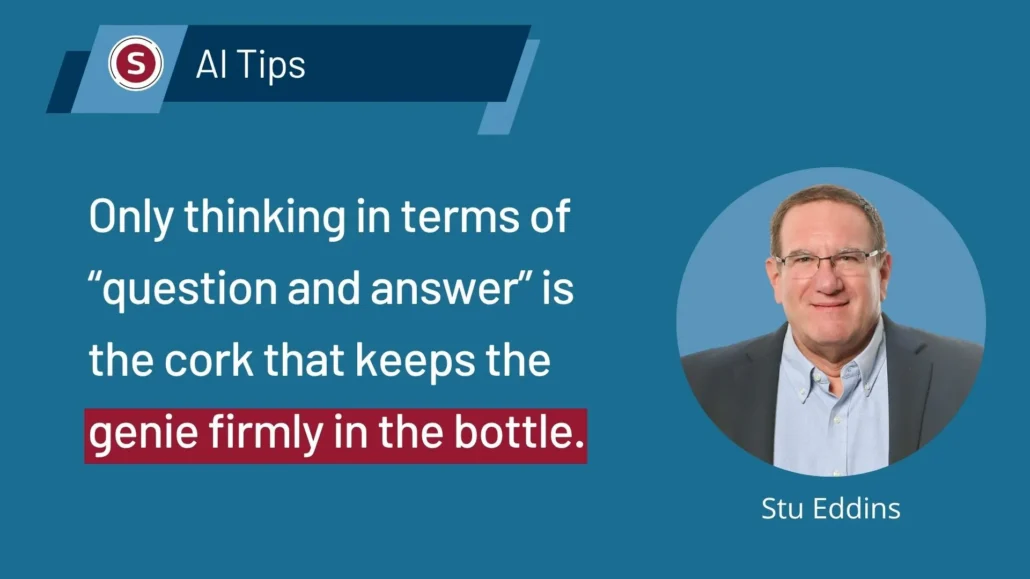
A recent study found that 80% of AI chatbot interactions consist of a single question and a single answer. Today’s users ask nothing more of AI chatbots than for them to be “super search engines.” This type of usage isn’t wrong; sometimes you need an answer. But it isn’t leveraging anywhere near the full potential of AI. Only thinking in terms of question and answer is the cork that keeps the genie firmly in the bottle.
If You Need Super-Search
My two cents: If all you need is a quick answer without digging through links to read the content, use Google Search. Google’s search engine is the most current, connected, and informed tool for information retrieval on the internet. And if you don’t want to click links to find your answer, Google’s AI Overview solves that for you.
The AI Overview pulls in the specific answers from across all the blue links on the results pages and summarizes the information for you. The most current information available, not a blend of older and dated training data, plus live search if it’s deemed necessary.
Old Habits Die Hard
Have you been using the internet long enough to remember search engines in the early 2000s? Back then, we knew the question we wanted to ask, but had to take a beat to distill it into two- or three-word search queries. Nobody taught us to do this, but after repeated trial and error, we just figured it out. “I need to find a top movie playing tonight, starting around 7:30” became “local movies”. A few years later, we could add the start time condition to our query and expect a response.
Even as recently as 2023, the average consumer search query was still between 3 and 5 words in length!
A New Habit to Develop
The key to getting more out of AI is to develop new habits. To make the AI experience more than just “super-search,” we start by unlearning the habit of condensing our needs into a handful of descriptive words. We can express our queries and prompts as full thoughts and sentences; we don’t need to edit and reduce.
After all, these are large language models; we can talk to them as we would a coworker. We can and should expect more than one standalone answer per interaction. We get there by learning a new habit that will make your AI experience much more productive and meaningful—using more words to create a conversation, which means no longer thinking about AI the same way we do a search engine.
Related: Read “4 Content Moves That Matter for AI Search in 2026”
Avoid Mega-Prompting
Another factor we must consider is that AI chatbots have access to vast amounts of information, which can cause them to drift off topic. Without initial grounding and refocusing on the goal along the way, a chatbot will often stray into tangents that yield less useful responses. This is why one big Mega-Prompt isn’t the best approach.
“Mega-Prompting” is a trend in which users try to write a 500-word prompt that covers every possible detail to get the perfect answer in one go. While this can sometimes work, it often leads to two problems:
- Prompt Dilution: The AI may follow 8 out of 10 instructions but completely ignore the other two because its “attention” is spread too thin.
- The “Wall of Text” Error: If the AI makes a logic error in paragraph one of a long response, every paragraph after that is usually based on that error, ruining the entire output.
If you find yourself spending 20 minutes “perfecting” a single prompt or query to get a one-and-done answer, you’ve likely spent more time than if you had just had a 2-minute, 4-query conversation.
Related: Read “Want to Get Found in AI Search? Start With Really Good SEO.”
Success Is in the Process, Not the Prompt
| The Goal | Approach | Why |
|---|---|---|
| Simple Facts | One Question, One Answer (Direct) | For “What is the boiling point of water?”, a conversation is a waste of time. Efficiency is king. |
| Creative Work | Multi-Question (Iterative) | AI often gives “average” answers first. Pushing it through 3 or 4 refinements forces it to move past clichés and get more specific. |
| Complex Logic | Multi-Question (Structured) | As mentioned before, AI accuracy drops with massive prompts. Breaking a big task into 5 smaller questions is more accurate than one “Mega-Prompt.” |
If you are working on something complex, like a marketing plan or a creative task like a writing project, a conversation will always yield better results.
Start by grounding the conversation with your first prompt. Briefly lay out what it is that you need, what the parameters or conditions are, and any unique aspects that make your desired result stand out.
“I need a marketing plan for an Occupational Therapy Assistant AAS degree. The goal is to earn RFI forms from prospects who haven’t yet fully committed to a college. The unique offering is free tuition for qualified students, and what makes XYZ College unique is that most students’ first jobs have annual salaries 2X greater than the cost of the degree.”
This example is a complex request, so we can expect several conversational adjustments as we fill in strategic holes and continually force focus on our desired outcome. Each successive prompt will refine the result, and it might take four or five back-and-forth exchanges to arrive at a satisfactory outcome.
If we expect the first response to a complex or creative prompt to be accurate and effective, we will be very disappointed. You probably wouldn’t expect a one-and-done solution from a junior colleague. That describes an AI chatbot—a lot of knowledge at their fingertips, not a lot of understanding of what’s important.
Related: Read “Is Schema Markup Necessary for AI Discovery?”
In Summary
AI tools and chatbots can be much more effective if we treat them as more than “super-search”. A key first step is to develop new habits rather than sticking with our time-honored search engine behaviors. AI tools and chatbots benefit from queries that are full thoughts rather than condensed descriptive statements.
We are having a conversation with a language-based tool, so expect multiple exchanges before arriving at a workable answer. Along the way, remember to stay focused on the desired outcome by reinforcing your follow-up prompts as needed. Finally, avoid Mega-Prompting. It might sound like a 500-word prompt full of details would be more efficient, but the results are usually far less useful, and creating the Mega-Prompt takes more time than a targeted 4-prompt exchange.
Your AI Discoverability Questions—Answered
Questions? Confusion? We’re happy to talk AI discoverability any time!