Written by
on
AI may be changing how patients find care, but it isn’t changing what they expect from healthcare brands: useful information, trustworthy experiences, and a clear path to the right care.
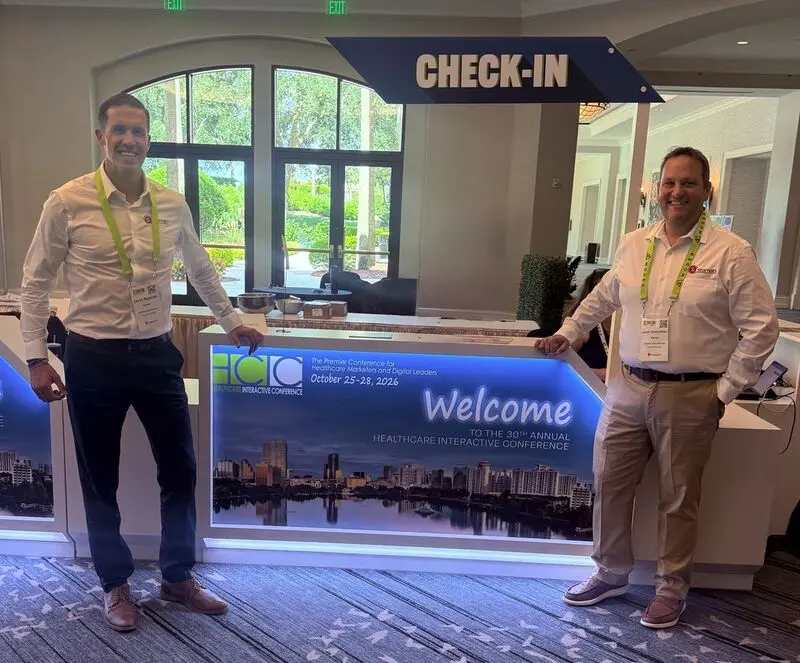
That tension between technological progress and human experience shaped many of the conversations at the 30th Healthcare Interactive Conference in ChampionsGate, Florida.
Jared Zimmerman and Chris Rapozo attended sessions covering AI-driven search, patient acquisition, data privacy, employee advocacy, and emotional intelligence. Across those topics, the idea that technology can make healthcare more efficient but can’t replace the need to make patients feel understood and cared for surfaced repeatedly. replace the need to make patients feel understood and cared for surfaced repeatedly.
Here are four lessons you can apply to your healthcare marketing strategy.
1. AI Is Changing How Patients Find and Evaluate Care
Healthcare search has traditionally focused on website traffic. AI-powered search is disrupting that familiar journey by giving patients answers directly, sometimes without sending them to a health system’s website.
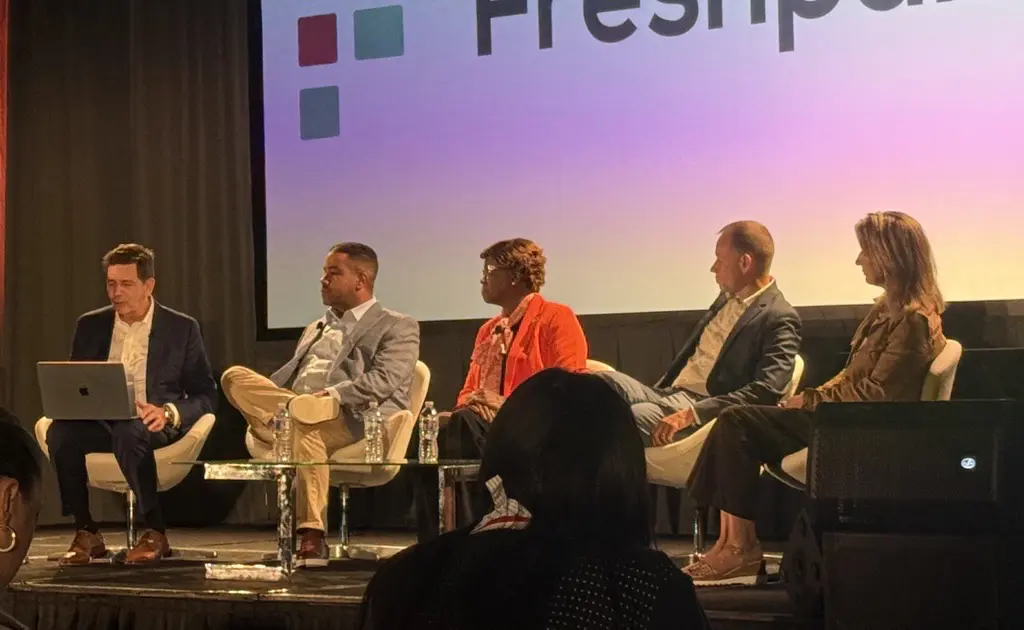
During Designing Your Healthcare Brand for AI-Driven Search: How to Win in a Zero-Click World, John Davey of Mount Sinai Health System, Julie Spencer Washington of Trinity Health, Kathy Smith of Roswell Park Comprehensive Cancer Center, and Val Lopez of Baptist Health South Florida explored this shift with moderator Stewart Gandolf of Healthcare Success.
Healthcare Search Visibility Goes Beyond Website Traffic
For your team, the question is no longer limited to whether your organization ranks for an important search term. You also need to know whether your expertise is represented accurately in the answers patients receive.
That raises the value of clear, authoritative content built around real patient questions. It also requires a broader definition of visibility. If fewer patient journeys begin with a website visit, clicks alone can’t tell you whether your content is influencing decisions.
Your search strategy should account for all the places patients may encounter your expertise, including traditional search results, AI-generated summaries, provider profiles, and third-party platforms. The goal isn’t simply to attract traffic. It’s to be credible and useful wherever research begins.
2. Marketing Measurement Must Connect Activity to Patient Outcomes
Clicks, calls, and leads can show that a campaign generated activity. They don’t necessarily show whether it helped someone become a patient.
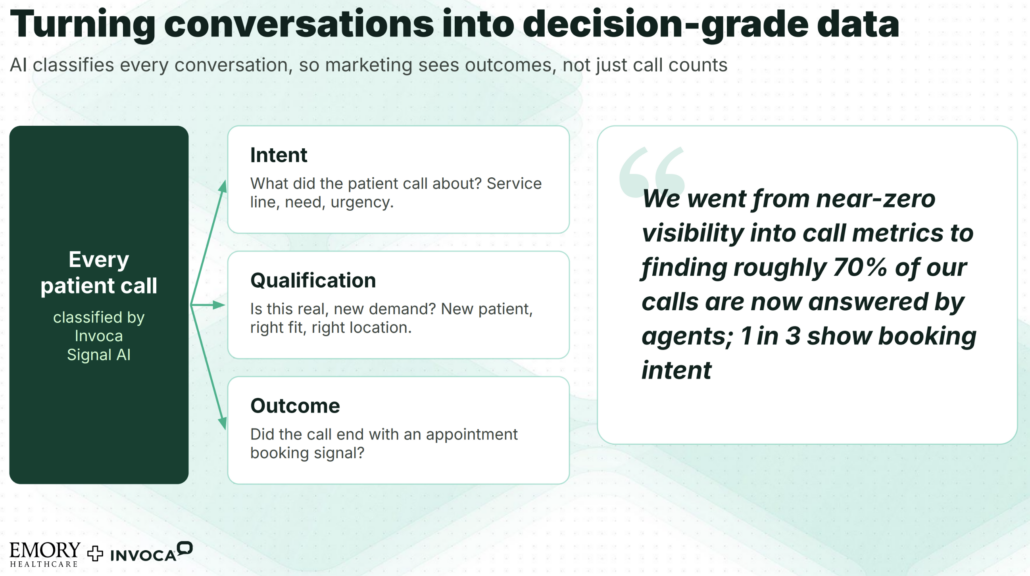
In Prove It or Lose It: How Emory Healthcare Uses Conversation Intelligence to Defend Budgets and Drive Decisions, Wade Huttunen-Smith of Emory Healthcare and Tom Phillips of Invoca showed how conversation intelligence can provide a better view of what happens when prospective patients call.
Instead of treating every call as an equally valuable conversion, you can analyze caller intent to determine which marketing efforts drive appointments and meaningful patient engagement.
A second session demonstrated what stronger measurements can look like at scale. In One Strategy. Zero CRM. $7M in Results: Turning Integrated Engagements into 1,600+ New Patients, Allison Wibbels, Kathryn Kahl, Morgan Crockett and Sarah Ramage of Norton Healthcare joined Tami Weigold of Unlock Health to discuss an integrated strategy that supported service-line growth without relying on a traditional CRM.
What made Norton’s approach interesting was its ability to track engagement beyond clicks, including health risk assessment completions, appointment scheduling, and performance against national benchmarks. By partnering with Finance to match assessment participants with billing records, Norton could also measure new patients and downstream revenue. The program reported more than 1,739 appointments, 735 new patients, and $7.77 million in measured net revenue across the health system.
The lesson: You don’t necessarily need an enterprise CRM to demonstrate marketing’s value. You need the right data and collaboration across departments to connect marketing activity to patient growth and revenue.
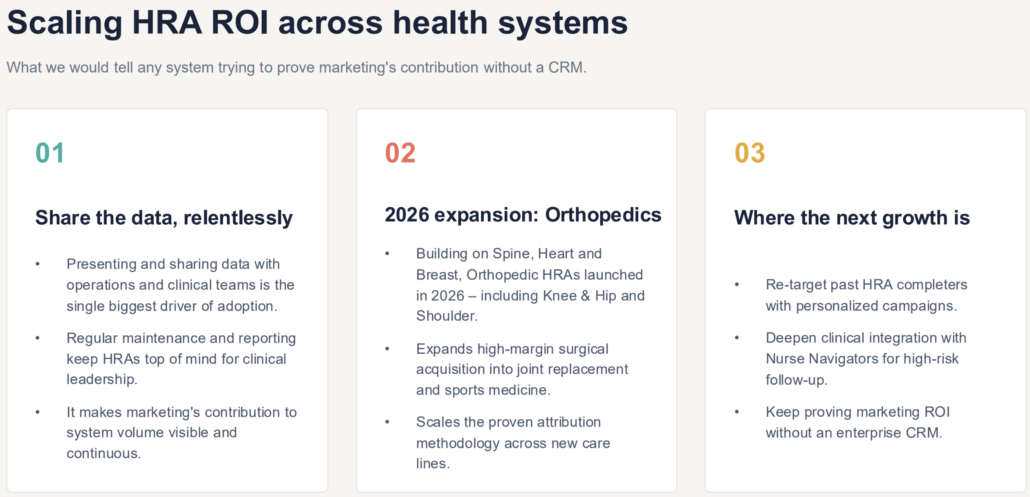
That doesn’t mean abandoning channel metrics. It means connecting them to appointments, patient acquisition, service-line growth, and other meaningful outcomes. When you can trace that connection, your reporting becomes more useful to both marketing teams and organizational leaders.
3. Measurement and Privacy Must Evolve Together
Better performance data can help you make better decisions, but healthcare marketers operate in an environment where privacy mistakes carry serious legal and reputational consequences.
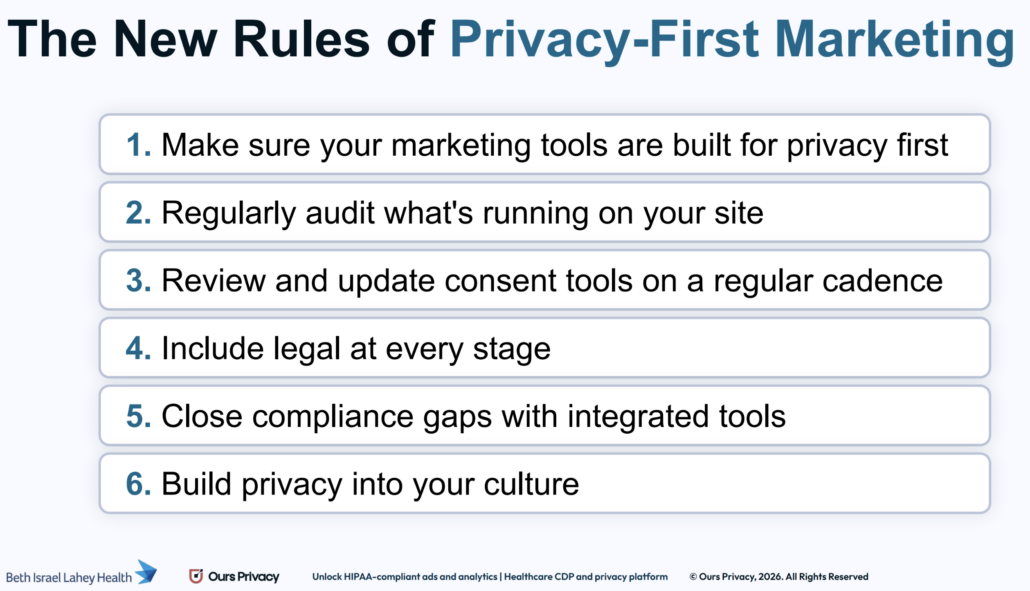
In New Rules of Privacy-First Marketing, Mariia Derhachova and Vanessa Hill of Beth Israel Lahey Health joined Jessica Holton, co-founder and CEO of Ours Privacy, to examine how privacy requirements are changing established analytics practices.
The team shared that it removed its website analytics and tracking pixels in 2022 amid growing privacy concerns. With approximately 17 websites to manage, the organization lost visibility into website performance, making it difficult to measure marketing effectiveness and justify spending.
The session also highlighted overlooked privacy risks, including embedded YouTube videos, Google Maps, and live chat tools. The presenters advocated for privacy-first measurement that respects patient consent, limits the information shared with third parties, and regularly audits website technologies.
The takeaway: Protecting patient privacy and measuring marketing performance don’t have to be competing priorities. Healthcare marketers need to understand what data their websites collect, where it goes, and how to maintain useful measurement without unnecessarily exposing patient information.
Richard Chapman, Enterprise Privacy Director for Health and Hospital Corporation at Eskenazi Hospital in Indianapolis, continued that conversation in From Campaign Optimization to Litigation Exposure: How the Marketing Stack Became a Legal System. His session underscored how technologies selected for routine campaign optimization can create legal exposure.
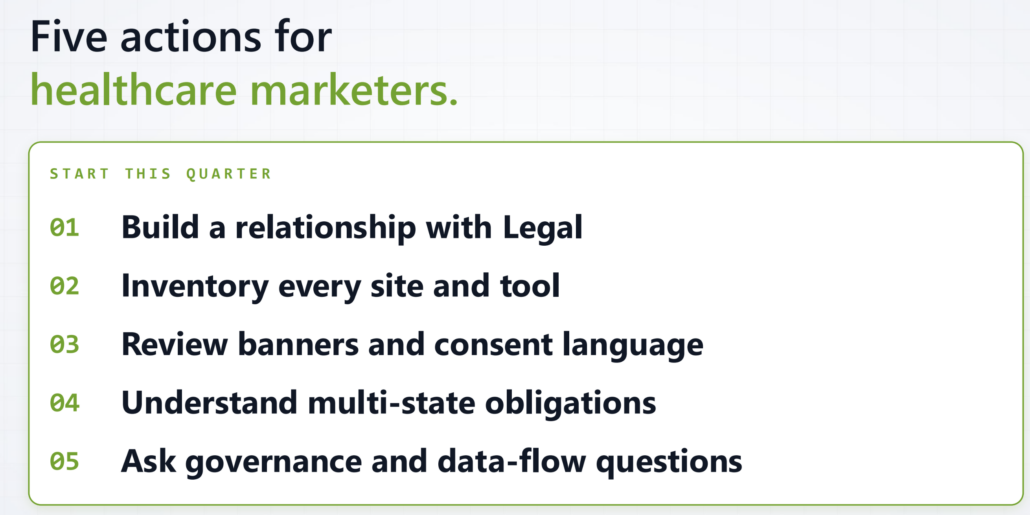
Privacy isn’t a final compliance check after a campaign has been planned. It should influence decisions about analytics platforms, website technologies, data sharing, vendor relationships, and performance reporting from the beginning.
For your team, that means asking two questions: Will this data help us make a better decision, and are we creating unnecessary risk by collecting or sharing it?
The strongest measurement strategy isn’t the one that gathers the most information. It’s the one that produces useful, defensible insights while protecting patient trust.
4. Human Expertise Is Still a Competitive Advantage
Technology can remove friction, but it can’t compensate for an experience that makes patients feel ignored or processed. That was the central message of Jake Poore, president and chief experience officer of Integrated Loyalty Systems, during The New AI: Authentic Interactions in an Artificial Intelligence World.
Small gestures, such as listening carefully, remembering something personal, or recognizing a patient’s concerns, can shape the care experience in meaningful ways.
Andrew Chang, chief marketing officer at UChicago Medicine, and Kristy Roldan, vice president of growth at MDRG, extended that idea in Trust, Transparency, and Patient Flow: The New CMO Imperative. Trust is influenced by the entire journey, including how easily someone can find information and schedule care.
Your brand promise doesn’t end when a patient responds to a campaign. And if the next step involves unanswered calls or a frustrating scheduling process, that promise breaks.
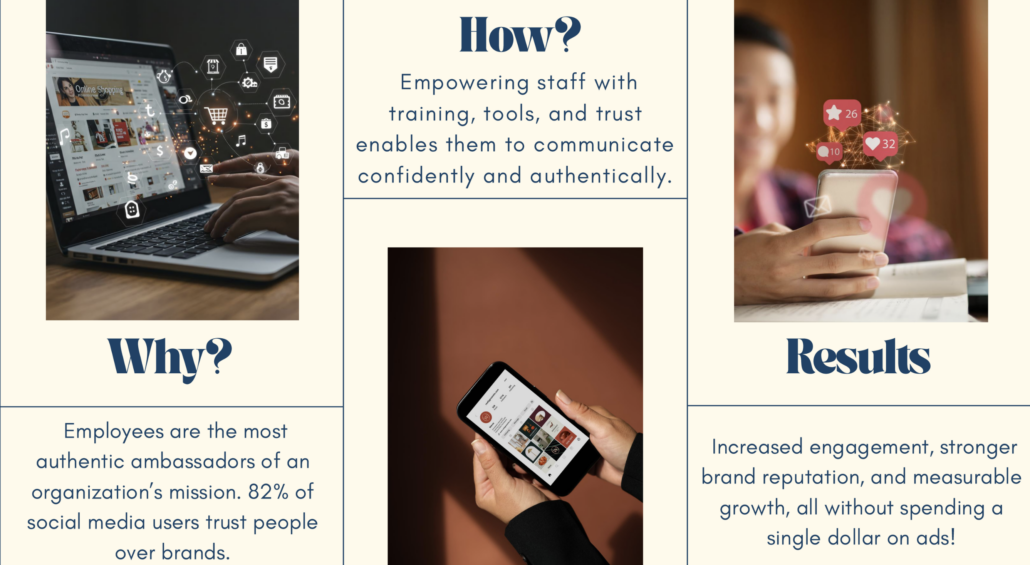
The people inside your organization can also make the brand more credible. Kristina Chaki and Genevieve Moorhead of Sheppard Pratt joined Brooke Koppeser of Hootsuite in An Internal Influence: How Employee Ambassadors Are Paving the Way for Brands to show how employees can extend reach and add authenticity to communications.
Kaiser Permanente highlighted a related opportunity in From Podcast to Platform: How Kaiser Permanente Uses Physician-Led Video Podcasts to Drive Trust, Reach, and Measurable Digital Impact. Meredith Herzing and Dawn Piper of Kaiser Permanente’s Mid-Atlantic Permanente Medical Group joined Bill Klaproth of DoctorPodcasting to discuss using physician-led video podcasts to make expertise more accessible.
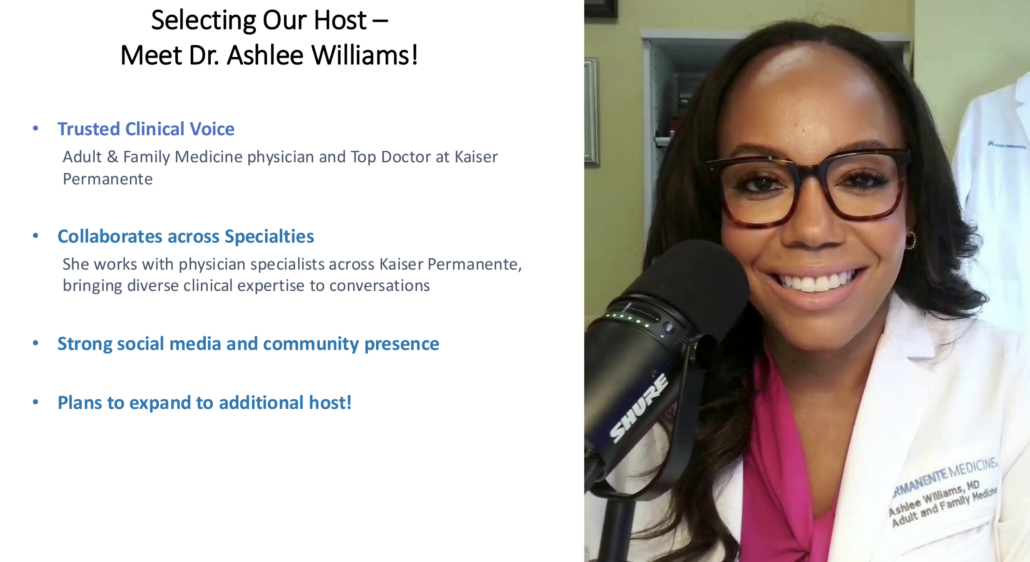
Clinicians, employees, and leaders already hold some of your organization’s most valuable content. A sustainable expert-content program can help patients understand their options while introducing them to the people behind their care.
What HCIC 2026 Means for Your Marketing Strategy
The tools available to healthcare marketers will continue to change. AI will reshape discovery. Privacy expectations will influence measurement. Leadership will keep asking marketing to demonstrate its contribution to growth. But the purpose of the work remains consistent.
Your job is to help people find reliable information, navigate their choices, and connect with the care they need. Technology should make that easier. Measurement should show whether it’s happening. And every brand promise should reflect the experience patients receive.
Contact us to learn how you can strengthen your visibility in AI-powered search and connect more patients with the expertise they’re looking for.
Let Stamats Help You
Interested in applying these ideas at your system? The team at Stamats helps healthcare organizations turn strategy into measurable results. Let’s talk.