Written by
on
April 3, 2026
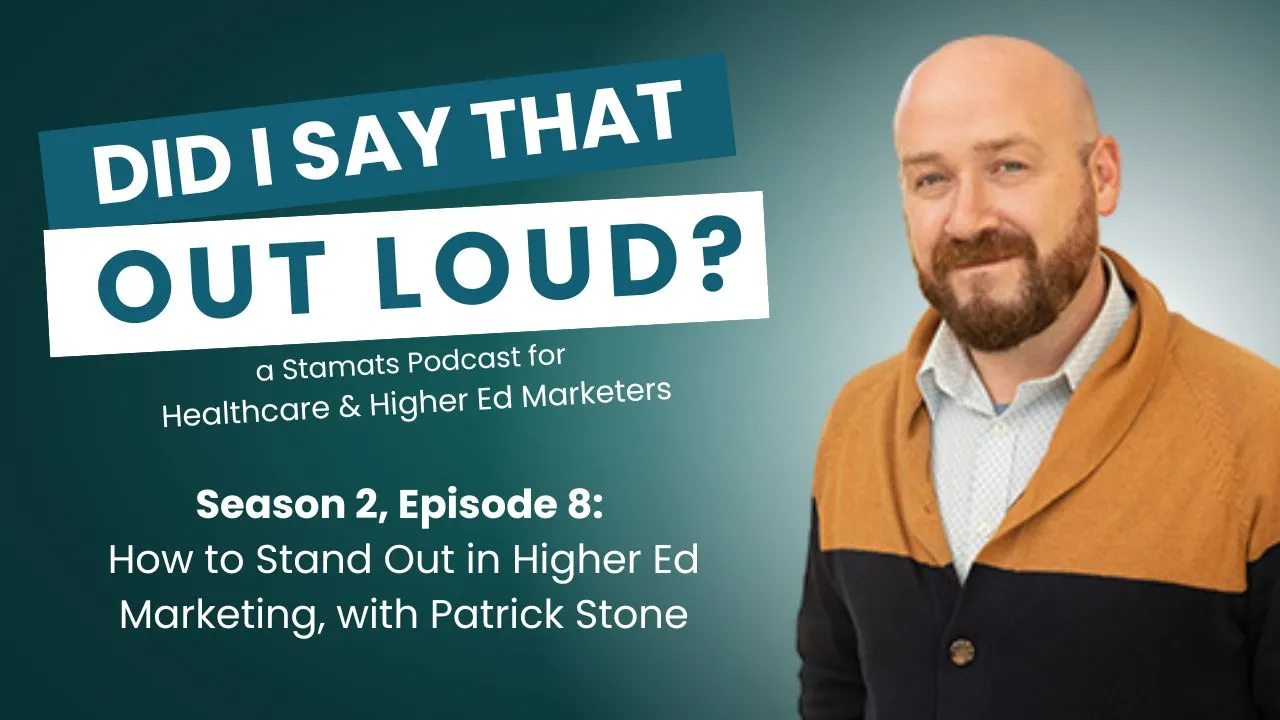
Season 2, Episode 8
Your [journey] [career] [story] starts here. Sound familiar? It’s tough to make your brand stand out in the saturated world of community college marketing. Patrick Stone shares insider info on the plusses and panic of taking big marketing risks and the surprising benefits of loosening the reins.
Listen to Episode
Show Notes
Transcript
Mariah Tang: Did I say that out loud? Welcome to “Did I Say that Out Loud?”, a podcast where Stu Eddins and Mariah Tang reflect on agency life and answer questions from our higher ed and healthcare clients about the latest in digital marketing, content and SEO.
Mariah: Hey everybody, thanks for joining us. We are here live from the Cedar Rapids headquarters with Patrick Stone. He is the Director of Strategic Communications and Marketing for Cape Cod Community College, and he is the NCMPR president. He is a community college graduate. He has worked in community college marketing since 2011, and he’s led successful and innovative teams for several institutions in the south coast of Massachusetts and Rhode Island. So since 2019, he’s served on the National Board for NCMPR. That is the country’s premier professional development organization for marketing and communication specialists in community and technical colleges. So welcome, Patrick. Thanks so much for joining us.
Patrick Stone: Thanks so much for having me. It’s very much my honor.
Mariah: Yes, yes, we are jazzed. We’ve met you at NCNPR and now we get a chance to chat with you and pick your brain about some marketing stuff. So let’s just jump in with the most obvious statement that Stu will hear me make today and it’s probably going to be one of many: higher ed is a crowded market. There’s a lot going on. So as you have mentioned many times in your LinkedIn policy and in your presentations over the last couple of years, standing out is really essential for marketing teams. And you recently did an article about this for the Community College Daily and we’ll put a link to that in our show notes, but could you give us just a high overview of that piece, Patrick?
Patrick: Yeah, sure that and thank you for…this is my favorite stuff to talk about marketing stuff. Yeah, so I’ve talked about this for a really long time since working in higher ed marketing, but standing out in a crowd. Kind of even follows me back to my first real grown-up job was working in radio. I was a production director for a talk radio station and so I did all the commercials for this small radio station and that was sort of my first introduction to the psychology of marketing and advertising and how do you take something that can be otherwise dull or just the idea of I need you to listen to my ad and then do something about it afterwards. And then that was sort of a guiding principle when I did radio commercials and how do we, you know, I’m working with a mom and pop pizza place who spent a lot of money on radio time in the small radio station. I can’t just make them this boring 30-second commercial; it has to stand out. And that’s been even more pervasive in higher ed and doing this for 15 years.
So the thing I wrote for CC Daily, I was really privileged to talk to a bunch of really, really smart people from across the country. I did it when I was on my tour of the district conferences for NCMPR in the fall and had this idea in mind. Kind of this piece I was writing for CC Daily about standing out in the marketplace in higher ed because yeah, like you said, we are in competition as community colleges.
We’re in competition with first and foremost nothing at all, right? Our students just deciding not to take action. But we’re up in the same marketplace as these mega online colleges from across the country who have infinite resources and are talking to the same exact students we’re talking to. We’re in competition with the local four-year colleges and universities who again are trying to target the exact same groups we are. And then there’s us with our limited resources, our, you know, small budgets, our small teams trying to stand out in this space.
And so you know what I wrote about in TC Daily is kind of a three-fold approach to how do you go about standing out, especially knowing our modern audiences. And you know we could have 5 seconds or less to try to talk to a student if we’re talking about like a social media video.
So focused on three things, taking big swings with confidence in your messaging.
The second being not trying to solve every enrollment nuance in those 8 seconds. I think that’s one thing that does trip us up a lot in higher ed. We get those, you know, it’s time to do an ad campaign and OK, well, we first we have to listen to what admissions has to say. And financial aid didn’t like what you had to put up. You know, you said do your financial aid, but you didn’t give all the nuances of who is eligible for financial aid and trying to solve all those massive complications about going to college in advertising and making it more about, you know, get them to the front door and the last being this, the sort of modernization of the big brand message and sort of peeling back from, you know, one big message to rule them all in more multi-tiered audience specific, you know, highly targeted.
Ads that on the surface will make it look like you don’t have one big brand campaign. It’ll look like you don’t just have, you know, your one big fun tagline and one picture and one image that you sort of rotate through. And instead, you have 15-20 different ads running at the same time that all point in the same direction, but on the surface probably don’t look like one big brand campaign. Instead, they’re very specific to the audience that you’re talking about.
So, you know, there’s a lot of things that go into standing out. I think, you know that first one, the taking the big swings, that’s been, you know, really big in my career and from what I’ve observed and you know to me that means you’re taking risks, right? You’re it’s very easy when we sit down and talk about how are we going to market our college and how are we going to try to get students to the front door. And we all sit around and we go, well, what are the selling points of the college? Well, we have 90-plus programs and we have lots of scholarships and financial aid, and we have small class sizes. And all those, we all have the same things and so do the four-year colleges.
And you know, I always like to think about this in terms of radio commercials. You hear radio commercials and it’s, you know, come to “blank blank” Community College with 90 plus programs to choose from and you’ll feel welcome and opportunity is here and you can start here and go anywhere. It’s all the same, right? Like it’s we’re not appealing to any sort of, you know, audience need or want. We’re not building trust. We’re just telling you why we think you should trust us and bigger swings are needed than that to stand out and build trust. And in this marketplace where there’s dozens of those commercials over and over and over again from our competition. There’s a lot we are ripe in the Community College space to push back on that and take those swings.
Mariah: I think we should hire you for a voiceover. That little radio voice was rad.
Patrick: I spent six years doing voiceover work, so…
Mariah: Go ahead, Stu.
Stu Eddins: You’ve hit on a couple of really outstanding points. First off, one thing that I’ve noticed is that the ideation stage is given little time the idea of how to get a message out. It does come down to a focus on. I’ve got enough money for one video. Let’s cram it all in there. That’s one thing you said. Or let’s make one really big one and cut it up nine different ways. And there’s some validity to that, but that doesn’t mean that the background and everything is going to work the same on TikTok as it does on Facebook. But the other thing that I found interesting and I’d like to hear your thoughts on this, how do you get that concept conceptualization, how do you get that ideation going in a brainstorm to generate the variety of ideas you need to get out across multiple media interfaces?
Patrick: Yeah, that’s a great question. I think that’s the hardest part, right, is how do you be? I always say that the two toughest things we have to do in our role are be creative all the time and care all the time. Those are really two hard things to do 24/7, but I think that’s kind of where it comes from is dedicating yourself to how can we tell, how can we tell what would otherwise be sort of a standard talking point for our institution and what someone might want to hear in a creative and fun way and build trust. And I think, you know, how do you get it across different mediums? I think you sit down and you think about, well, what is it we’re trying to accomplish here, right?
So if it’s, you know, we’re trying to get people to our academic advising office, right? Because they’re only going there to pick their classes and they’re not going there to get problem solved. And that’s like, that’s a hard one, right? Like that’s an institutional problem that most community colleges would have. And I think, you know, OK, well, we’ll strip that down to its bare bones. We’re trying to get students to take action, to know where to go when they have a problem beyond picking your classes. So you know, I could picture that being right. I use this as an example because we’re in the midst of a campaign on something like this now at Cape Cod Community College. You know, that’s something where you know our first inclination as a team is, OK, well, how do we brand the advisors?
Can we bring the advisors in such a way where they’re fun, right? Can we do this in such a way where it’s gonna be TikTok-friendl, where it’s short, punchy, fun, get to know the advisors. It could be, you know, we’re presenting them in sort of a funny way or we’re presenting it in sort of a super serious, but you know, tongue-in-cheek kind of way where, you know, these are your chief problem solvers.
That’s something where you could even, you know, one of the things we’ve dabbled with in that is, you know, picking your classes is easy. Come here for everything else because it’s hard, right? Like you can sort of flip. One of the things I think helps is just sort of flip the original idea you have on its head and make it obvious.
I’ve seen a lot of that in higher ed marketing over the course of 15 years. In fact, one of my the first campaigns I ever worked on when I was young and in the field was a campaign where we it was working at Bristol Community College in Massachusetts. And we were kind of feeling this pain that we’re spending all of our time trying to convince students that this is a good choice. But when you talk to students, when they get here, they know this was a good choice. And so it becomes sort of this self-defeating, you know, like we’re trying to convince you that we’re better than we, you know, we’re better than you think. And so inherently we’re telling you that we’re not as good as you think.
And we came up with this campaign at the time that was sort of steeped in, you know, you get, we called it, “you get it.” And it didn’t really work very well, largely because it just took on too many iterations. But that ideology, it evolved into something different. But the idea was the students know what they need. They know they’re here for a reason. They need help, right? So they need. You’ve identified the problem for them and then give them the resource that they need to solve it. Don’t tell them to go do something, right? Like we tell our students to do too much in these messages, like come to our event, come to our luncheon. Come to financial aid, come to advising. We tell our students to do too much. If we present it as picking your classes easy, we’ll help you solve something else. Then that’s what we’ve kind of broken through sort of the noise on it. We’ve told you the, you know, we’re not trying to tell you to go pick your classes here. You have to go pick your classes here.
And sort of hitting on the idea that we are you, you’re here, you’re here and you know what you’re doing, but we’re going to give you a solution to a problem that maybe you don’t know you’re having or a problem that you will eventually have. And then because you trust us enough to follow us and listen to us, hopefully that penetrates through and then you will have that resource available when the time comes that you need it.
Stu: Are you finding that a lot of that connection is over the awareness of a future problem, generating awareness of the future problem and offering a solution? Are you finding that social media is a particularly good channel for that or are you finding something else is working for you like blog articles for distribution?
Patrick: I think that the single most important channel we have with communicating with prospects and our current students is social media. It’s modern public relations. It is. We are controlling our narratives, we are controlling our story, we are controlling our brand, we’re controlling what.
We want to tell you who we are and what we stand for. So I think colleges, and this is something we take a lot of stock in here at Cape Cod, colleges that use social media to build the brand and build trust have a better opportunity to then break through to their students when they need that problem solved. Because if you are one who uses your social media to as an advertising platform, right? Like if you were using your Instagram stories to promote every event that’s happening on campus this week, we’re posting PDFs, we’re posting here, go to this event, go to this event, go to this thing, go to that thing. Your students will phase you out and they will not listen. I know on our Instagram, which is our primary communications brand tool to talk to current students, we don’t use our Instagram to promote events.
Because when we have done that in the past, we watch our followers go down and we lose that trust. There are a lot of other channels by which we can communicate events and we can tell you to go do stuff. But when we use that Instagram story or Instagram channel to say like a, you know, an example of an advisor, hey, I’m such and such an advisor or I’m, I’m so and so from the Wellness department. We have an event going on today. Come on by and this is what we have going on. And then you know it’s a trust building exercise to say we’re not…our channels aren’t here to get you to do something. Our channels are here to tell you who we are and that we’re here for you. So yeah, social media to me is the is the number one tool.
If you do it right, if you use it as a means to tell your story and to build your brand, your students and your prospects will understand you and trust you when that time comes where they need you for something.
Stu: Those are great points and a couple of things you said also in one way what I notice in a lot of the brand advertising that’s going on kind of switching from the connection to the brand itself. I’ve often thought that if somebody’s lived in a particular area for more than three years and they’re not aware of the Community College we’ve got a bigger problem to talk about. So let’s get off of “we’re here and in this” and talk about how we can serve you.
Patrick: Yeah, yeah, absolutely. That’s I that’s such a common thing that I still see that have nothing drives me more nuts than that Stu. Like it nothing drives me more nuts than colleges who start their message. Again, this is the Community College graduate in me speaking. I hate seeing a Community College that starts off with “we’re more than you think.”
Right. Like it’s I think we’ve advanced past this idea of like we have a stigma. I think we’ve I truthfully across the country believe we have advanced past this idea of the stigma and even if there’s spots where it does exist to lead with the stigma only enhances the stigma. I completely agree with you.
Stu: Nothing is more true now to me than it seems from the 1960s when it was stated the media is the message. You do have to make sure that you’re cognizant of the platform you’re using.
You mentioned you don’t use Instagram for promoting events, but you’ll use it to promote the person who may talk about it. Do you find that there’s other media that you tend to lean in into for specific purposes? And I’m not talking about events and not necessarily program promotion, because I think there’s a little too much fixation on that from time to time as well. But is there anything that or let me rephrase this because I do want to be cognizant of our time. Are you using your media to try to drive people toward a one-on-one engagement with your counselor? I think I heard you say that, but is that close to the truth?
Patrick: I think it, I like you said, I think it depends on the medium and it depends. So like if it were just like breaking apart the different channels, right? Like our public website is for prospective students, right? Like our number one marketing tool all the time. So that’s our that is our that is only for prospective students, our student portal. It’s for our current students. It’s where all the news, the calendar events. That’s where people, that’s where our current students are face. What’s the dipping into social media? Facebook is like to us, our own newspaper. We use Facebook as a means to say to give you news about the institution because we know the audience there is skewing older. It is skewing potentially.
Parents, decision makers, grandparents, it’s going to skew older than our, you know, largely from our average-age student here of 27 at Cape Cod Community College. So Facebook to us is like, you know, back when the media industry was still thriving, the local media industry was thriving. Stuff I would have sent out as press releases to them. I’m now putting up on Facebook as news. Now Instagram is our current student tool for communications. We use our post to show.
Instagram is where we show you how cool we actually are, right? We’re gonna show you what we look like. We’re gonna show you the programs. We’re not gonna tell you anything. We’re not gonna ask you to do anything. We’re gonna show you what we do and how it’s cool here.
TikTok is brand building for a younger audience. TikTok is where we’re starting to build development and engagement and trust with high school age students, younger, right? It’s funny. It’s short video. It’s not branded to do any particular thing other than, hey, we know what we’re doing here and it’s a cool place. And when the time comes and you’re ready to trust us, door, you can trust us. We know what we’re doing. And so, you know, you talked about finding a counselor. I think it depends on. So what are we trying to accomplish? OK, so now we’re talking to current students. We want to get someone over to advising.
So that means we’re probably gonna be leveraging our Instagram channel, right? When it comes time to do that and not throwing every single thing we have up on Facebook. As you know, we made a video over here and it took us a long time, so put it on every single solitary channel. Now it didn’t really work that way. It used to. I know when I first started in social media, that was. You know, develop one thing, post everywhere, but that’s not true anymore.
Stu: Do you try to adhere to a very high standard of production or are you OK with more of that user generated content look or even just I had a moment, I made this video. Do you have anything you try to adhere to on that?
Patrick: Little of both. I think you know you’re if you’re on social media or on Instagram reels, cell phone shot video is fine, right? It’s authentic. You’re showing people what it looks like in the moment. When we’re doing photos, you know we’re showing what the college looks like on our on our channels. Yeah, we want, we have. I’m very fortunate to have basically everybody on my team is a professional photographer. I don’t know how that worked out. They’re all, they’re all photographers. So yeah, that looks. We try to make it look like 1,000,000 bucks. I think visual communication is still if not the most important, pretty close to being the most important thing that we do at the community colleges, because it’s easy to dip into that. Well, it doesn’t really matter what we look like, right? You know, I to me, you know, if you’re if we consider ourselves up against something like a southern New Hampshire, you know, university with millions and millions of resources, one thing that SNHU can’t do or these online mega universities can’t do is they can’t outlook us, right? Like they can’t out visualize our colleges. If we put effort and strategy into looking the part when it’s appropriate to look the part, then that’s it’s something we do prioritize.
Mariah: One of the things that we talked about in our pre-podcast meeting was the role of courage and confidence in higher ed marketing. And you alluded to that in the beginning. So I wanted to swing us back around to that with all these new social platforms like TikTok, I guess not new anymore, but it’s always changing, right? Everything is changing all the time with all the AI tools and all of that good stuff. A lot of these, the younger generation of marketers that are coming up have really cool ideas. They have really cool perspectives and then they run into people, you know, like my age and up that are.
Like, you know, hold your horses here. Let’s, let’s take a beat here. Is this what we want to do? How can we take ourselves out of that and just say, let’s let these, you know, newer professionals kind of take the reins a bit. How can we encourage that behavior in those younger marketers?
Yeah, I it, you know, I I think as bosses, right, as supervisors, as, you know, senior marketing people running departments, I think it’s letting your team take those risks, right? Like it’s tough for me. It would be tough for me to say at CC Daily take big swings and then my team comes to me with a big swing and I go, oh, that makes me scared.
Mariah: Not that big.
Patrick: Trust me, a lot of time, a lot of time it makes me scared. We’ve done a lot of things where I go, Oh my God, I’m turning off notifications in case this goes bad. But you have to have trust. And I I think, you know, as long as the team, as long as you know the team, and I think this is true with a lot of young, young and newer members coming into the field and there are a lot of young and new members coming into the field, especially in creative fields is I think they do have a really strong understanding of the connection between the message and the psychology of the audience.
And I really do think that’s because of how you know Gen Z and now Gen Alpha are consuming messages and then turning it back, around…I don’t think they’re burdened with, you know, the history of how this is how we’ve always done advertising, right? Like we have to say start here and go anywhere because that is the promise of the institution. They have different takes on it and not everything’s going to work, but not everything has to work. So you know, there’s a reason why we have AB testing when we do ads, right? You want to follow the data. But you know, I think that that’s the big thing is, is, you know, trying things out and then doing your best to follow the numbers. And then if it works, continue to pursue it. If it doesn’t, don’t linger on it. You know, not everything is going to be a home run. Not every big swing is going to be all is going to hit.
And when it does follow it right and then adjust it. And I think that’s that’s one thing that we, you know I’ve stressed a lot to you know when I’ve had a chance to talk to newer people in the field is that you took a big swing and it worked great. Now do something different. Where like you can’t like it’s not gonna be the same. It can’t be the same thing over and over again. You know, gone are those days when it was like, wow, I found a really great brand campaign. I’m gonna do it for three years.
You know, when I first started, that’s what we did. It was like, oh, awesome. I found this really awesome brand campaign. It’s resonating. It’s visually cool enrollment. You know, took a dip up. We’re doing a good job. I’m gonna keep it for a long time. You can’t. You can’t now. Now you have to keep that idea of like, all right, well, maybe we grabbed onto a thread there. Like, what made that campaign work? What made that message hit? OK, well, now let’s dig into it and maybe shift it and try something different. But yeah, as the senior folks, I think, it’s just, you got to kind of let go of the rope a little bit and let, you know, let the team have ideas.
Mariah: Yeah, yeah, there’s always room to fail quickly and room to learn from that. And one thing that I kind of get my hands slapped for saying this to clients, but honestly, unless the mistake or, you know, “mistake,” is egregious and offensive and terrible. People probably aren’t gonna notice until you make a big, you know, hubbub about it. So if there’s a typo, edit the post and fix the typo. If there’s like a mismatch of coloring, swap in a different picture or take it down and repost it later. It’s, you know, it’s not the end of the world. And I find myself freaking out about stuff because, you know, agency life.
All right, so if I can give you my favorite example of failing and learning from it. So I mentioned earlier that idea of the of you get it campaign. So this is this is a a million years ago now but. So I was leading the marketing campaigns for Bristol Community College and we kind of felt like, all right, we tried to peek around the corner and sell. OK, we want to change the message. We want to get away from selling students. We want to get away from this idea of convincing students that this is the place we want to be. And so we developed this, oh, because students get it right. They they get where we’re coming from. So that became our campaign tag. It was you get it. And we thought it was like, oh, this is fun, double entendre where like you get it and then we can do you get. And then when we thought further out in the campaign we can do, you know, you get services, you get support, you get colleagues like there was a lot of different likes to this and we really liked it.
We launched it and it was kind of like, all right, we’re going to launch it as a brand first. You get it and make people go, oh, what does that mean? And then we were going to keep layering it out and then our designer left the college and she had custom made this, this kind of brand and we kind of spiraled and we thought, OK, how do we got to advance this quickly now and we started jumping into get blank, get, you know get support. So we started leaning into some of those different those different tropes and we had a big wall of ideas that our newer designer who was who was very young and he’d come in and he came up with these great visuals of get you know blank right and then and then something with it.
And there was probably 20 of them up on a wall.
And then I went on vacation and I came home from vacation to drive down the highway and see that one of those had been chosen for a billboard while I was gone.
Mariah: Oh, no.
Patrick: And it was one that was kind of serious, but not really serious. And it was get a life. And there it was driving by it on the highway and I came into work and to say people were mad at me is an understatement.
Mariah: So millennial me thinks that’s hilarious and I I would totally love that, but perhaps I am not the audience.
Patrick: Correct. Yeah. Millennial B was like, well, it was funny. It was funny and it hit well when I was looking at it on a wall. But to see it blown up on a billboard when I didn’t say that was OK, not so much. And so we wrestled with it and we struggled with it and we tried to salvage the campaign and it it really it that hit so poorly, and it left such a bad taste in people’s mouths that we by the that was in the fall. By the spring, we sat back and went, all right, we I like the tenets of what we were trying to do that didn’t work. And so that was a big swing and boy did we miss. And so we pivoted it…
Mariah: Get a new campaign.
Patrick: Yeah, so we pivoted to, OK, well, you know that same idea of like something really strongly visual. Anyway, we landed on a redeveloped campaign that was alumni based. But that same idea of like we’re not going to sell you on anything, we’re going to show you the success stories and that’s how we’ll point in that direction. And that turned into what it was called Because Bristol (Bristol Community College).
And it was really cool and it was very visually striking. But we took the same tenets of that big miss and we turned it into something that ultimately wound up being a win. And that semester, yeah, you dwell on it. You get upset by like, I can’t believe that didn’t work. I’m never like you still have to take those lessons learned from something that didn’t work. There’s probably something in it that was a good idea that got you there in the first place. And then keep trying.
Mariah: Yeah, yeah, absolutely. And you know, as a younger teammate or as a novice teammate, if you’re coming in from a different industry into higher ed marketing, I think it’s very easy to get like, here’s all of my great ideas and then get completely squashed by the well, we can’t do that because or the fine print is here. And…so when you’re when you’re mentoring or when you’re coaching your newer team members, how do you, how do you encourage them to really push some of those ideas forward? What’s the line to draw?
Patrick: What’s the line to draw is a good question. I think so long as it is, as long as the good idea ultimately ends in what’s a student going to get out of this or you know, what is a current student or what is a prospective student going to get out of this depending on what we’re working on, as long as that’s at the core. There, I think I tend to give rope. I tend to say, all right, you know, I understand the psychology of what we’re doing. You know, if we’re doing something just big and silly for the sake of being silly, it’s like, OK, well, let’s talk about maybe the channel that’s going on, right? If we’re doing something just funny for the sake of it, maybe it’s TikTok, maybe it’s something we don’t do at all.
But you know, like, and a lot of this stuff, I’m elder millennial. A lot of this stuff goes over my head and it’s like, you know, once upon a time I knew what I was doing when it came to social media. But you know, we had a, you know, we have a lot of fun in our social media channels and we do, I think we do a really good job and you know something that comes along like last year we worked with two student workers and they were really funny.
And they were really deadpan and they had all these great ideas and you know they came to us with this idea of my guy, my team who read social media and he said we’re gonna do a video where it’s have you seen that “I’m gonna throw a box at you trend” and it’s I’m gonna get my message in before the box hits you. And I was like, no, I have no idea what you’re talking about. That’s….don’t get it. We said we’re gonna do it to promote going to see your academic advisor. It’s advising season for midterms and I thought, OK, that’s I understand at least as long as it’s ending with it’s like mission-centered.
It’s like we’re asking you to do something and they did and it was one of the more shared things that we did last year. And it was like, you know, it was silly. It was funny. It was an odd swing I never would have came up with. But it was centered to, all right, we’re trying to communicate something really, really important that is very boring to communicate. We have to come up with a fun way to do it. And that was the solve. And it did it. It worked. It did. It ultimately did work. And I think there’s merit to taking a step back to go, OK, well, you know, it’s tough being creative. It’s tough breaking through the mold. What do you like? What do you like?
You know, McDonald’s runs 25 different campaigns at a time. Progressive Insurance is selling the last thing. They have funny commercials. They’re not selling insurance. All these ads that there’re things we can learn from these major ad campaigns and stuff that we like in our own lives. What made you go buy the thing on Amazon that we just bought last week? Like, what got you there? Was it an ad that told you every single solid?
Or was it a brand message that got you to take interest in it? And you and I talked about this, but my aha moment with this many years ago, when I first started in the field and was wrestling with this, was there was a short story written in a bunch of stories by the author, Chuck Klosterman, who was like a pop culture.
Critic and he had a book called Eating the Dinosaur and one of his essays in that book was it’ll surprise you how much it never happened. And it was this juxtaposition between Mad Men, the culture of Mad Men and advertising in the 50s and when advertising really first became pervasive, and then the launch of the launch and failure of Crystal Pepsi.
And it’s really worth reading to get the short essay. But what hit me about it was, you know, what he summarized was the modern audience knows we’re being advertised to. And so if we all know we’re being advertised to take the opportunity to appeal to what interests them, entertain them, make them like you, right? Like this isn’t Mad Men in the ‘50s saying, you know, we have to come up with a way to subvert housewives into buying microwave ovens and we’re going to appeal to all these. I think we’re really going to sneak by their front line of mental defenses and really, you know, incept them. It’s like, no, that’s not the case anymore. We all know we’re being advertised to. So if you’re doing this messaging, even if it’s something a pre-roll, a three second pre-roll on YouTube.
To a long form 60-second commercial, are you entertaining? Are you giving them what they want or are you getting what you want out of it? Are you just telling them all the things that you think they should know? Are you giving them what they want? And I think that’s a really important thing to step back from when developing messaging when you want to stand out is consider that that.
You know, not everything you do has to be for you. Make it about them and the things that they would like to see from you so that they can learn to trust you.
Mariah: Yeah, I love that. That’s gold. Thanks for listening to “Did I Say That Out Loud?” with Stu Eddins and Mariah Tang. Check out the show notes for more information about today’s episode. And if you have any questions, concerns or comments, hit us up anytime at stamats.com.
Let’s talk
You have questions, we have answers. We will customize a solution that is guaranteed to impress.