Written by
on
July 24, 2026
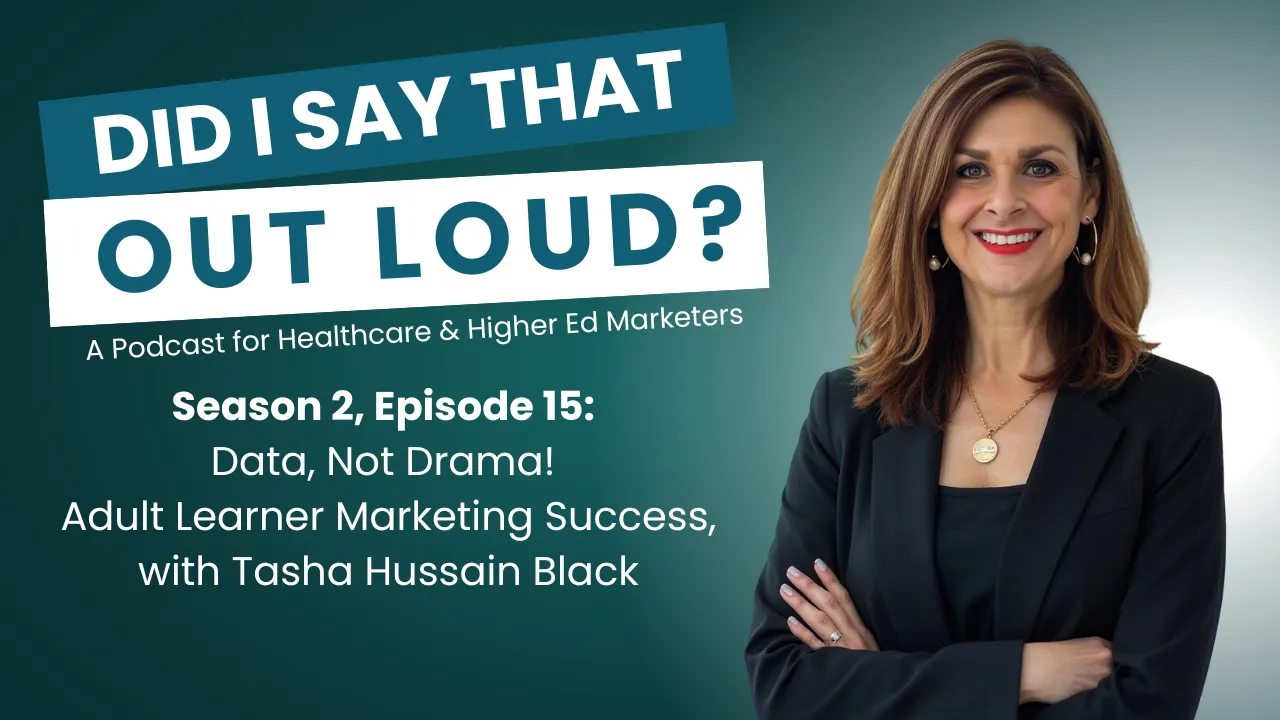
Season 2, Episode 15
Higher ed marketing campaigns without the drama? Yes, please! Tasha Hussain Black of Owens Community College and Lisa Starkey-Wood from Stamats talk through a savvy pathway to secure funding for an adult learner campaign and surpassed expectations with a focused, agile campaign plan.
Listen to Episode
Show Notes
Transcript
Mariah Tang: Did I say that out loud? Welcome to “Did I Say that Out Loud?”, a podcast where Stu Eddins and Mariah Tang reflect on agency life and answer questions from our higher ed and healthcare clients about the latest in digital marketing, content and SEO.
Mariah: Hi friends. Thank you so much for joining us for the Did I Say That Out Loud podcast. Once again, Stu is missing in action. I guess he’s doing actual work. But instead, we have the lovely Lisa Starkey Wood. Do you want to introduce yourself, Lisa?
Lisa Starkey-Wood: Thanks Mariah. I’m Lisa Starkey-Wood, VP of Enrollment Strategy at Stamats, and I’m so excited to be here today for this discussion.
Mariah: Yes, and we have our fantastic guest of honor, Tasha Hussain Black. She is the Vice President of Strategic Initiatives, Marketing, and Communication for Owens Community College. Tasha has 25 years of experience in marketing, branding, strategy, planning, and team development. She leads the marketing strategy and strategic priorities for Owens, and she is an adjunct professor at Bowling Green State University, where she teaches managing change in organizations and success in leadership in the Department of Management. Not a small feat. Look at that title. You rock, Tasha. Thanks for joining us.
Tasha Hussain Black: Thank you. I’m happy to be here.
Mariah: Yes, and we have a fantastic story for you today. Tasha and her team and Lisa and her teams both do such amazing work, and they are a fabulous collaboration that we’re just super excited to showcase for you today. So, let’s just jump right in. We’ve put together a couple questions like we always do, but please feel free to jump right in, make your comments and tell these stories that our audience wants to hear. I’ll just kick us off here. So, community colleges, we know, are really a hub of the community and for so many reasons, so important to the communities across the United States. Owens fits that mold perfectly. And, you know, one of the things that community colleges really do best is connect the workforce with those professionals who are up and coming across all skill levels. So, Tasha, could you start us off and maybe talk a bit about how Owens connects with that local community?
Tasha: Yeah. Happy to. I mean it’s you know, just the name Owens Community College. It says it right there in the title. We are of the community and for the community here in Northwest Ohio. And you know, while every single community college across the state has a very distinct legal service district, that gives us an opportunity to really get to know the needs of our community in depth. I’d like to say we’re kind of at the table with every major conversation that happens in the community and what I mean by that from you know understanding with our economic development partners you know what sort of business and industry are looking to expand you know may need additional workers or may need ⁓ upskilling or training for their workforce.
We understand what business and industry are newly attracted to this area and you know maybe we are in a position to start up new programs to meet that need, that future need. I think about things like in our neck of the woods, the evolution from the automotive industry into data centers. You know, I know that this is a hot topic across the entire nation, so that kind of gives you an example. we also see ourselves because of you know where we sit in the community, really connected to the entire ⁓ education and training pipeline, right? So we are so intentional about making sure we understand what our K through 12 partners are needing and how we can sort of step in and start, giving some of those students who may be considering higher education at one point, you know, sort of the understanding of what types of jobs are out there and you know what they can make.
What that path could look like. We also, you know, we sit in a really interesting place because we have some incredible four-year partners too, right in this region. And you know, we have very strong relationships with them for additional programming and transfer opportunities. I would also be remiss if I didn’t mention the really strong advisory boards that we have with Owens across all of our schools that brings in experts from business and industry who in real time can just sort of help us navigate what they’re seeing, what their pain points are, and how we can step up and help them with developing the pipeline and kind of the workforce of the future.
Mariah: The bigger audiences that you serve and so many community colleges across the country can relate are those adult learners at various levels of education. You know, some going to college for the first time, some coming in to get certifications or continuing education credits and things like that. These are generally, you know, eager, ready to engage individuals who are looking to upskill, looking to get ahead in their career and education. So, both of you, actually, could you talk a bit about how Owens has recognized this and how you and that college community have picked up that mission and really carrying these adult learners forward?
Tasha: Yeah, this is this is such an important topic. you know, I Lisa always laughs when I say this, and you know she feels free to use it where she needs to but you know I always like to say data not drama right and I I think around it the adult learners there’s a lot of assumptions right we know I mean and I’ll just share a national statistic that I think everybody should sort of you know kind of scratch their head at but we know that there’s over forty million people in this country who have some college maybe but no credential, right? And these are kind of that’s kind of the population we’re talking about. If if we look at the opportunity here in northwest Ohio and around the Toledo area, we know that our adult learner population that sort of fits that. Maybe they started, stopped out, maybe they never pursued higher education is somewhere around 190,000. So, when somebody asks me” “why I get up every day and do what I do,” I can point to that number and say we have such an opportunity with a population to engage and re-engage, right? In higher education, maybe some training as well.
Mariah: Lisa, what would you add to that?
Lisa: That’s what I love the most about Tasha’s story with adult learners is that ⁓ it was all backed by data and she really used the data to drive the decision to put an adult learners campaign in market. ⁓ Tasha had a slide in one of her slide decks at a conference that said data not drama, and I told her I think it’s my favorite ever seen. Needs to be framed. But you know, they did this feasibility study. They recognize that there’s this underserved population in their own backyard and then we really worked together to create really targeted messaging that spoke directly to adult learners and that’s why I think they saw the success that they did because it was armed with data. We used that data to create a really targeted message and people responded to it. That’s what kind of kicked off the adult learner campaign was Tasha being savvy like she is, found ⁓ additional sources to help fund the campaign for this market. And then once the grant ran out, we continued to prioritize and keep that in market for her.
Tasha: I always like to sort of take a look at things from a lessons learned, perspective Lisa mentioned we were able to kick off a feasibility study for the city of Toledo specifically. Now, one thing about Owens that I think is really important to note is that we are the only community college in the state of Ohio that does not have a physical campus around the largest city that it serves. We serve three counties specifically around the city of Toledo and the city of Finley and we also serve a couple other adjacent counties as well and we do not have a physical presence in the city of Toledo in Lucas County which it which is where Toledo is. And the feasibility study was actually kicked off to find out if there is a need for a physical presence in the city of Toledo.
So we partnered with Trellis Strategies, who has you know a lot of expertise, particularly in higher ed, and what they like to coin the modern learner. And they worked with a lot of partners, they interviewed industry folks. We actually got support from the City of Toledo and Toledo Public Schools to conduct this feasibility study. So that kind of goes back to the partnership that we were talking about for the community. And that is where we discovered this unmet need of you know the 190,000 folks that are 25 and older that have not finished either a credential or you know a degree of some sort. So the marketer in me is like, holy cow, this is an opportunity. And we also through that feasibility study understood some of the barriers that they were faced with. some of them financial, some of them transportation, some of the things that we, you know, kind of intuitively know.
But one thing that came out loud and clear was the competing priorities that these folks have, right? They are not just one thing, they are multiple things. they are not students first. They are students if everything else in their life is working right and they can fit stuff in. So, you know, you now start to develop the really important framework of how we’re going to start navigating, reaching these people, and the messaging that’s going to resonate. And then we did go after a grant from the Lumina Foundation who does a lot of this work, supports a lot of this work across higher education. sometimes the stars align because this grant was for $50,000 for digital marketing.
And it was like, you’ve got to be kidding me. So we were actually one of six recipients across the nation that won this grant, and we had $50,000 to use to develop, ways to reach this audience. with the help of Lisa and her team and the Stamats team, we stood up a very comprehensive campaign for this specific population. And when I think about the evolution of the campaign, the first thing this did was it allowed us to be so flexible and agile because it was its own separate campaign. We could stand things up in real time, look at the data and then pivot our messaging or the way that we serve up, you know, some of these ads to this population but we started with short-term certificates because we were like, hey, this is probably fitting some of the challenges that were coming out of the feasibility study.
So, we identified, I think, eleven or twelve short-term certs to start and we watched the data, we watched the responsiveness, we watched what was working, what was resonating, and what wasn’t. And the things that were not resonating, we didn’t have to take it to a big committee.
And mull over whether we were going to pause these things or not. We made the decision and said, nope, we’re going to pause these four, we’re going to stand up another two. Maybe we do this a different way. This messaging is resonating. Maybe we need to tweak this. And it allowed us to live in this pilot program to really get a lot of data very, very quickly. So, you know, we started with short-term certificates, and the way that we ended up at the end of the year-long campaign was transitioning into online programs because we were starting to get information that, hey, this is probably an important thing to talk about with this population.
Mariah: Yeah. And being on the outside of both of these teams, it was so fun seeing Lisa share like this cool thing happened with Owens, look at these great numbers and seeing those roll in. So Lisa, if you could elaborate, you’ve worked with Tasha on some very strategic adult learner campaigns over the past couple of years. Could you share some of the stories about how the two of you work together to set up those strategies and maybe some takeaways for the audience?
Lisa: Yeah, for sure. I’d love to. so the first thing that’s really important I think is making sure that we have messaging, imaging, creative copy, and also tactics that really resonate with adult learners. And so that’s one thing that Tasha’s team was really great about being a part of that strategy and helping us come up with, where can we reach these people in their markets? And then making sure that the image
and the copy in the ads and on the campaign landing pages really speak to these students. It’s a different message. It’s different types of imaging than your traditional first year students or even undergrad transfers. And so really making sure that we’re talking about their lifestyle.
Like Tasha said, they’re this, they’re this, they’re this. They’re not, you know, a a traditional age student. They’re a parent. They’re a working professional. They are a student. I think the term Tasha said Trellis uses is the Anders, if that’s the right phrase, Tasha. Really talking to them about their goals and showing what the end result is going to be. Tasha’s team was really great about helping us get some labor bureau statistics that talked about what can you expect to earn once you have this degree. You really need to illustrate those outcomes in the ads and in the campaign landing pages and speak to these people about, you know, we know you’re busy, talking about that flexibility, making the shift to online because we saw the opportunity there. I think one thing that Tasha and the team’s campaigns that we run for them are successful because we provide the data and they let us shift quickly.
When we make recommendations, you know, they make quick decisions and that’s why they’ve seen the results that they have with these campaigns. I think the first year we had it in market, Tasha, you saw like a 74% increase that spring in your non-traditional students. So the results speak for themselves when you’ve got the right tactics, the right creative and copy and market, you know, driving to a campaign landing page that speaks to that audience and then making those shifts as you see what’s working and what’s not working quickly. That’s how you see the results that the team has seen.
Mariah: So I’ve heard you both say these were really successful ⁓ campaigns for your adult learner audience. Could you talk a little bit about the outcomes? What did you determine were the success points?
Lisa: I think one thing that we’ve seen really great success with Mariah is aligning the campaigns with the start term. So kind of having a a strategic plan in terms of when are we spending and when are we increasing spend taking up to each of those start terms, knowing people are kind of driven by deadlines. With doing that with these campaigns, we saw a fifty percent increase in click through rates and a 36% increase in RFI form completions. Just the first time we did that for the first start. And again, we’ve also seen some really great success with making sure that we’re really aligning the campaign landing page with copy that’s relevant to that target audience. Some of Tasha’s campaigns where we’ve stood them up really quickly and didn’t have a campaign landing page one year and then the next year we did. We’ve seen increases in conversions as much as 163% increase year over year in conversions, having a really specific targeted campaign landing page that’s more focused on, you know, the overall experience, really specific messaging to that target audience instead of, you know, just more overall brand messaging. And we’ve seen really great increases in enrolled students for them for this campaign.
And for other campaigns, we did a visiting student campaign for them where we first went to a page on the website and then had a campaign landing page the next year and we saw a thirteen percent increase in their visiting students that summer. So ⁓ again, when you align the tactics with kind of what the audience is looking for, you see great results. And I think my favorite statistic is the 74% increase in the non-traditional students ⁓ spring 2024 to spring 2025 because that really aligned with the adult learner campaign and having that first campaign in market and having really specific messaging for adult learners.
I mean we showed images of students who looked like adult learners instead of, you know, your 17- to 20-year-old. Maybe not images of students walking around campus and, you know, hanging out on the quad if we’re marketing online courses, you know, showing what does that experience really look like is really important to help students say, that could be me. Yep, I’m going to click and go to the campaign landing page and there needs to be messaging there that’s really relevant for adult learners and not just, you know, the more general speak.
Tasha: Yeah. And you know, I would add these stats that Lisa just shared, you know, we were watching and that was an early indication that we were doing a lot of things right and being able to really intentionally make sure that we were moving things around as needed. it’s kind of a conversation about digital marketing, but we also from a traditional marketing side made sure that we were in a good place to support that throughout an entire integrated market.
So there was some important lift that I think that we were seeing as all of this was working together. So the visuals that we were using in our digital marketing were also carrying over to, you know, any of the stories we were writing, for this area, maybe the billboards they were seeing, the postcards we were direct mailing. And, you know, we did see an increase in this population coming in for open houses, you know, physically on campus.
And, you know, so there were a lot of things that were pointing to we were starting to make inroads and these folks were listening. Like every institution, there are things that you know that we’re measuring when things are in market and then, you know, we always sort of a a lagging type of thing is, okay, where is our enrollment landing, right? I mean we are happy with our conversion rates, and we’re happy with the request for information forms, and some of those things along the way. But our non-traditional category has increased year over year which to me is showing the fruits of the labor right because that doesn’t necessarily show up right away and you know we are we are seeing six to seven percent increases in this particular category year over year which I think is just incredible.
Mariah: Yeah, especially given all of the different challenges with higher ed and all of the different challenges with search and just all of the changes that have happened in the past couple of years, you’re just rocking it like always. So between the two of you, my rock star friends, what are maybe three to five key messages that you would share with other community college marketers out there to maybe start plussing up their campaigns, really targeting down to those adult learners and making a good experience for that population?
Tasha: The game changer for us was being able to go after a very specific grant that we were able to leverage specifically for this campaign because if this starts out as something that is in a regular budget or is part of many umbrella campaigns I think maybe sometimes we do not give ourselves the ability to be as flexible and nimble. And I mean there were some weeks we were making decisions, multiple times a week to change messaging, take things up, take things down. And I think that being able to run a pilot, and I, you know, I’m using that word deliberately a couple times, gives us the opportunity to test things. When in higher education marketing do we get the opportunity to like say we are testing stuff and some of it’s gonna work and some of it isn’t? But this gave us the opportunity and the learnings that we had outside of this were so incredibly strong that it is now part of our regular campaign portfolio.
Lisa: Yeah. So so true, Tasha. And just to piggyback off that a little bit, one of the reasons the campaigns were so successful is because Tasha’s team has that data that they come to us with and they’re really great about saying, Okay, this program’s full. Let’s pivot to these programs or okay, we need more students in this program. Every meeting that we have, we start off with, okay, how are your numbers looking for, you know, summer or fall or your adult learners? And they always have that data because they’re using data to drive those decisions. And that’s so important. because things are not always as we think they are. and then again, just making sure that you’ve got really targeted messaging for your particular audiences and having those separate campaigns. You can’t just have one umbrella campaign that’s all Owens’ brand going out to everybody.
We’ve got really specific messaging for first year students, for transfer students for the adult learner campaigns. And then a lot of times we focus on having fresh content in the ads, but it’s just as important to make sure that we’re optimizing those campaign landing pages. Our team is, you know, always looking at what are people searching for and what resonates with this audience and making sure that we’re keeping those refreshed. Those aren’t just said and forget. You know, it’s constantly updating, refreshing, constant strategy refresh, you know, as we shift to online, changing out those ads, but also updating that campaign landing page to really focus on the online experience.
You know, we have people who want to just send everything to their homepage with their ad clicks. And there’s many reasons why we don’t want to do that, one being that. But Tasha’s team is just amazing at providing, you know, fresh assets, really receptive to suggestions and ideas. in addition to, you know, they’ve added to their team to have a recruitment outreach specialist. So as we’re getting leads from these campaigns, they’re getting contacted right away. And that’s a big part of the success too. The marketing and admissions team at Owens are meeting regularly and you can tell it’s not happening in silos, which is another slide that Tasha and I have presented on together, breaking down those silos. Owens is the gold star for a lot of these things that we talk about as kind of industry best standards. So ⁓ it’s why they’re seeing the success they are.
Mariah: Continue to crush it, ladies. You’re doing amazing. So are both of your teams. And thanks for your time today. Before I let you go, I always want to ask, are there any new projects or exciting things that are coming up for the twenty-six, twenty-seven academic year that you’d like to share?
Lisa: Well, Tasha’s team just had a really exciting project, Tasha. You want to talk a little bit about what you guys just spent the last few months doing?
Tasha: Yeah, we just launched an entire website refresh. I mean a redesign. It was thousands and thousands of pages, all of our academic pages. We really paid special attention to the home page, the navigation. You know, the idea is if you know as folks come and visit our website we want to make it incredibly intuitive and consistent and easy to find things. So you know if you come to the website it’s very easy to understand outcomes, how long programs are going to take, where credentials are, stackable credentials. you know, you think about what we just said with our adult learners. I mean there’s a few things that are going to be important to them. the new refreshed website really caters to making things way easier to find and it it also gives just so much consistency and taking a lot of the clutter out ⁓ just so people can find what they need very easily. So we’re very excited about this.
Lisa: Yeah. And there’s great performance data too. We send Tasha regular updates so she has them to report out, but just great increases in engagement, time spent on the page, engaged sessions. We’re seeing really great results so far. And one thing that the team worked really hard to do ⁓ is updating those program pages. Tasha’s team worked with ours to really make sure that we have program specific outcomes for all those program pages. And they’re beautiful in addition to having great content. And also just a great CTA strategy where those next steps are top of mind and really relevant. We’ve got some sticky nav. They’re, you know, at the top of the page, at the bottom of the page. So we’re really having that right there for students as they’re consuming the content and they’re ready to take that next step. They’re not having to say, okay, now where do I need to go from here to fill out that RFI form or register for a visit? ⁓ and Tasha also did an awesome job of having, faculty feedback involved and admissions feedback involved as we were working on the website. So I feel like it was just such a huge success, Tasha.
Tasha: Yeah. Ahead of schedule.
Lisa: It was a three-year project and their team got it done in less than a year. So amazing, amazing.
Mariah: Just cooking. Just cooking. Well, kudos to all of you involved with all of those projects. And now you have a beautiful foundation for your next round of campaigns. So as always, it’s a pleasure to talk with you, Tasha. Thanks so much for joining us and Lisa as well. You made my day. Sorry for Stu to have to miss you.
Lisa: Thank you, Tasha. Thanks, Mariah.
Mariah Tang: Thanks for listening to “Did I Say That Out Loud?” with Stu Eddins and Mariah Tang. Check out the show notes for more information about today’s episode. And if you have any questions, concerns or comments, hit us up anytime at stamats.com.
Let’s talk
You have questions, we have answers. We will customize a solution that is guaranteed to impress.