Written by
on
June 19, 2026
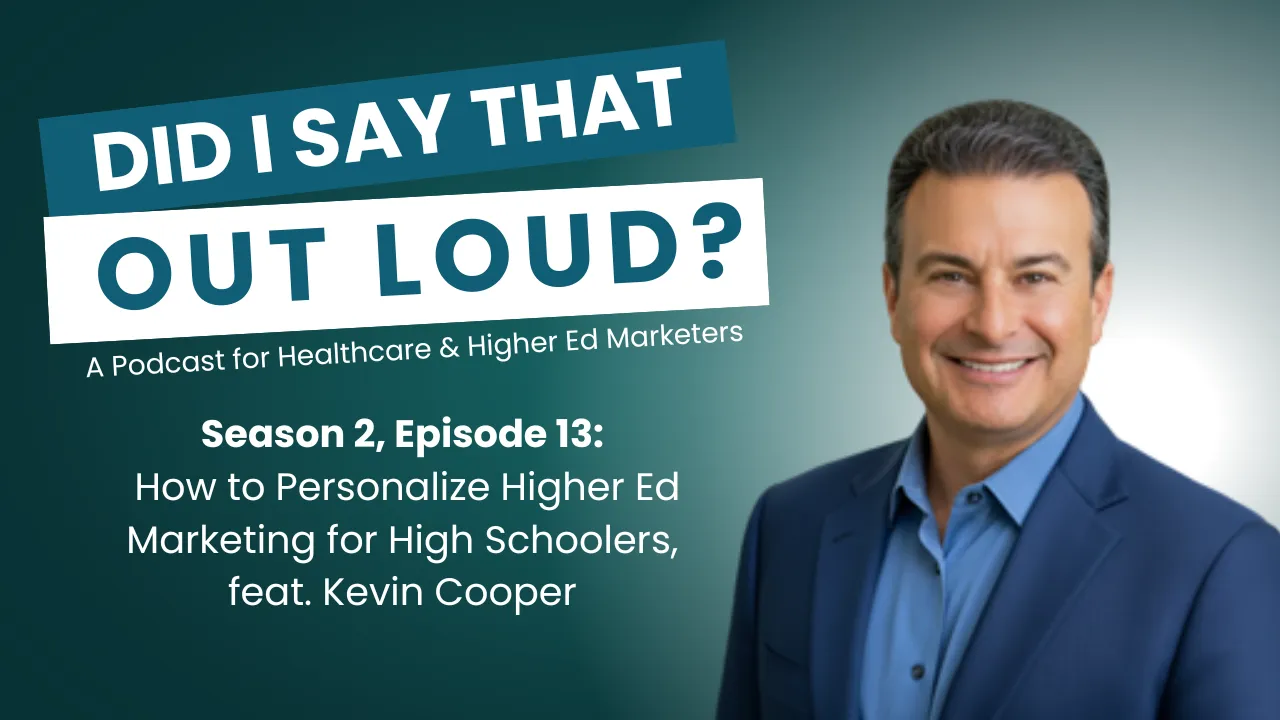
Season 2, Episode 13
Communicating with your own teens about their education is hard. How about messaging to OTHER people’s kids about the academic opportunities that await after high school?! Kevin Cooper, founder of go Prep, a tutoring firm in Texas, discusses how to personalize higher ed marketing for Gen Z and Gen Alpha students.
Listen to Episode
Show Notes
Transcript
Mariah Tang: Did I say that out loud? Welcome to “Did I Say that Out Loud?”, a podcast where Stu Eddins and Mariah Tang reflect on agency life and answer questions from our higher ed and healthcare clients about the latest in digital marketing, content and SEO.
Mariah: Hi everybody. Thanks for joining me. You’re going to notice an absence of Stu. That’s okay. You’ve got me. And Kevin Cooper, one of my friends and longtime colleagues. Kevin has known me since I was just a little baby marketer back at a previous agency. So Kevin, just in case you guys don’t know him, he is a healthcare IT marketing executive. He has more than 15 years of experience across health systems and health IT companies. Right now, Kevin serves as the head of marketing at T2 Group, a healthcare IT firm, and he founded a startup called go Prep Tutoring, an AI personalized test prep service, pairing smart diagnostic tools with expert live tutors. Welcome, Kevin. Thank you so much for joining us.
Kevin Cooper: Thank you for having me, Mariah. It is so fun because we’ve known each other over a few different lives.
Mariah: Yes, yes. I think when I tallied it up, probably about almost 15 years, 10, 15 years, something like that, gone through various hair lengths in that time.
Kevin: I had hair back when you met me.
Mariah: It’s so cool. Like right before we jumped on here, we were talking about how fun it is to work across different industries and you’ve made that leap from healthcare to higher ed to tech to entrepreneurship and you’re one of those people that’s just always doing something cool and new. So tell us a little bit about that. How did you get from working in a healthcare institution to now being this entrepreneur guy?
Kevin: So we met at UT Southwest in around 2015. That was the second healthcare institution I worked for. I started my health care career at Tenet Healthcare downtown the corporate side of healthcare. But I was thrilled to be on the beautiful side of healthcare at UT Southwestern with a three-part mission of patient care research and education and a lot of what we’re talking about today still I continue to work inside of patient care and education and even I was grateful at UT Southwestern they helped fund some of my doctoral work and a lot of that made me feel closer to, and here I am crossing some of those same bridges with my own family and my daughter. Anyway, from UT Southwestern, I had the chance to kind of shift into product marketing related to software. I worked for a variety of different companies inside of the back office of healthcare. Probably not the sexiest side of healthcare, but medical coding and billing and reimbursement. That’s how providers get paid. I got to work with some of the largest companies in the business and some of the smallest. I got to work for providers as well.
It’s a triangular relationship related to product marketing between marketing sales and product, but it’s also a triangular relationship with payers and providers and patients. And those types of things are things that I’m really interested in. So it guides a lot of my work. And when you’re interested in what you do, it’s fun to experience it from different angles and to work with people through different lives. Like you and I have worked together from a content marketing perspective for a long time and to learn from other people. Thanks for having me here today. I’m thrilled to chat with you about the subjects.
Mariah: Absolutely. I love that whole journey that you’ve made and I love those distinctions that you made like a triangle. I just finished a business finance course and I hate math. know this about me. Everybody knows this about me. But like you said, if you want your business to be successful, if you really want to understand how everything works behind the scenes, getting that granular information can be super helpful and especially in a tech capacity like you’ve landed in. You mentioned this already, Kevin. You’re a dad. have awesome kids and one of them is starting to already look at her post-high school options. So do you want to tell us a little bit about dad Kevin and how that’s going for you and your kiddos?
Kevin: Sure, so when it comes to education, I have three that are pretty concentrated in age. I’ll have five that’ll be thinking about college and at college at the same time. So it was busy years, but now it’s fun. And you get to that journey so much faster than you ever expected. And a lot of things have changed, and a lot of things haven’t changed related to how you and I approach that journey and what the expectations are and the competition and people’s interests, and what you’re going to do with that education. I think, the most planning and discussion and figuring out what works for you and your kids and your family and then financially trying to figure out how to make it all work are things that a lot of people are thinking about now.
Mariah: Yeah, yeah. When I was going to college in the ancient times before, before all the tech, it was fill out an application and send it to the school, fill out an application, send it to the school. Now they have things like Common App. You can, you can apply to 10, 20 different schools all at once. And some of them take ACT/SAT. Some of them don’t require it. My, oldest is a sophomore and she’s getting ready to go, I’m sorry, a senior and she’s getting ready to go to college and she didn’t have to take the ACT, but she had to do just a ton of paperwork leading up to it, getting those scholarships ready and all those things. So it is interesting thinking about parental involvement, thinking about those first-generation students whose parents maybe didn’t go to college, but are super invested in getting their kids there. And you’ve got all these different walks of life. And I think it’s fascinating how different institutions are approaching that.
And your business model is really catching families before they get to that point and as they’re starting that point. As you’re thinking about where your daughter is, thinking about where other students are, maybe they have a good amount of support at home trying to get ready for college, maybe they don’t. But they are looking for connectors between that high school experience and college experience. Can you talk a little bit about how your go Prep tutoring and some of your services and how you’re helping institutions really connect with those young people and their families?
Kevin: When I saw with my daughter and my wife and I were exploring the options for test prep and we were exploring the options for college advising, there’s a huge range. There’s a lot of cookie cutter approaches. There’s some really white glove, high service level approaches as well. And we met with a variety of different tutors and guidance counselors and there’s lots of great options, which is a good thing. But at the end of the day, it’s just like everything else today, information overload and being able to synthesize what would be best for my particular daughter may be different than my other two daughters and that’s okay. But at go Prep the idea when I met her tutor was to leverage the very best, know, 10 years of really successful tutoring in a very concentrated area of North Dallas and a couple suburbs nearby. And we built kind of a private tutoring model. Turned out academic tutoring was just as requested and we were very close to University of Texas Dallas and a lot of those tutors met the profile of the students’ requests of like wanting to work with somebody that’s a little bit closer in age. And then we also found some seasoned tutors. But my point is this range of tutors, range of ages, matching kids up with tutors that fit them worked really well. And it’s been successful, but it’s not necessarily scalable. And that’s where this idea of go Prep Online developed. When we found a development partner that helped us create an AI personalized experience that was much more affordable, just to take a free diagnostic tests and then to just practice at their own speed, still keeping the parents posted from progress reports just like those tutors would do as well.
But it was this idea of being able to translate online to private and letting those tutors beam into the very point where they struggle in addressing their needs. And instead of paying for a one-hour session for 30 minutes, they can book an appointment on our website and then they come into the very problems where they’re struggling. And that appeals to a lot of students and a lot of parents as well. And I think that that hybrid model and that pay as you go model of having the very best technology, the very best tutors, the very best service is still possible to meet people where they are, whether that’s a pure online, a hybrid, or an in-person. It’s much like how you and I talk about the benefits from a professional perspective as well. I think those same ideas apply. And there’s no right or wrong answer, but figuring out what works for you and your kid, and most of all, what’s going to generate results.
A lot of these universities that she’s looking at have moved to test optional types of periods, and where everybody in America lots of kids have an A average. The only way to separate it is through test prep. And while my wife and I were, neither one of us were stellar test takers, the idea of practicing and sticking with it and taking a short sprint and really focusing, first we did it on the SAT and now on the ACT, gives different types of tests for different kids. But at the end of the day, practice makes perfect. And I think a lot of those models apply.
Mariah: Yeah, yeah, I love what you are saying about that customization. We’re seeing a real niching down across various technologies in media, in industries, especially in healthcare and higher ed. We’re seeing the broad discussions really coming into, let’s talk about this one step and then we’ll help you get there. Let’s talk about this one step and we’ll help you get there.
Like Coe College, where my daughter is going in the fall here in Cedar Rapids. She received personalized, at least personalized-feeling messages from a specific human being with a specific name that you could look up on LinkedIn and say, that’s a real person. And they give you the step-by-step. It’s not, here’s your to-do list. Good luck. see you in the fall. Here’s one step you can do today. Here’s the next step after that and the next. It’s really a great way to break down that admissions process. And it sounds to me like what you’re saying is breaking down the pre-admission process that can start, you know, anytime in that high school career, starting with those basics, starting with those areas where you’re feeling most challenged and not, you know, a deluge of let’s do all of this general stuff. Let’s find out what you need help with and focus there and pay for that, not just this whole bulk of things.
Kevin: Spot on. I think humans, as human nature, we bring accountability both from a student and a parent and a tutor perspective. Everybody owns the time that you spend together and parents, of course, want to use it wisely. Kids want to just get the most out of it. And I think, you know, it meets people where they’re at and I think that’s really important.
Mariah: Yeah, yeah. And right now, this is a question I always love asking, guests because there’s so much that has changed in our industries, whether you’re talking about higher ed or healthcare as verticals or marketing just in general, in the past three days, let alone the past six months to a year, everything has upended, which, you know, in some ways is really awesome. And there’s a lot of opportunity there. Some ways it’s like, nah, go back to how it was. Why is this moment, why is right now important to an important time to launch a business like yours? Why are these services so in demand right now and for the foreseeable future?
Kevin: So one of my mentors, early in my career, in my 20s, I actually had the opportunity to work in marketing for 7-Eleven, their headquarter downtown, and I got to be a brand manager. And I was really young, but Jim Keys was one of my mentors. He’s the CEO for a long time at 7-Eleven. He has a phrase that CEO stands for change equals opportunity. And the idea, even in these dynamic, changing times, being able to adapt with the times, being able to be your best self despite chaos and sometimes unpredictable challenges, I think is really important. I think change, whether in your professional work or whether you’re trying to help a 16 or 17-year-old figure out how change equals opportunities is something that we should all consider.
Mariah: Yeah, yeah, you had mentioned personalization. That is another thread that runs through just about every discussion that we’re having right now. Whether you’re talking in a way that you present an idea or a way that your site or platform or whatever media is structured. We’re hearing a lot about customization personalization. Would you tell us a little bit Kevin about how you go about designing those experiences for your clients and their kids?
Kevin: Sure. I think it starts with a human connection. While people might submit a form, our first goal is always to connect directly with the families, not just the parents, not just the students, but to have everybody’s input. It’s that human input that ultimately is going to personalize the experience and generate the best results for the student. So kind of that human connection and being able to personalize it, I think, is key. And so every piece of it requires that humans, I mean, we’re so wrapped by information and noise and it’s harder for a 16- or 17-year-old to find meaning and results inside of the chaos.
But that comes from experience. learn that sometimes through the school of hard knocks of figuring out how to do that professionally. But being able to synthesize information and being able to call the most personalized unique experience that benefits you I think is really important. So like I think about work the same way I think about how I would guide my own daughter on that journey and making the tools available is really important. You know, she’s gonna get her information from TikTok, Snapchat, Instagram. She’s gonna get it in 60-second Reels. And while I may sound like one of those 60-second reels from the repetition of trying to instill in her the outcomes that I’d like to see, I think by having the right people involved in our lives, that personal touch where we started, the right technology, I think it guides the experience and creates options and options again change options creates outcomes.
Hey, look, like different platforms have different purposes. It was one of my priorities that even as a high school junior or senior that she just understand what LinkedIn is and be able to get online so that she could observe and see maybe what other college students were doing from a work perspective on campus. And some of her best babysitting jobs came from Facebook. It’s not a platform that she probably chose to be on, but just by being able to direct message with moms and families, she started to build a babysitting. Point is, like different portfolios have different uses for different people at different points in their journey. But it doesn’t matter that, and you know what? She won’t answer my text messages, but she’ll answer my Snapchats. And it drives my wife crazy. But I’ll Snapchat her, and I’ll meet her where she’s at. But one way or another, I need to know when she’s coming home or what the plan is.
Mariah: Not to get into like the lawsuits and things, but there’s some stuff happening legally with social media, with some of the ways that digital marketing can and can’t be done. And I think this is much needed. You know, we’ve got to put some guide rails around these things. So given that kind of narrow and further narrowing platform opportunity we have to connect with young people. What are some of the ways that we can really get creative that maybe our higher ed audiences and healthcare audience would be interested in? Like what have you done that’s creative or what are some ideas there?
Kevin: Well, I tried to introduce my daughter to email, but she just literally couldn’t understand that if you have an email, people are going to write you. And if you want to the internship at the hospital this summer, you have to check your email. But again, it goes back to meeting them where they’re at. And she has to meet the hospital system where they’re at, because they’re going to email her the results if she wants to show up on time for the interview and read the directions. It’s not something that they’re going to text her, and they’re not going to Snapchat it to her. I think there’s some adaptation and it gets real when it’s something that she wants. And if she wants to show fit to major and she wants to show healthcare experience, she has to do that and be able to communicate appropriately. So little by little, we’ll all end up at the right spot.
Mariah: I always appreciate, with Coe, the school my daughter is going to attend, they sometimes will copy me on some of those messages, or they gave me that, they gave her that option to add me. And so when something comes in, like, here’s a step you need to take, I can casually plant the seed that it’s her idea, like, hey, kiddo, have you checked your email lately? And you wonder if there’s something from Coe and that way it’s maybe helping her build that habit without me being like, go check your emails.
Kevin: I was totally surprised she didn’t even have the email icon on the home screen of her phone. I don’t know what to say.
Mariah: It’s just a whole new world, man. It’s a whole new world. Yeah. Well, you have a new job since we have lined up our interview. had to switch up your whole bio which is very exciting. Tell us about your new position.
Kevin: Yeah, I’m the head of marketing for T2Group. T2Group’s based out of California. It services the country’s largest health systems related to healthcare IT, remote workforce, and our contact centers, as well as sourcing talent. And we even have a startup called EZCare, which is pretty interesting because it targets health systems and it makes it really easy to get the things that your physician recommends during the visit, land on your doorstep the next day. So it’s been a wild ride. It’s been really fun, though. Incredible organization with incredible leaders and I’m jumping in.
So from the very beginning, like from my marketing experience, I’ve always worked to communicate to niche audiences. Trying to be one size fit all and be everything to everyone is not a winning proposition from any healthcare academic marketing type of scenario. So being your authentic self and being able to find your people and communicate to those people however they want to be communicated to, lots of video these days, less words on a page, I think that’s what I try to on and to really hone those messages for niche audiences. So I’d encourage any marketer to consider doing the same.
Mariah: Thanks for listening to “Did I Say That Out Loud?” with Stu Eddins and Mariah Tang. Check out the show notes for more information about today’s episode. And if you have any questions, concerns or comments, hit us up anytime at stamats.com.
Let’s talk
You have questions, we have answers. We will customize a solution that is guaranteed to impress.