Written by
on
April 17, 2026
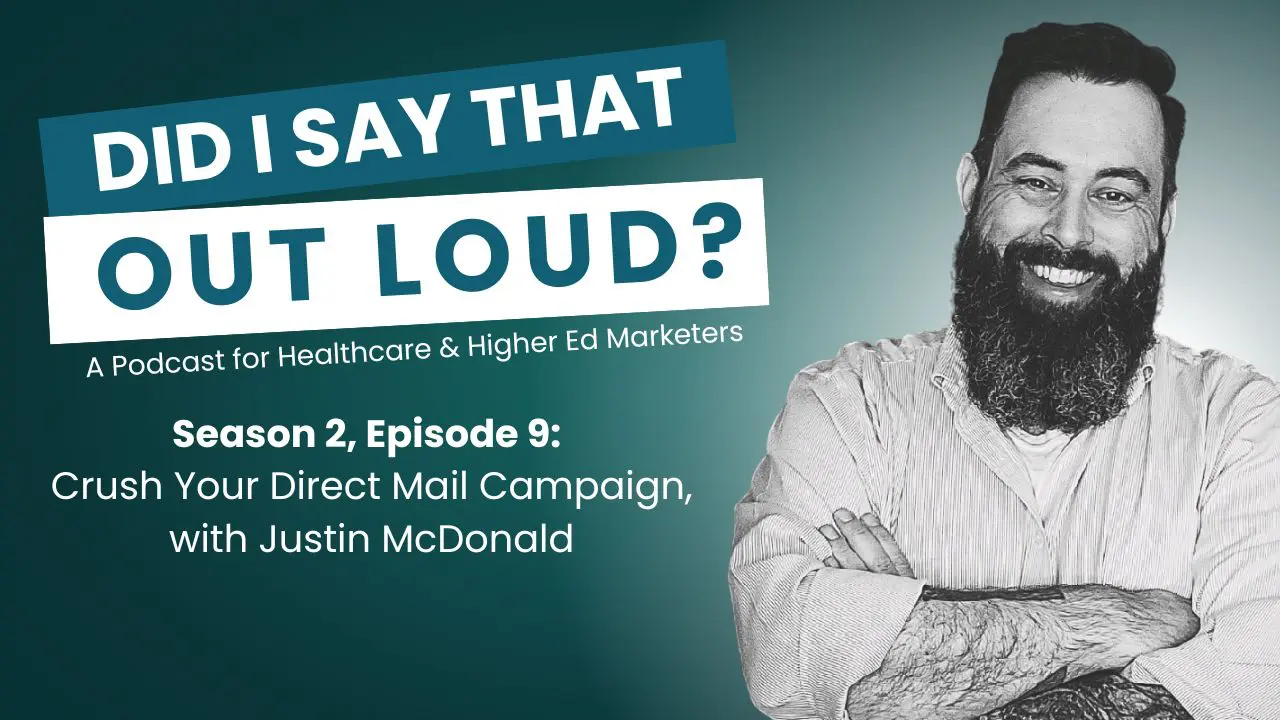
Season 2, Episode 9
Print is the gift that keeps on giving. Even today, when direct mail has become a novelty for young people. Justin McDonald, Director of Sales and Marketing at Cedar Graphics in Cedar Rapids, IA, shares insider tips on how to create innovative, data-driven print campaigns and why “lumpy mail gets opened.”
Listen to Episode
Show Notes
Transcript
Mariah Tang: Did I say that out loud? Welcome to “Did I Say that Out Loud?”, a podcast where Stu Eddins and Mariah Tang reflect on agency life and answer questions from our higher ed and healthcare clients about the latest in digital marketing, content and SEO.
Mariah: Thank you for joining us on the Did I Say That Out Loud podcast. We are graced with the presence today of a Cedar Rapids colleague, which is really fun. Usually our guests are far-flung, but we’ve got a local. This is Justin McDonald. He’s the Director of Sales and Marketing at Cedar Graphics.
Justin, do you want to give us a little bit about you?
Justin McDonald: Yeah. Hey, y’all, thanks for having me. So as she said, I’m Justin, I am our sales and marketing director at Cedar Graphics. So Cedar Graphics is a large commercial printer that’s probably very similar to commercial printers you have near you, except one of our kind of areas of expertise is we deal a lot with data-driven campaigns and variable data-driven marketing and various kind of that intersection of where data meets postage and mailing and print design. So that is where I kind of fit in.
Mariah: I love it! And like Stamats, Cedar Graphics has been around a long time. You serve clients all over the country and we’ve worked with you many times over the years. So it’s kind of a fun thing to get to have one of our neighbors down the street to chat with us, so.
Justin: Yeah, I think if you go back far enough decades back, I think Cedar at one point, Stamats used to have a printing division that Cedar bought that was actually. So we actually were part of that building back behind you guys for many, many years, so.
Stu Eddins: Right.
Mariah: What a what a time to be alive. It’s such a small little world, isn’t it? Well, like you said, you know, we cut our teeth in publishing and printing, you know, decades ago. We just had our 100th anniversary not here too long ago. And so like you, we’ve made that big pivot into digital. Not to say that we don’t do print still, we don’t do print magazines, we don’t do print jobs. So it’s very fun to have print still in the mix and it’s got a huge place still in healthcare and higher Ed, which are the two primary markets that we serve. So we wanted to pick your brain today about how you’ve seen print change over the last, I don’t know, it’s hard to go back past 2020 because it’s like the before times, but since 2020 maybe or even a little before that and where you see it going.
So, I guess I want to start with, you know, we work with some large hospital systems and institutions, higher education institutions. And they still send out view books. They send out quarterly magazines, you know, 3 times a year community health publications. And these are still huge parts of their marketing mix in their marketing budget. So maybe we can start there. Talk to us a little bit about what you’ve seen as far as volume versus I guess, not quality, but quantity versus quality in print over the last couple of years.
Justin: Yeah, we’ve seen a little bit of a yo-yo effects with especially when you’re talking about higher Ed as well. Higher Ed marketing always has a tendency to shift a lot and move around because they’re constantly trying to chase a younger demo. If that makes sense, that is a lot more likely to be quick on the uptake for new technologies, and so you constantly kind of have. Colleges and universities and higher Ed chasing that uptake of new technologies. And so we did see kind of a huge, you know, shift. You know, as e-mail started getting popular, you started seeing a lot more integrated marketing campaigns where you had. A lot of what we were building were campaigns that were triggering e-mail blasts based off of deliverability, and you still see a lot of that.
But it’s weird. We saw a little bit of a die down in print campaigns for higher ed and then just a very quick resurgence. And part of it is that as everybody started jumping into the digital landscape, the exact same arguments that were made to why should I do direct or why should I do e-mail is direct mail. It used to be, well, the mailbox is full and you can’t get through the clutter. And so now it’s the exact same thing. The e-mail spam box is now so full and we can’t get through the clutter.
And the big difference is that when you compare an e-mail campaign, you know sometimes has a shelf life of two hours. You know a direct mail piece has a shelf life of sometimes up to 17 days, that piece sticks on the on the counter, on the box, on the refrigerator throughout those different things. And so that shelf life of the campaign, although it’s becoming, it’s a more expensive way.
Getting through Gmail’s spam filter and all of that has just become so incredibly difficult that it’s kind of steering the other way back around. And especially here, one of the big things you see is the USPS getting behind that, where in the past the most things that you would see is, you know, using some of the new technologies in your in your print pieces, but now like especially even 2026, there’s actually a lot of postage discounts, like even the post office giving like an additional 5% for catalogs, 5% discounts if they can buy online, 5% if you’re using their notify, the one that notifies. I don’t know if you guys have the app where you actually get the notification of everything that’s coming in the mail that day. So yeah, they even give a 1% discount for using that free service.
And so a lot of marketers who are getting smart about their data are doing kind of a couple things. They’re making their direct mail a lot more variable. They’re using a lot of data to where even when the catalogs are going out, they’re no longer 64 page catalogs trying to appeal to 200,000 people, they’re 16-page catalogs and there’s 64 different versions of them. And all of those page counts are different, you know, based off of the target buyer that has a child, the target buyer that’s a newlywed, the target buyer that’s a new homeowner. Even those catalogs are all different page counts and they all vary based off of the digital data.
Mariah: Yeah, yeah, I got one in the mail for my daughter and it was so fun. Like she’s planning to go to Coe, which is another school here in the Cedar Rapids area. And she got this fun little breakdown that had her name and a bunch of little facts about her all throughout. And I was like, this is rad. I don’t think they had these when I was going to college.
Justin: Yeah. And you’re seeing a lot of even traditional catalog places, like even look at the IKEA catalog. Now you can scan the furniture to see it actually in your room and in your home. And so all of those different types of interactions with print. Are driving new engagement, but you’re even getting discounts now for your postage for doing those types of things as well. So it’s really you’re seeing a big merger of data and creativity taking advantage of all the postage discounts.
Mariah: Yeah, for sure. I mean, you have a generation of marketers coming out of college, maybe entering these specialist roles. Sometimes those are the folks that are handling the a lot of the tasks associated with the big publication or even some of those micro publications like you’re talking about, the very strategic and personalized pieces. For that generation of folks that maybe didn’t grow up in the print environment like all of us did, what are some of the, I guess some of the hot tips or just starting out with print type tips that you would give those individuals?
Justin: I mean, the real trick with any type of a campaign is now print has gotten cheaper to be…variable data has gotten cheaper . In the past, a lot of campaigns were limited to a large, big offset run. You’re not able to do a lot of changes, but now the digital presses, which could do every single, you know, version of a postcard or a catalog different, are faster. You know, some of them now are as fast as the offset presses used to be. And so because of that, planning out a campaign should, at a bare minimum, have some sort of an A/B test, regardless of what you are actually trying to measure, you know, kind of, your actual results or your actual ROI of the campaign within that campaign you need to do some sort of a micro A/B test, even if it is just the call to action, use a different graphic.
I have some customers that are so specific that they can actually even tell you the difference between round cornering a postcard, how much that can make a difference in their return. So taking advantage of variable data printing and using the data that you have to AB test within your campaign is not nearly as expensive as it used to be, and especially if you’re doing smaller runs of less than 10 to 15,000 pieces, there’s no difference in the cost other than planning and kind of thinking a little bit ahead of how you’re going to put those pieces together, but generally speaking, that type of data and personalization is free if you just take advantage of it.
Stu: I think you were one of the first places to have variable printing available in our particular market.
Justin: Yeah. Yeah.
Stu: And the one thing that really opened up was the shorter run capabilities of doing less than massive amounts of print work to support a campaign. And I think that’s finally getting back into our client type of mentality or they’re thinking about campaigning and more specialized pieces that they can send out more or less to support mid-funnel development as opposed to the blast to get people’s attention, followed by something very selective to the specific people. That’s more personalized. I think it’s kind of from what I’ve seen supported that middle step, in the middle in that funnel process a little more.
The one thing that does come to mind is that we are getting a lot more of our RF PS that are coming in asking for print support too. Are you seeing a wider variety of clientele come back to print? Come back to print makes it sound like you know, but anyway, I think you get what I mean on that.
Justin: Yeah, yeah. So we see a kind of a combination of things as, especially with higher Ed, is that you do have a lot of higher Ed schools that in the past even had their own print shops. You know, Wartburg, University of Iowa, a lot of those guys, you know, they would, they were able to do some of their own smaller campaigns.
Unfortunately, those digital presses have now gotten a lot bigger because they what used to be a small copier is now running a 30-inch sheet and is now, you know, $1.2 million and weighs 2 tons. And so universities are putting in some of this high variable, you know, technical equipment anymore. So you are seeing a lot of them kind of come back in. But what we’re seeing just a whole lot more is just the more creative use of the data and that we are seeing kind of the same numbers, but instead of it being an 80,000-piece offset job.
It is still an 80,000-piece, you know, run, but there are 10 versions of it and they’re actually all only 8000 a piece and they’re all able to run together. And so they’re actually kind of merging departments. So instead of thinking of, OK, this is the School of Dentistry, this is the, you know, School of Education and all of those. They’re taking all of these departments and creating one postcard that maybe that has eight different graphics, eight different calls to action, eight different years of graduation, and that card is being printed and piled as it goes through the press. You know, we’re now making 80,000 versions of this postcard now as it’s going through.
And that’s what you’re really able to cut through that mailbox garbage because not only is a, especially with higher Ed, that 18- to 21-year, let’s back it up. You know that 15- to 18-year-olds aren’t on as many mailing lists as Mariah, Stu and I, you know they’re not cutting through the five insurance offers in that and so when they get. It’s both the novelty of a direct mail piece and the customization to where it is now targeted and relevant to them. The same things we were trying to do with email, except now you’re targeted and relevant and in their hand, you know, in a much easier long-term fashion.
Stu: Yeah, ages ago I was doing catalogs and we’d always hoped that we could have the outer cover be relevant to the recipient. It won’t it was photography. So if I could have a Canon cover, Nikon cover and so on, we would have thought that that was the best thing in the world. That was just before this technology was available and we just couldn’t do that.
So I can imagine because of our tremendous desire for that, if we take that into a into a higher education or even a healthcare concern, what we’re what we’re able to do is address the prospects needs on the front. They’re more likely to open up and get into the meat of what you have to offer in the middle. And you brought up a point earlier that I thought was interesting. It used to be that I’d go out to the mailbox on Wednesday and I’d have to pry the lid off and all the stuff out of it for all the circulars and all.
Today it’s unusual to get mail and I think that that does make it a little special. I know that my well, my grandkids, they’re younger teenage people never get mail and they are just whooping excited when it shows up for them. They’ll probably lose a little bit of that by the time they’re 18, but I think there’s going to be some of that that sticks around and. It looks a little more intentional to come in the mailbox to them than just something rando showing up on their phone, and I think that translates for them.
Justin: So I see. And it is funny as I have my, you know, well, sophomores in college are calling back going, what did I get in the mail? You know, what is can you put this? I’ll be back. I have another daughter that’s at a different school that drives over once a week to pick up her mouth. But then on the other end with the young ones, you know, the other one is getting a book from Dolly and the imaginary library, you know, every couple of weeks. And so there is that excitement even from the because it’s not that common, you know, the only thing they get is a book from Dolly and maybe a note from Santa, but they don’t usually get a lot of stuff.
But you do bring up an important thing about that informed delivery, which I think is an underutilized piece of marketing because the especially when you’re talking about higher ed Is that you’ve. I remember like battling with my, you know, like, what did you get? Did you fill out the application? Did you what you gave? Because it’s no longer addressed to me as the parent. And so that is where like that informed delivery was super helpful because you’re able to see what’s coming into the household, you know, and I know that we’re getting something from U of I and now with you informed delivery, there’s an actual ad on there. So I can see that, oh, Jacob’s getting something from U of I, I can click on it and respond in the USPS app to the ad before I’ve ever even gotten it. And so then I’ve hit two audiences with the same, you know, campaign with potentially two different calls to action because the parents are going to see the informed delivery, then the child is going to see the actual guidebook.
Stu: Yeah, and we actually do have marketing that’s kind of like that as though not exactly this, but parents, this is a safe campus. You can send your kid here, kid, all your friends are here. You’re going to have fun. And from the same campaign, that would be wonderful. The other things that I tend to notice is that I’ve seen a lot more creativity in the deliverable itself, everything from very artful foldings and everything else going into it. Do you think that it’s necessary? Is there something still for a flat postcard in the mail or a leave behind or do you think that the more developed and artful creative type of presentation still has a home? You know you open it up and there’s the multi-tab presentation and so on. Is the creativity still there or is it just give me the information and go?
Justin: I think it’s a trade off. I think it depends what you’re using. I think the if you are going to use a more basic type of a design piece, the trade out needs to be using the data that you have to then make it more personal. Does that make sense? To where and almost where you’re thinking of it. So, so many people treat direct mail like a billboard in the box. And it’s not. It’s not because you have so much more data on that person that’s getting that than you do the person that’s driving down Blair’s Ferry.
So if you’re going to use just a square, use the data to then make it personal, have their name on it, have. I’ve seen some unique ones where you use vehicles and swaps out the imagery based off of their VIN, anything like that to try and at least make it look personal, if you’re not going to go for creative is where you’re going to get that ROI out of it.
But creativity wins. Lumpy mail, I joke around, always gets opened. You know, I can’t tell you. I can read and I know 100% that that is not a credit card in that, but I open it just in case, just in case, even though I’ll go, oh, yes, it’s a piece of cardboard, because it’s that feeling of what’s in it that unfortunately, direct mail or nothing else will ever, or sorry, email blasts or anything like that will ever really be able to overcome that “what is this” that tactile kind of thought and especially connection to a brand. So there’s a lot of great studies out there that talk about, you know, interactions with the brand, everything from, you know, paper choices to color choices to that connection actually say a lot more about the brand and how it’s presented that you can’t get across via e-mail. And so considering a lot of that stuff and the tactile feelings of the pieces that you’re getting can also help as well.
Stu: Yeah. And it sounds to me like if you’re going to have a more simple mailing, maybe make up for it by being more personal.
Justin: Exactly.
Stu: Yeah, use the use the data to make to make the you have one chance to make an impression like anything else. I mean, whether it’s an e-mail or direct mail piece, if I hold it in my hand, it better grab my attention. I do like that approach and I’ve actually seen some success where people have done both a joint mail and e-mail campaign, almost like using one to prep for the other to arrive.
Justin: Yes, so you can do that.
Stu: And I think there’s some room for that and that may be some of that testing you were talking about earlier.
Justin: Right. So there are a lot of things that you can do, particularly with the intelligent mail barcodes that are now being used. USPS made a move over to require that, but and we do some campaigns like that that based off of the scan of that intelligent mail barcode at that final delivery you can time email campaigns, all sorts of stuff to hey, check your inbox, you’ve got a cart from us today, you know, click here. So we do a lot of those types of higher Ed campaigns, so.
Stu: And the leave behind is still very important particularly when we’re when we’re talking well in this case it’s more of a direct marketing piece because we have a lot of course college pairs going on and such and I’ve seen some…when I was in high school, it would the equivalent would have been run this off in the mimeograph machine real quick so we can have it handy. And I and I think that there’s a lot of potential there, like somebody like Cedar Graphics actually can help with some ideation on that too, could they not?
Justin: Yeah, absolutely. So we do a lot of that type of piecing together or even looking at like what data you have. I mean, unfortunately, sometimes there’s a lot of companies that look at it and go, I don’t have any data or I don’t have anything that I’m measuring. And we had a university that was like that. It’s like you have an address. And you have your address. Well, you could very easily on that piece go. You’re only 153 miles from our school. And so just using where you’re at, where the customer is at, we started doing different pieces based off of the distance that they were from the school.
Because people who are closer to the school are going to be more interested in, you know, staying home and the great things about Cedar Rapids, whereas you don’t have to tell, but somebody that’s in Minneapolis, you’re going to have to tell them about the local theaters and the local movies and so just knowing. Two addresses gives you two completely sets of imagery that you could be using in calls to action.
Stu: Yeah, that’s close to a campaign idea that I had that was shot down completely close, close enough. Mom can still do your laundry.
Justin: Yeah, it was real easy. We did and we took their data and we ran it through Google Maps and we wrote an API. They just went and did a quick look up of every single address, returned the driving directions and then you were actually able to use the driving directions in the parts of the printed piece.
Stu: Yeah, terrific. Terrific.
Mariah: Yeah, yeah. That was going to be my last question for you, Justin, is when one of the biggest challenges we see with our groups too is like, oh, our data is a mess or we don’t have any or we have way, you know, like 7 spreadsheets wide worth. So if you if you had maybe one piece of advice for folks thinking about doing a print personalization campaign. What would be the top things you’d like to see them do with their data?
Justin: This is just a printer pet peeve, so that’s first. Please keep your name, city, state, zips in different columns. I can’t tell you, like, that sounds like such a little thing, but most places like us.
Mariah: Yes, preach.
Justin: When we actually get ready to run your campaigns, they do go through a cast certification, a national change of address, clean and a lot of that other stuff. And those do require those columns kind of being there and in the right order and I can tell you hours of time spent trying to split up addresses, but you don’t have to necessarily over complicate it when it comes to like what we as a printer are getting. In most cases, to design your campaign, we just need a PDF and a spreadsheet. And as long and as long as that spreadsheet is consistent, you know, whether it’s their major science, English, whatever that is, and we have a JPEG or a PDF that is English dot JPEG, math dot JPEG, whatever it may be, we can swap out anything we can deal with ugly data as long as it’s consistently ugly. Does that make sense?
Stu: That’s good.
Mariah: I love that.
Justin: Because, yeah, we could, yeah, between we’ve got programmers and other stuff that do a lot of cleaning. We had one just recently that the mailing list was less than 100,000. Their suppression list was 8 million…
Mariah: OK. All right.
Justin: …having to figure out, OK, who do you, you know not to get it and all of that. And so big databases aren’t a worry as long as they’re just consistent in how they’re kind of marked and labeled so.
Mariah: Don’t let your data be the barrier. The folks at Cedar Graphics or your friendly local printer will help you.
Justin: Yeah, but definitely the real big thing though too is when it comes to like savings, like reach out early because like there are a lot of weird things, I should say weird, really unusual for the post office that I have not seen in years. And some of these include if you’re using AI in your card, are you are you doing a mail piece that has like a call to action where they can check out online? Are you using like near field codes even if you are sending to?
The same group of people multiple times, like a search/reach campaign. Even knowing ahead of time, you can register that campaign with the post office and you get a 5% discount for those different things. You get an extra 1% for using informed delivery, but you do have to register those campaigns. So, reach out to your printer. Go, oh, I’m doing the catalog at the end of the year. Well, as long as you have a way for them to check out online, that whole catalog mailing is now 5 to 6% cheaper right off the top. So it.
Mariah: That’s awesome. That’s awesome.
Justin: So just, yeah, reach out. There’s a ton of those out there. The USPS has a whole schedule this year of discounts, and they vary for recurring campaigns, using data, online calls to action, augmented reality. Every single one of those things gives postage discount for the 2026 year.
Mariah: That’s awesome. That’s an A I thing we can live with for sure. But yeah, well, Justin, thank you so much for taking some time to chat with us. Really appreciate it. Looking forward to all the cool things that Cedar Graphics and the print industry at large does for 2026.
Justin: Yep. Awesome. Thanks. Y’all have a great one.
Stu: Thanks, Justin.
Mariah: Thanks for listening to “Did I Say That Out Loud?” with Stu Eddins and Mariah Tang. Check out the show notes for more information about today’s episode. And if you have any questions, concerns or comments, hit us up anytime at stamats.com.
Let’s talk
You have questions, we have answers. We will customize a solution that is guaranteed to impress.