Written by
on
November 20, 2026
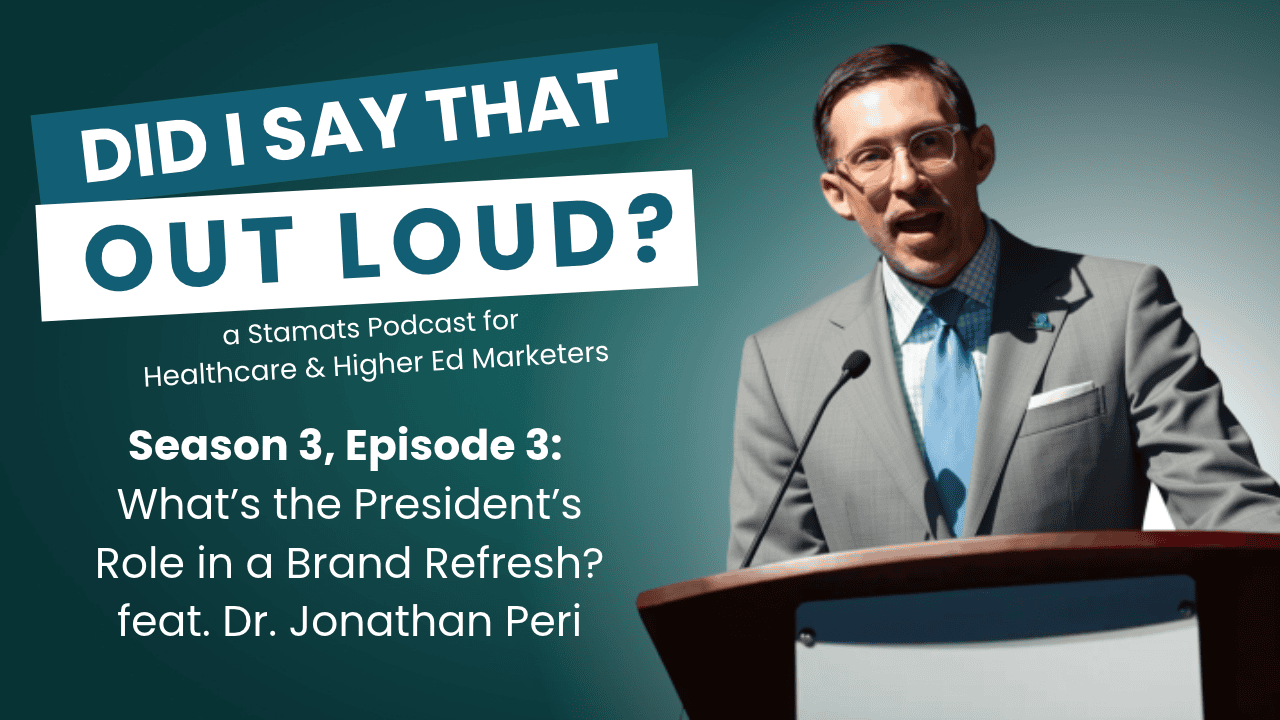
Season 3, Episode 3
Going through a higher ed brand refresh takes a lot of strategic planning. From budget to buy-in to best-fit roles on the team, the college or university President has a unique role in guiding the project without stifling creativity. Jonathan Peri, Ph.D., J.D., President of Manor College, describes how his team approached a fresh, sustainable brand redesign early in his presidency that is still going strong today.
At Manor College, Dr. Peri has driven enrollment growth, campus modernization, and strong financial performance while maintaining high safety and affordability ratings. With a background as a university general counsel, corporate legal advisor, and political consultant, he brings extensive legal, governance, and long-range planning expertise to his leadership roles. He also holds key board positions, including at Citius Oncology, a NASDAQ listed pharmaceutical company, and he serves as the Vice Chairman of for the Middle States Commission on Higher Education.
Listen to Episode
Show Notes
Transcript
Mariah Tang: Did I say that out loud? Welcome to “Did I Say that Out Loud?”, a podcast where Stu Eddins and Mariah Tang reflect on agency life and answer questions from our higher ed and healthcare clients about the latest in digital marketing, content and SEO.
Thank you so much for joining us today. With you as always, I’m Mariah, and we have a wonderful guest here with us today, Dr. John Peri. He is the president of Manor College. Dr. Peri has driven enrollment growth, campus modernization, and strong financial performance while maintaining high safety and affordability ratings.
With a background as a university general counsel, corporate legal advisor, and political consultant, Dr. Peri brings extensive legal, governance and long-range planning expertise to his leadership roles. He also holds key board positions, including at Citius Oncology, a Nasdaq listed pharmaceutical company, and he serves as the vice chairman for the Middle States Commission on Higher Education.
Dr. Peri, thank you so much for joining us today.
Dr. Jon Peri: Thank you so much, Mariah. I’m glad to be on with you.
Mariah: It’s super funny because I throw this tiny personal tidbit out all the time. My husband is actually a lawyer. He works for the county attorney’s office north of where we live. So it’s very fun to visit with another person with a legal background.
Dr. Peri: It’s helped me a lot. The legal mindset is one that’s very analytic in nature, in some ways distinctive from a PhD or an EDD for those in higher ed and elsewhere. And I think it lends itself to supporting the best scenario of outcomes.
Mariah: Absolutely. That analysis of situations, you just can’t beat it. So this is a really good segue into our topic today. We’re discussing the president’s role when a college or university is headed into a brand refresh. And I really loved your perspective on this, Dr. Peri, when we were talking previously before we recorded. There’s just such an interesting mix of different political perspectives to consider, different marketing and communications perspectives when it goes into a brand refresh process, there’s just so many different things to consider and it’s so easy to get into the weeds and really get lost in the details. So I’d love to just pick your brain a little bit about that process that Manor College went through and then maybe if you could offer some recommendations for our listeners.
Dr. Peri: Sounds good.
Mariah: Dr. Peri, in all your various background roles as well as a president. Sometimes in higher ed, there can be a resistance to bringing new or underdeveloped ideas to leadership, especially to the president’s office. Could you address that concern amongst the team members there at Manor College or at your other organizations you’ve worked with? And then what can cause those kind of hesitations to exist?
Dr. Peri: Well, I’ll frame it in the context of our experience here at Manor. when I came into the role, there was I think some of that kind of resistance to the concept of moving toward new and fresh ideas and maybe eventually a rebrand. And I want to share a story about one of our current vice presidents. Her name is Kelly Peiffer. She really emerged during a time when there was some resistance as someone who was a go-getter and initiative taking as an individual.
Kelly’s story is a really great one because initially she said, you know, I really like this role, and I had a lot of reticence to give it to her because at the time she was, I think, 25 years old. And I was saying, to myself, will she have enough experience to be able to lead in this way? And we may be a small institution, but it’s a complex endeavor. Well, as soon as I gave the okay, she ran with it full on at full speed, and really helped us to move into the places where we needed to be, the issues that we needed to be thinking about. We had largely outsourced our marketing in general up to that point and she moved everything back in-house and under her control and supervision. She did it so well and then when we came to the moment of rebranding, we talked about that because our past logo really needed a refresh.
And so then this question started coming up with, okay, well, where do we need to get to? And that was connected with the vision for the institution as becoming a larger and not just associates, but associates and bachelor’s granting institution. And so that was sort of how those conversations initially unfolded.
Mariah: She sounds like a real go getter. She was actually the one that referred you over to our show. She had appeared with our colleague Chris Rapozo on his show, Education Marketing Leader. What do you think it is, Dr. Peri, that that maybe prevents people from bringing concerns or bringing new ideas to the president or to another executive in the group? Do you think it’s maybe, like fear of being turned away, looking silly, what are some of the reasons you’ve heard?
Dr. Peri: Yeah, that’s a really good question. And I think it’s got multiple parts for an answer. One of them is the competence of the individual in the role. People can get stuck in their same lanes. You know, as human beings, there are a lot of elements of our lives where we are habitual. And we are in a groove and we stay in the groove and we don’t get out of the groove. And that’s just what we do. And it’s really important to be ever expanding if you’re in one of these marketing kinds of roles, because the marketplace is so dynamic and changing. It’s really important that we change with it, that we understand it. You know, it’s not just perceiving the market, it’s taking action. And that initiative taking is perhaps the most important part.
Even if you get it wrong, you have to take the initiative and you have to be willing to take risks. And you have to talk about that with your campus leader. If it’s your president, great, you know, have the conversation. I’m going to take a risk on this. You know, we might win, we might lose. But and and on the other side of that, you have to have a president who’s also willing to take some risks. And you know, those risks are judgment oriented. Right? What is the likelihood of success? So that’s sort of some of the multiple parts. The others could be some of the things that you suggest, you know, fear and those kinds of things.
And my answer to that is you’ve got to get the people who are the stakeholders in the same room at the same time. You’ve got to be able to sit down with your president and say, We need to take a risk on don’t know, buying this list or advertising in this region. And, you know, maybe it will produce five or ten new students for us, or 50 or 100, or maybe it won’t. But we want to test it out because, you know, we’ve done as a foundation, you know, some market study or research, and we think that there’s some value to doing so here. Again, it really is dependent on the personalities. If you get somebody who’s a Luddite or a stick in the mud who’s a president and who doesn’t really want to take risks, that’s going to be a tougher road to hoe than if you got somebody who’s willing to take some risks. And I think probably most people who’ve been in the role for three to five years or more is somebody who’s willing to take some risks. And that’s a good thing. It’s about having the right conversations and setting yourself up for success, even when you have failures.
Mariah: Absolutely. And it’s so interesting that you talked about that risk tolerance personality trait. Just this past summer at Stamats we did an exercise with the entire company trying to calculate everybody’s risk aversion or risk tolerance. And it was really interesting to see the division of individuals. It was like split down the middle where the implementation teams about half of them were risk averse and about half of them were risk tolerable and the same with the executive team and I fully believe it takes both, especially in an institution like a college or like a university where you have all of these different, sometimes conflicting, sometimes overlapping needs. And then going into something that can be as subjective but objectively important as a brand refresh, it’s good to have all of those different perspectives.
When you and your group were looking at the brand refresh project and starting that initiative, how did you help to close the gaps when people had new ideas about the brand or maybe had a direction they were looking to go? How did you make yourself accessible to the marketing team when they were bringing up things at the idea stage?
Dr. Peri: Well, I was a fairly big part of the conversations uh out of mutuality, which is to say that Kelly invited me to be. And I really wanted to see Kelly be successful in how things went, so I didn’t by any means micromanage, I certainly didn’t, but I made myself constantly accessible.
And just as a matter of institutional function, as a president, I have an open door policy. I do understand why some bigger institutions maybe can’t do that. But, you know, to the extent that any president can do that or segment their time so that they can have open door policy from X to Y time, you know, some days a week or hours a day, that’s really important to do.
Accessibility to your not only your teams but to the community at large is essential. That’s how you learn things and you’re able to support projects and ideas and give people pathways forward where they’re just looking for that acknowledgement or support that’s going to get them there. So in the context of our particular project, we were just in constant contact with each other. We had an outside firm that helped us with things like building out a logo. But the lion’s share of what it meant to do a rebrand was largely accomplished by Kelly and her team.
Mariah: I love that you phrased it that way, that she invited you in and really made it clear that they wanted you to be part of that process. You know, sometimes a lot of the groups that we work with are very, you know, communicative with their leadership, but we’ve seen instances where especially as colleges get bigger, universities get bigger, where it can be one, challenging to have those relationships for the reasons that you just mentioned. And two, sometimes it’s like, are they just going to come in and tell us our ideas are crummy and then we’re back to square one after we’ve done all this work? So I feel like she has a lot of trust in you. The team has a lot of trust in you, and that’s mutual and so important especially when you’re bringing in outside firms to be on the same page about the goals of that project.
Dr. Peri: Yes, and you know, part of it was also taking projects to a certain point, meaning elements of the project to a certain point, right? And then having these check-in moments. And we even still do that with a lot of things today. Kelly just last week stopped by to share about new ideas for bus backs and billboards and just you know talking about our creative together and we have our institutional tagline, but then we have these tier two taglines that are going to go on a bus stop. You know, Philly needs nurses and so on. That’s the kind of thing where we talk about what’s the best way to frame it, because we’ve got two nursing programs. We’ve got pre-nursing then we also have practical nursing. So are we going to create advertising that’s focusing on one or the other, or are we going to find a way to do both? And then also playing that back to our institutional mission and our tier one tagline, which is you belong here, which is trademarked and which is in our mission statement. All of those things come together in positive ways through the constant communication that we have with each other.
Mariah: Dr. Peri, could you describe how some of those conversations went? I’m imagining the perspective that the president would bring of the brand may be a lot different from what marketing or admissions would see in that day-to-day conversation with students and parents. Could you talk us through how you brought your unique perspective to that group and kind of how those things coalesce together?
Dr. Peri: So as we were considering the different elements of rebranding, it was an incremental process, an iterative process. So there wasn’t a huge amount of internal conflict or disagreement, so much as that we considered the issues and topics together, and then our outcomes were outcomes that were formed mute mutually. And so, for example, in talking about the logo. Our former logo was almost like a rooftop of a church with a cross on top. And our new logo, we were deciding about, you know, how do we reflect the fact that we’re a faith based institution? And how do we create within the logo encouragement for people to feel aspirational and enthusiastic about coming to Manor.
And so we had talked about whether the the logo which has sort of these three buildings on it would have these pathways and where they would go and that kind of thing. And ultimately we decided that it would be the pathways forward to the building and then an icon above one of the buildings to reflect our faith-based nature. But there were some different sort of versions of what it was before we got to that. And we also talked about the language. When we describe the logo, how will we describe it as connected with our institution, our institutional history, the fact that we are broad-based welcoming liberal arts institution that’s just outside of Philadelphia. And so we had to sort of talk through all of those different subjects. And it was just a continuous refinement process.
Mariah: Yeah, very fluid conversation. And and I feel like a lot of groups when they enter into a brand project, maybe don’t realize that it that it must be that way because so many decisions are do you like this or this? Yes, this, okay, move along. And it’s not that easy with brand. It’s just not. So I I applaud you all for going in with that perspective, like this is going to be iterative process, this will be a challenge, this won’t be just a one and done decision.
Sometimes it can be very easy, like you had mentioned right at the start. You might feel stuck in an idea, a group may be, leery of shifting because it’s like, is this too far out, are we are we off base here? Could you talk about how you worked through those challenges and reassured each other without just becoming yes men or yes women for an idea.
Dr. Peri: I think the root solution to the problem presented by your question is who you have in the seat. And what I mean by that is there’s a continuum of personality types. And there are some who are very ambitious. And very intentional. And who take great initiative. When you have people who are categorically that, as opposed to the people who you have to tell them to move along, there are people who, as a matter of leadership and management, they want to be good employees. They want to do their jobs well. They take pride in it.
But it’s hard for them to envision something more than their ordinary daily activities, the things that are spelled out for them in their job descriptions. And then there are people who envision for themselves and for their institutions or organizations something greater as a part of an institutional or organizational vision or a vision set forth by a president. So when you have someone who is categorically more than competent but visionary, then the question that you ask about moving things along is one that’s pretty easily answered because they do it.
And so, you know, what does it really take? It takes all the things that we’ve talked about so far already, but it also takes someone who can row their own boat. Right? If I died tomorrow, I’ve probably got four or five people who are on the executive team who could run. This organization as well as or better than me. But part of that is not just who is there, it’s also organizational culture. Kelly knows, and the other members of my executive team know that they are my colleagues.
That they are people who are trusted and entrusted. They’re people who sometimes I have a laugh with, and sometimes we’re concerned about things together. There’s a leader named William Bowen, who’s one of the Ivy Institution, former presidents, emeritus now. And he said university and college leaders should consider themselves first among equals. And that really is the type of culture that I worked to instill here. I’ve also seen that there’s organizations and universities where there’s not a lot of trust, right? You’ve got really smart people who are type A and really accomplished, and they’re around the table with each other, and some of them are friends, and you got factions. But if you’re a leader who can instill a sense of colleagues and friendship, you can get past almost any challenge.
I’ve been president here at Manor for 11 years. There have been some executives that have been sort of more difficult to work with than others. But when you get that right mix of people who don’t put their egos first, and instead who put their organization and the mission first, you really can get through anything. At Manor, 75% of our students are Pell, 80-85% are working, 94% are receiving tuition aid, 60-65% are first generation to go to college. So if you’re here, you really need to be here for a mission purpose. You need to be willing to say to yourself in the morning, afternoon, at night, and night that your purpose here is not for our own sake, but for the sake of others. We all need to make a living. We want our salaries, you know, the prestige that comes with a name or title and all those things. But we have to have to put our students first. If we put them first and we’re collective in that thinking, and giving in our spirit, then we’ll receive so much more, in how we accomplish our goals and and the things that come back to our institution.
Mariah: In the northeast part of the United States, there are so many colleges and universities and that grasp for mindshare really depends on having that strong brand message and those strong brand ambassadors. So let’s fast forward to the end of your brand project when you’re getting ready to roll this out to the community, to the prospective students for the next season of of enrollment. How did you help with that process? And can you describe some of the the lessons learned in that rollout process?
Dr. Peri: Yeah. Well, the first lesson is make sure you have the right budget for it. You know, as a smaller institution, it was really, really hard for us to develop a budget for our rebrand and we had to use existing operating budget and cut into that sum in order to rebrand for that year. We did that early on in my presidency, so there wasn’t a lot of time in terms of, pre-existing savings to occur. But if you can line it up like three, four years in advance and tuck away, you know, X dollars a year so that when year four comes around and you’ve accumulated those, you know, four times twenty-five thousand or two hundred and fifty or whatever it is for your size institution. All the better for you to be able to get through it. In terms of the rollout and messaging being received, that all went incredibly well on our campus, despite the budget limitations, because we had included the campus community from the outset.
We almost approached it like a strategic plan where you do surveys and focus groups and so on. And so there was a holistic sense of, okay, you know, we’re doing this and and what does it mean? And and let’s talk about it. And then when we got to our Founders’ Day, I went through it in my remarks, line and verse. And we had our full employed campus community there and some of our students as well. I went through and I said, you know, this is our brand promise and and here’s a picture of our new logo, and here’s what it means. And it’s a full page of explanation of the path walking up to one of our buildings, and there’s three buildings because we have three, and we were founded by Ukrainian Sisters, and one of the symbols of Ukraine is a trident. And so just going through all of these kinds of meanings, meaningfulness that you bring to those conversations. so that all went really smooth, and the community adopted it right away.
There was a little bit of concern about, well, we’re a Catholic institution, why isn’t there a cross in the logo? Part of what we discussed is that there is a cross in the logo, but it is not a traditional cross. And it’s hard to find because it’s more like a But also we have the insignia on top of one of the buildings to designate faith-based. And, we talked about that honestly with the Sisters. And we said, you know, it’s not a traditional cross or a traditional representation.
And we’re living in a world now where we want to ensure that people feel that they’re welcomed, no matter what their faith is. And that’s important from a marketing perspective. You know, on our campus, we have a chapel. We also have an interfaith prayer room, which is a separate location, because we have a lot of students here that are Muslim and Hindu and Jewish and we want all faiths to feel welcome here. And so, we’ve carried on with this logo now for nine or so years. We only sort of heard that kind of perspective shared at the beginning of the rollout. And because people know who we are and what we stand for, it became less about the symbol being so ironclad specific and more about the culture that we foster here. And and the culture is really what carries the day, our institutional culture as an inclusive Ukrainian Catholic institution.
Mariah: That is a beautiful way to summarize. I mean, at the end of the day, encapsulating that culture is really the goal of a brand refresh. Yes, we want things to look modern. Yes, we want our messaging to feel and be heard in a modern capacity. But it’s really that showing instead of telling perspective that’s at the heart of a branding initiative. I know we’re getting close to the the end of our time, Dr. Peri, but I I wanted to just ask one final question. If you were speaking to a group of marketers who maybe are considering starting a rebrand initiative at their college or university, what would maybe be three to five tips that you would provide from your presidential perspective on getting that rebrand initiative started on a successful path?
Dr. Peri: Well, I would say first and foremost, have a go getter attitude and a can do attitude. No one wants somebody who’s going to be a stick in the mud who’s going to say the same old thing. Beyond that, make sure that your conversations that are happening on campus are robust and inclusive of all of your constituent communities. And when it comes down to the creative, have the right people there too. The symbolism of things is important. Don’t let the outside world define for you.
What your symbols are. You as your community need to define what your symbols are. And when you do that, you then as the leaders of the organization need to frame it. You need to be the ones who say, okay, here’s what we heard. And then you define it in your terms as to what you heard, because at the end of the day, you’re the one who has to distill it, whether as an individual or a small group. You have to distill everything you’ve heard and then place that into the categories that you believe are going to be meaningful for your community. So for us, we thought that our logo would be meaningful for our community and the ways that anybody can go on our manor website and look up about our logo and what it means. That’s how we defined it. And it was based upon our community, but ultimately us who framed how our community considered it.
So you’ve got to do all those things and then, you know, maybe the other part of it is have fun. It’s a serious endeavor and you need to be successful because institutions of higher education are becoming more highly regulated and having fewer students and a lot of demographic regions nowadays. So, you know, success is essential. But part of success is also enjoying what you do. So have fun while you’re doing it, and that catches on. Your competence and your character will see through provided that you have both.
Mariah: Dr. Peri, thank you so much for joining us today. We really appreciate your perspective and I’m sure our audience has several takeaways that they could pull from your wonderful insights. Thank you.
Dr. Peri: Hopefully. Thank you.
Mariah: Thanks for listening to “Did I Say That Out Loud?” with Stu Eddins and Mariah Tang. Check out the show notes for more information about today’s episode. And if you have any questions, concerns or comments, hit us up anytime at stamats.com.
Let’s talk
You have questions, we have answers. We will customize a solution that is guaranteed to impress.