Written by
on
May 8, 2026
Season 2, Episode 10
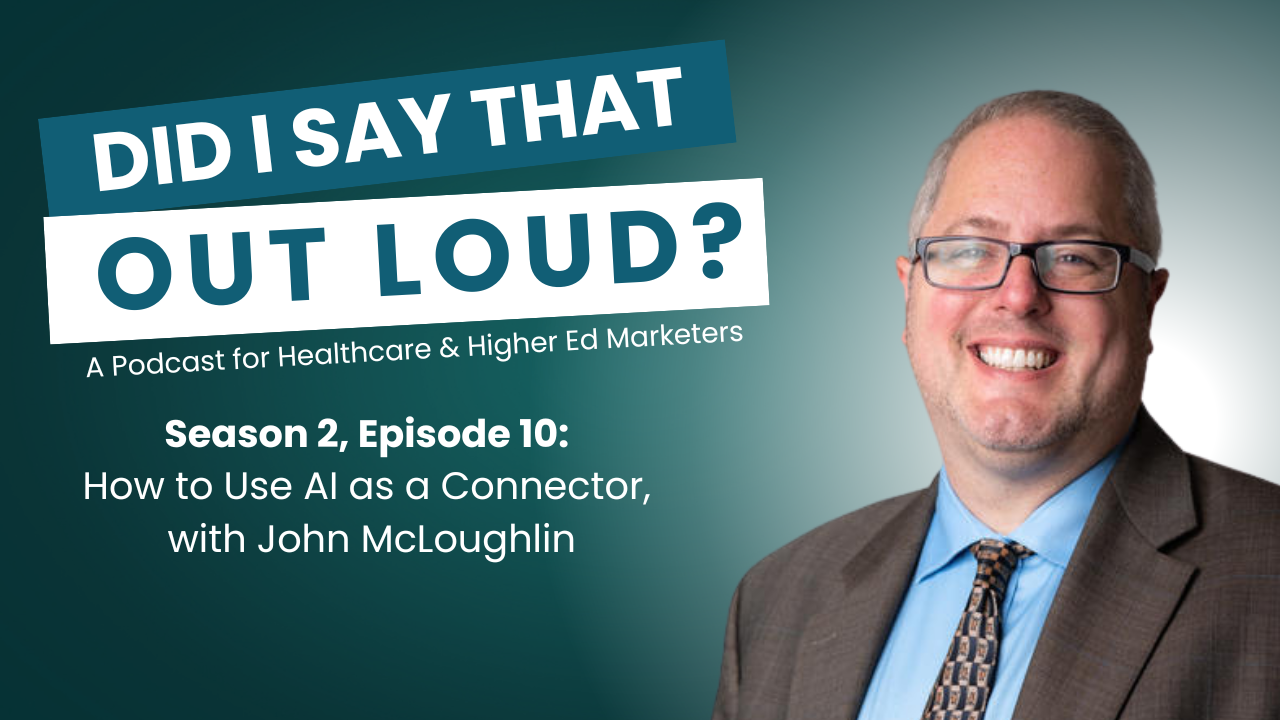
There’s a lot of talk about the divisive uses of AI. But the tech can also become a fantastic connector! John McLoughlin gives Stu and Mariah the scoop on how NYU School of Professional Studies uses AI to personalize the student experience from info-seeking through prospect conversion.
Listen to Episode
Show Notes
Transcript
Mariah Tang: Did I say that out loud? Welcome to “Did I Say that Out Loud?”, a podcast where Stu Eddins and Mariah Tang reflect on agency life and answer questions from our higher ed and healthcare clients about the latest in digital marketing, content and SEO.
Mariah: Well, thank you all for joining us. Welcome back to some more shenanigans on the Distal podcast. I’m Mariah. I am here with Stu and our fantastic guest, John McLoughlin. He is the Associate Dean of Enrollment, Management and Student Success at NYU School of Professional Studies, where he leads initiatives that shape and elevate the student journey from recruitment through graduation.
He has twenty years of experience in higher ed administration, and he has dedicated his career to expanding access and opportunity. Two things we love to hear about here at Stamats. John is really passionate about advancing the future of work and learning, championing industry-driven curriculum and workforce aligned programming to prepare students for the future of the global economy. So this just fits perfectly, John, with what we were going to talk with you about today. So thanks for joining us.
John McLoughlin: Oh, thanks, Mariah. Thanks, Stu so much for having me. Really excited about the conversation today.
Mariah: Yeah, yeah. And right before we clicked record, we were kind of giggling about our first interview with John way back in 2019, like the before times. So at that time, we had Stamats 2020, which is a conference that we would run annually, bringing people from around the country and that kind of dwindled away with the pandemic. We shifted more towards the webinar space. But at that time, we had talked about the emerging role of technology and student enrollment, and now it’s no longer emerging. It’s a must. If you don’t have it, you’re kind of falling behind. So we really wanted to talk with you about that today, John. And first off, let’s give you a big round of applause because since then you’ve had a promotion at NYU, do you want to talk a little bit about that?
John: Sure. I really am very excited that I’ve joined the NYU School of Professional Studies community. I know that many people are familiar with NYU, probably not as familiar with NYUSPS. You know, as you shared, Mariah, at the beginning, I am very committed to access and opportunity and SPS has a long history of being able to be innovative and be able to provide more access to students across New York and even internationally. So we were founded as a school in the 1930s that supported retraining and reskilling during the Depression, and then we were there for veterans after World War 2 in transitioning to civilian life and new careers. We became the continuing education arm of NYU through the ‘60s and ‘70s, and now we have over 7,500 students in graduate and undergraduate programs and CE and it’s just setting every day that we’re so connected to the industries that make New York buzz and have this sort of global reach. Thanks to our arm of NYU that allows us to connect across the world. But yeah, it’s been really exciting work. I’m leading our admissions and financial aid teams, our career team. Academic Support Services and our CE part of Support Services. So a great team that’s doing important work and it’s been really exciting.
Mariah: Yeah. With all of that going on, we even more appreciate you squeezing us in today. And we were talking with a guest last week, Martha van Berkel from Schema App. And Stu had kind of made the joke, you know, back 15 years ago in digital, it was mobile first, mobile first and that was a really.
Lengthy runway to get from PCs to mobile. But now with AI and some of these other emerging technologies, it’s like tomorrow. It’s not a seven-year runway or even a two-to-three-year runway. It’s like now. So maybe let’s kind of start there. What’s one of the biggest technology shifts that you’ve seen in your various departments that you’ve worked in in the enrollment sphere?
John: Sure. Well, I think what we’ve seen, especially since our last conversation, is this is real shift in how students want to engage with colleges. And that’s been the, I think, the mindset for us as we consider how we’re engaging students that Roman technology to support. Students who really want to have a much more personalized experience, right? They many times want it on demand, but they want it to be very authentic. And so a lot of our decision making really is through that perspective, through that lens of how students want to engage. So we’ve really spent a lot of time thinking about.
Our tools and our technology and how we hyper personalize the student experience. And so that’s like our word particularly going into 2026 now that we really are focusing on how are we using data.
To make sure that we’re making meaningful connections to every single student in a way that’s meaningful to them when they need it, and also allowing us to be much more smart with our resources. So that’s been really the focus of how we are using our techniques. Technology and our tools, you know, we are recently, maybe in the last two or three years, we’ve brought out a new CRM and that’s been critical to the way that we are using data to better know our students the way we’re communicating.
We’re really segmenting and speaking to students in a way, again, that is very meaningful to them. So that’s been, I think, a big change for us that, you know, that we’re driving the CRM in a way that connects with the student in a much more personal way. And then we can’t ignore that, you know, AI is just the big game in town. You know, students are searching for colleges in new ways. And so we’ve had to adapt to that as well. You know, whether it’s, you know, you know we’ve implemented a chatbot and the chatbot has really been a tool not only to give students what they need when they need it, but also to drive them to our admissions team and to academic advisors and have really clear, you know, some connections to our staff for the support they need. And the chatbot has allowed us to have those intentional conversations.
And spend more time getting to know students and allow students to get the information need when they need it. So that’s been critical. But it’s also we’ve had to explore even strategies like we’re building new strategies around YouTube and Reddit and social media strategies that are all driven by how students are now exploring.
John: The college search through AI, you know, you know when they’re searching for our global studies program or real estate program, they’re putting it into ChatGPT now and not going on our website, right. So those are all things that we are adapting to and working very closely with you know our marketing teams on and you know, across the university, because this is new and students want to have very different experiences than they did, you know, even even four or five years ago.
Mariah: Yeah, I can see that Stu has this thinking face on right there.
Stu: Yeah, this has been something that I’ve been involved with like up to here in in the last probably year, year and a half. Technology’s enabling the prospective student to come learn about us in a dozen different ways. But I wonder if it’s. I’ve recently been wondering if that’s true. Maybe what’s happened is AI was the push we needed to realize they’ve always been coming to us in multiple different ways. Now I’ve talked to a lot of people who are looking at AI and trying to react to it. It sounds like to some extent you’re looking at AI as an enabler as some way that you can be reaching out across multiple platforms and enabling you to host those multiple contacts rather than waiting to get bombarded by them. Does that sound like a true statement?
John: Yes. And we want to be in front of this because we know our students are already ahead of us in this. Right? And so while there’s real important conversations that need to occur around AI and the ethics of AI and how do we make sure that we’re not leaving any student out as we, you know, as we continue to refine our use of AI, the reality, the reality is that students are there and it has allowed us to understand where they are, what they’re looking for, and it has given us the push to really rethink how we use AI as part of that journey.
Stu: Very good. Yeah, it it it took us ages and ages to even get to the majority, let alone now nearly 90% of households having Internet connections. Thankfully AI is coming through that connection to a large part. But I so I don’t think we’re going to see the economic challenge that we had with the onlining of the communities. However, the one thing that I keep wondering about and maybe you’ve had this experience as well, there’s an expectation for at some point AI to stop and have it be a human connection. Is that something you folks are trying to find that fine line, that goal line if you will?
John: Thanks. Yes, yeah. So, so you know, it’s interesting when we onboarded our chatbot, it was to address a number of issues, you know, obviously to be able to provide students with the most accurate information when they want it, when they need it. But we also knew that internally, it was a helpful resource for us to begin addressing all the questions that come in with 40,000 emails a year and phone calls. But what it did do, which is what one of the things that we wanted to do, it actually the chatbot directly drives students to book appointments with our admissions counselors.
And that has seen a significant increase and those are really important opportunities for the academic, I’m sorry, the admissions counselors and the prospective students to connect and have some meaningful conversations and it’s not just sort of the transactional. Types of questions that are happening in the chatbot now, it’s really meaningful about their journey, their experience, what they need and what they value out of a college experience.
And again, it’s made those conversations much more meaningful. You know, with AI technology, we’re doing a better job at helping students manage their degree progression so that now our advisor conversations with students are again more about how your academic connects to your career and what are you doing to study abroad or to have another internship opportunity. It’s not a 1/2 an hour conversation about what class are you selecting. So that is right very much that tech and touch which we believe very much in and we want to try to live every day.
Stu: Are you able to bring in those interactions with your chatbot into the CRM data to aid those conversations directly?
John: Yes, yeah. That integration happened about a year ago and it’s been brilliant. It’s been absolutely fantastic to be able to have that. It’s really giving us a lot of data also to better understand what students are asking because then we were able to take that and make sure that we were enhancing our website. We were adding it to our information sessions and our open houses. So, if students were asking certain questions, if they were trying to figure out certain learn more about certain programs, we wanted to make sure that we were also sort of closing the loop. And again, we couldn’t have done that if that wasn’t going back into our data, going back into our CRM.
Mariah: I like how you positioned AI as this connector and not as a replacer. I think that that’s essential for people to understand in higher Ed and that you’re using it not as a tool to loop people out and you know now you have more time to go hammer away at this pile of work on your desk. It’s now you have a specific personalized experience to give to a student. Make that connection, like “connection” should be the word of the year. Sorry, Stu, go ahead.
John: 100%, yeah.
Stu: Yeah, yeah and it seems yet another example of using an AI for efficiency, in this case communication efficiency. So the admissions person isn’t asking the same questions the person filled out on their app. Ask the chatbot, add data, they come into a warm conversation that way.
I love that approach. I wish we could have that everywhere because that’s probably the ultimate benefit of this entire near-term revolution that’s going on. The thing that kind of comes to me next is that there’s always been to some extent a a bit of an air gap between marketing and admissions as far as their roles, one thinks they feed the other and it’s never quite on parity sometimes. Have you found that some of these tools and things like your CRM initiatives and so on have kind of bridged that gap between the departments?
John: Certainly I think you know at SPS we’re very fortunate. We have a Chief Marketing Officer and a marketing team that really is aligned. They’re driving enrollment goals just like our admissions recruitment team driving enrollment goals and so having that same focus and that same target has.
Been helpful in how we work together to utilize different tools. So you know there’s marketing uses the CRM slate to drive all of their communications and their nurture stream up until for us the way we manage it is up until admission.
And then once a student is accepted, our admission team and our communications team leads that. But it’s all connected through Slate, and so it’s seamless to the student. It’s one experience, right? But we really have managed to take the experts from each of our teams and put them in the right places so that we are performing well, but also connecting with the students again in the most meaningful ways. And so yeah, it’s been really important. It’s critical that marketing is at the table as part of all these strategy conversations and tech conversations that they’re a partner.
You know, I’ve been at places where marketing has been a fulfillment house and that is no longer acceptable in any place, particularly in higher education. They have to be part of every conversation, every decision from day one. And I’m thankful to have a great partner with my colleagues at marketing and I know I hear a lot of folks at admission saying marketing and admission structurally, it’s better that they’re all together and all in one place. I think it’s just really a matter of how you’re coordinating the technology and the resources and the right folks leading parts of the process.
Stu: Yeah. And I think that, in my recent experience, again, what I’m seeing is AI is kind of making sure that the data is shared equally so they all know that they’re going for the same goals and the same everything else. It really, it would appear that in in your usage, what you’ve done is removed a ton of friction for the person coming to you for your solutions, grease the skids if you will. So so that there’s fewer bumps about what next and so on. How long did, you know you added the CRM, how long of a transition phase did you have? Was there a lot of feeling your way through the process, or did you have it well-mapped out from day one?
John: This is something I think the, you know when we sort of think about pitfalls sometimes with technology. Everyone wants to move, you know, I think with sort of unrealistic aggressive timelines. It’s like we’re going to, we’re going to implement a CRM or a new tech support for our students and it’s going to work from the minute we flip the switch. And that’s not the case. You have to build it out in phases. There has to be a consideration around the training, the integration. And those are things that sometimes get ignored, right? It’s really exciting when we talk about some of these shiny new objects, but it’s really critical that we are planning it out.
And so we knew when we brought on our CRM, for example, that every bell and whistle was going to be operational on day one. And then we were going to build it out over time together with academic units, with marketing and it allowed us to take time also to listen and learn, right. And we had to see what was working, what was not working, see how our students were engaging. Like for example, we built out an application portal initially. But we didn’t build out an admitted student portal. We wanted to understand how students were going to engage with the application portal first. So that informed how we built out our admission or accepted student portal.
You know we recently onboarded A peer-to-peer engagement platform. And same thing. You know, you know, it’s exciting to think about how we’re going to be able to engage students across every single part of our school. But that is just not realistic. So let’s pilot one part of our student population. Let’s learn from that, and let’s tweak and continue to grow. And so I think it’s managing expectations. It’s mapping out a process that really looks at, you know, what does this tool do for us over the next two to three years and how do we continue to build and grow from there.
And a lot of the CRMs that are out there now, we’re a Slate school, but a lot of CRMs out there start out as that blank slate. And if you try to solve every problem from day one, I don’t think you’re really taking advantage of the CRM. You have to really learn who your students are, what they need, what your community needs, the faculty that may be engaging in the CRM, your marketing team, and then maturity and take time to really enhance it as you learn through the experience.
Stu: I like that you talked about the CRM bells and whistles, and I think often people forget that you have to decide who gets to ring the bell and the correct way to blow the whistle. It’s vast and it comes down, it comes back to that old adage about, “How do you eat an elephant? One bite at a time.” But it sounds like you had some idea of where you wanted to wind up, and you’ve stayed probably, I would imagine, fairly true to that goal. But have you found that your end goal has kind of moved a little left and right of where you thought it might have been in the beginning?
John: Sure. I think the early on, you know particularly with our CRM, we saw it very much as a tool for the marketing and admissions offices. We’ve quickly learned you know we’re doing more now to enhance how we’re using it within our financial aid office. We’re even looking at how we support our continuing education population with the CRM, how we allow faculty to have access to portals. Early on there were some like we knew that that was something that was possible, but so much of the focus was on that, that early experience of students in this area. And now we’re really at the place where we’re seeing what that could be, what the needs are of our community are and how do we shift it. And so it’s really driving us to, I think, move forward in some of these other areas more so than we would have probably imagined, you know, two years ago.
Stu: We’re good, good, right? I’ve been hogging the conversation so far.
Mariah: Yeah, I have heard a lot from our strategists outward and from our clients inward about personalization this year. And I keep thinking, you know, like there’s only so much you can do on your website. There’s only so much you can do on platforms you don’t own like social. But the one experience that you really do own is after that handoff occurs to the admissions team or financial aid or marketing or whoever is in touch with the student. So, John, like what are some of the ways that SPS really personalizes that experience post-handoff?
John: Sure. Yeah. So we’ve been really experimenting with more of this concierge service, which if NYU is very new because there’s a, it’s very heavy application driven institution, right. The ability to really connect with students early in the process has not been, and particularly at SPS, really rooted in our history, right? You know, even for students who were applying, they may not have heard from an admissions counselor until after they were admitted. And even those conversations were really more about, you know, you’re missing this or you need to do this by this date.
And so we’ve really made an effort to have those connections much earlier. And again, the technology has allowed us to do that. We also are better understanding who our students are. So we are better understanding who we need to have these conversations with much earlier as well. So it’s really driven everything from, you know, we were able to revamp part of our admissions information session process similar to you. A lot more is being done virtually in virtual information sessions and what we found is that students are able to get more information about the admissions process through our YouTube videos and our social media and even, you know, if they booked that one-on-one appointment and want to have more of that conversation with the admissions counselor, but they really needed more time to better understand the academic programs and the career outcomes.
So we’ve revamped that part of our introduction to SPS, everything from better virtual information sessions to more one-on-one meet and greets. And it’s allowed us to really emphasize the value of our programs, right? And you know, we are 80% of our students. are in internships, 66% have a job outside of graduation, right? You know, before graduating. You know, we have almost across every curriculum now in every course, a executive or industry leader partnered with a faculty member teaching real world situations that we’re solving, those things really were muddy that those because we were talking, taking so much time to talk about the business part process with the student, right? Make sure you get your transcript in by this date and now we can really share with them what this value is of SPS and we’re doing it through communication, we’re doing it through meetings, we’re doing it through virtual information sessions. So we really there’s a lot of noise out there. We try to get that noise out. So those personal conversations are really, really meaningful.
And then it’s also allowed us to be very creative, like we now can better identify where all of our students are coming from, from all of our feeder schools and we are bringing our dean out to those feeder schools and celebrating admitted students together. So from day one, they’re seeing themselves as a community. You know, we would have students from a local community college going into our undergraduate program, 10 students from one community college, all ten didn’t know they were all coming together to our program. And so now, early on, they’re building that community even before they leave their current institution to come into, you know, our program. So those are ways that we’re trying to make it more personalized and as I mentioned, hyper-personalization is that keyword for us this year.
Mariah: Yeah, that is. That is so special. I mean it for a lot of young people, especially now when we’re seeing more and more first-generation college students, that sense of community is so profound and they don’t know to ask for it because they’ve just always had it, right? So when you’re bringing that to them, it’s really, you know, that a phenomenal next step. And I think you’ve given us a lot to think about, John, with the, I would say the general position of the market is like AI is here, you’ve got to do it. And it’s that urgency that you mentioned that used to be kind of the way in the world of sharing academic programs with people. But I really like your choice of words, sharing and connecting and making those personalized experiences. I think that needs to really be the focus of, okay, you’ve got the big shiny tools. Now, how are you going to actually implement them and make people’s lives better, make their journeys better, as opposed to just whacking them with some more information all over the place.
John: No, I just, I think for your listeners, I think it’s helpful to remember always go back to your mission and to who your students are. And there’s a lot of noise, a lot of shiny objects, there’s a lot of new tools that can be overwhelming, but continue to really think about, you know, why you are where you are, why we do what we do, and think about the support structures around that to enhance those experiences for our students. And that helps to also figure out, you know, what are the right resources and what are the right tools to be able to make those connections for our students.
Mariah: Yeah, yeah. This was the warm, fuzzy conversation we needed today after kind of a crazy week. So thank you for lifting our spirits, John.
Stu: Thank you.
John: Thank you!
Mariah: Thanks for listening to “Did I Say That Out Loud?” with Stu Eddins and Mariah Tang. Check out the show notes for more information about today’s episode. And if you have any questions, concerns or comments, hit us up anytime at stamats.com.
Let’s talk
You have questions, we have answers. We will customize a solution that is guaranteed to impress.