Written by
on

Every year, marketers ask the same question in a new way: “How should my SEO strategy change next year to keep up?”
Right now, that question is often tied to AI Overviews in search. Here’s the short answer: If your SEO strategy is working, it probably doesn’t need to change much.
But your content strategy might.
AI Overviews work differently than traditional search results. They generate fresh answers for each query and pull from many related searches at once. That changes what content gets surfaced and why.
More importantly, AI Overviews prioritize content that aligns closely with user intent, not just keywords. What someone is actually trying to accomplish with a search now matters more than how precisely a page is optimized.
Here are four content moves to focus on in 2026 if you want better results from search and AI-driven experiences.
1. Stop Chasing Definitions. Start Answering Real Questions.
AI Overviews show up most often for mid-funnel searches. Simple definition questions like:
- “What is…”
- “Examples of…”
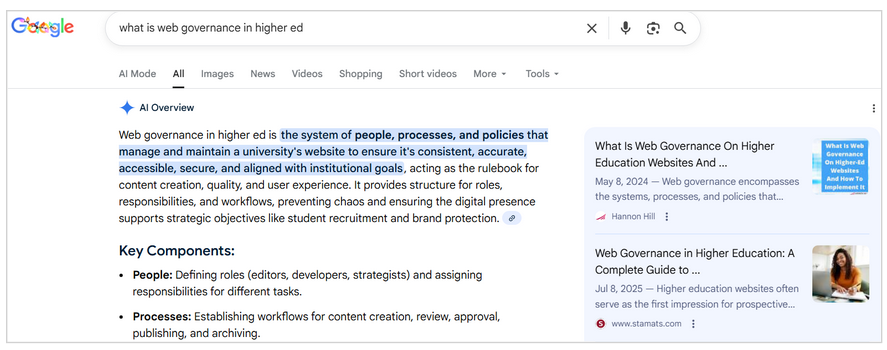
These are low-intent queries and getting cited here rarely drives traffic.
In fact, AI Overview citations average about a 1% click rate, and that click could go to any cited source, not just yours. Brand awareness may increase, but that’s based on surveys, not hard data. Your real SEO wins come after the definition.
2. Focus on High-Intent Questions, Not Keywords
This is where content strategy really changes: user intent. Instead of definitions, focus on questions like:
- Who is this for?
- Where can I get it?
- How does it compare?
- Why does this matter?
- How much does it cost?
These are still mid-funnel questions, but they’re often poorly answered by AI Overviews.
When users scroll past the overview and click a link, the use is already more qualified. They understand the basics and are now looking to make a decision. That’s higher intent, and better traffic.
3. Build Pages for High-Intent Modifiers
Certain search modifiers signal strong commercial or evaluative intent. These queries still matter in 2026. Examples include:
- Which: “Which [product] is best for [use case]”
- Compare / vs: “[Product A] vs [Product B]”
- Where: “Where to buy [product type]”
- Alternatives: “[Product] alternatives”
- Cost / Pricing: “Pricing for [service]”
- Best: “Best non-toxic floor cleaner”
- Review: “[Product] reviews”
Find these pages on your site or create them if they don’t exist. These users are closer to action, and AI Overviews don’t replace the need for detailed, human-focused answers here.
4. Optimize for Humans First (Even if It Feels Backward)
This part surprises people because it sounds counterintuitive.
Apply core SEO best practices. Structure, internal links, schema where it makes sense, clean headings. But stop short of over-optimizing for search engines at the expense of readability.
There’s a real paradox emerging. AI systems may interpret heavily optimized pages as being written for algorithms, not humans, and choose not to use them for summaries or citations.
Clear structure, plain language, and helpful explanations still matter most. Content that feels human often performs better, both for readers and for AI.
Start 2026 With A Clearer Content Strategy
AI isn’t killing SEO. But it is changing which content actually performs.
If you’re not sure:
- Which pages on your site answer high-intent questions
- Or how prepared you are for AI-driven search experiences
- Where your content stops at definitions instead of decisions
A content audit is a smart place to start.
Or, if you want ongoing insights like this throughout the year, sign up for the Stamats newsletter and stay ahead of what’s changing, and what isn’t.
The basics still work. You just need to aim them at the right questions.
Start Your Content Moves
Book a strategy call to evaluate how your content performs in AI-driven search.